TL;DR
Emirates has launched a premium economy seat on its A350s with a full-height privacy divider that raises electrically, describing it as a world first. Japan Airlines already has full-height dividers in the same cabin class, so the genuine novelty is the motor. The more interesting context is that Emirates is spending on a connecting hub whose surrounding airspace is under a live EU conflict-zone bulletin, and the seat is partly an argument for keeping that connection.
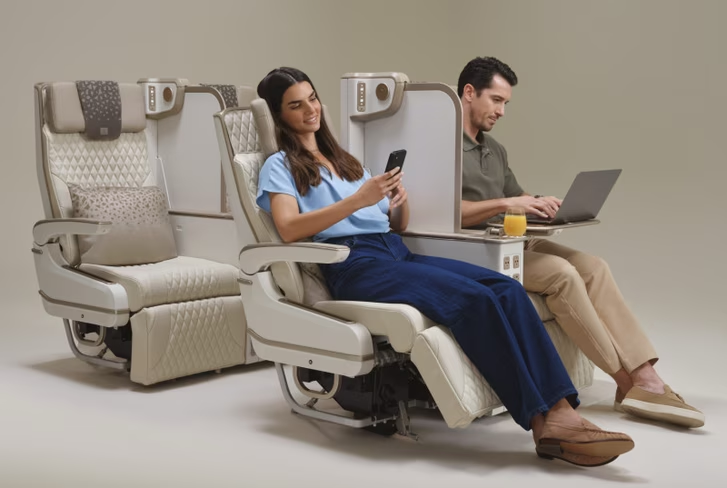
Emirates has launched a premium economy seat with a full-height privacy divider that raises and locks at the touch of a button, on newly delivered Airbus A350s. The airline described it in a statement on Thursday as the world’s first electrically powered premium economy seat, and the divider as the first of its kind in the cabin class worldwide.
That claim rests on three qualifiers stacked together, and TNW has not independently verified it. Full-height dividers and powered partitions already exist in premium economy separately, and what appears genuinely new is combining them and driving the screen with a motor.
What was already flying
Japan Airlines fits Safran fixed-shell seats in premium economy on its A350s, an arrangement Safran Seats announced in 2023. Those shells put a full-height divider between neighbours by design, though the structure is fixed rather than adjustable.
United’s Premium Plus seat, built on the Collins Aerospace MiQ platform, adds privacy wings and a sliding partition. It is manual, and it does not run the full height of the seat.
So the honest version is narrower than the announcement suggests. Emirates has taken a feature that existed in fixed and manual forms, put an electric actuator behind it, and extended it to every seat in the cabin.
The reason to defend a connection
Mohammed Sergie made the point the press release does not, writing in Semafor’s Gulf briefing: a better seat could help Emirates hold on to connecting passengers wary of transiting through a region prone to conflict. That is the part worth taking seriously.
Emirates suspended all flights to and from Dubai in early March during regional airspace closures, extending the suspension as the situation developed, and closed its city check-in points across the emirate. For a carrier whose entire model is a single connecting hub, that is an existential category of disruption.
The regulatory position is still live, and it is more specific than the headlines suggest. EASA’s conflict zone bulletin for the Persian Gulf and Gulf of Oman names the Emirates flight information region and runs to 30 September.
Read the actual text, though, and it is narrower than a blanket warning. The restriction covers airspace over the waters of the Gulf, “except to the extent necessary for arrivals at or departures from aerodromes within the affected FIRs”, with caution advised over land.
Dubai arrivals and departures are explicitly carved out, so this is not a regulator telling airlines to avoid the hub. EASA also revised the bulletin on 31 August to reflect a change in the risk level, and the direction of that revision was down.
What it costs to be a connecting hub
The commercial exposure is real even when the airspace is open. Capital keeps flowing into the region regardless, and so does the risk attached to it: Iran has threatened OpenAI’s $30bn Stargate data centre in Abu Dhabi, which is the same calculation in a different asset class.
A premium economy seat is a modest hedge against that. It is, however, one of the few levers an airline controls directly when the alternative is a direct flight that skips the region entirely.
Why the middle of the plane
The wider economics point the same way. Premium fares can generate 1.5 to 3 times standard economy revenue for only modestly more cabin space and service cost, as Gordon Smith reported for Skift.
Premium cabins now account for roughly 24% of global passenger revenue, around $188bn on Skift’s figures, and at Delta the proportion has reached half. For two decades airlines competed on first-class suites and flatter business beds, and the growth is now in persuading economy passengers to pay more.
Privacy as a purchasable feature
The divider is the clearest signal of what is being sold. Separation from the stranger beside you used to be something you bought a business class ticket to get, and it is now an itemised feature two cabins back.
Physical privacy controls have a familiar shape in consumer hardware. A hardware kill switch on a phone works the same way, turning a setting into an object you can see and operate.
The seatback screen is playing defence
The specification sheet contains a quieter admission. Emirates is fitting a 13.3-inch 4K HDR touchscreen, and beside it a tray table with an integrated phone holder that the airline says turns a passenger’s own device into a second screen.
Read that the other way round. The seatback display is now competing with the phone already in the passenger’s pocket, and the airline has decided to accommodate the phone rather than assume it wins.
The same pattern shows up wherever a fixed screen meets a personal one. Cars have run into it too, where a large centre display is the headline feature and integration is the hard part.
The rest of the hardware
Wireless charging arrives in the cabin class for the first time, alongside USB-C at every seat. The seat is 20 inches wide with pitch up to 39 inches, laid out 2-3-2 across just 28 seats.
Emirates has added a leather U-Dream headrest from Safran Seats with adjustable wings, and a footrest the release describes as manually deployable. Recline is preset, with lounge and meal modes selectable from a control unit.
Newly delivered A350s also gain left and right exterior camera views alongside the existing forward and downward feeds. Airbus has been reworking cabin design around perceived space for years, and camera views belong to the same effort to make a fixed volume feel larger.
What is worth watching
A motorised divider at every seat is a weight and reliability decision, not just a comfort one. Actuators, wiring and control units add mass to a cabin whose economics depend on density, and they introduce parts that can fail in service.
Airlines price that trade-off carefully. Ryanair’s Michael O’Leary has put the cost of Starlink connectivity at up to $250mn a year for his airline, partly because a rooftop antenna adds weight and drag and therefore fuel.
Emirates has not published the seat’s weight, the supplier for the divider mechanism, or a maintenance interval, and named no executive in the announcement. Those are the numbers that would show whether this scales beyond 28 seats on a new aircraft type.
The privacy screen will get the attention, and it should. It is the moment an airline decided that not seeing the person next to you is a feature worth wiring for, on a route people need a reason to keep choosing.