TL;DR
Modern trucks can run for decades, but their digital interfaces age far faster. Merge Screens sells Tesla-style Android displays for 2007-2026 Chevrolet Silverados, with vehicle-specific configurations for steering-wheel controls, factory cameras, and climate systems. The product illustrates a broader shift in the aftermarket from mechanical parts replacement toward software-dependent, service-backed digital upgrades.
Pickup trucks have a useful life that can span decades, but the digital interfaces of such trucks can hardly be as graceful. Infotainment systems specific to vehicles are becoming a software solution between outdated hardware and new demands.
A pickup truck manufactured in 2007 and one manufactured in 2026 may have a similar badge, yet the technology they include in their cabins is of different times. One of them was created at the time when a CD player and auxiliary input might be considered as premium equipment. The other views navigation, related applications, cameras, voice recognition and a big touchscreen as one digital system.
The disparity shows a growing clumsy issue in the automobile industry. Cars are long machines with short interfaces that are digital.
With hundreds of thousands of miles to live, an engine, transmission or chassis can be useful. Infotainment is a more consumer-like age. Mobile operating systems change, common applications take center stage in the users lives, and drivers start to demand the same connected experience in the car as being offered by a phone.
That makes it a new form of obsolescence to owners of trucks that are in mechanical good condition. The car remains on the main task, yet the interface utilized in each trip can be used to give the whole cabin a decade older than it is.
Infotainment is No Longer a Lonely Radio
When it came to the replacement of an old head unit it used to be necessary to match the size of the opening, wiring the power and speakers, and install a new radio. Dashboards in the present day are much more integrated.
The steering-wheel buttons, factory amplifiers, climate controls, reversing cameras, and parking systems, seat settings and other vehicle electronics can communicate with the centre display. The display is not just playing media. It is serving as an interface to systems distributed in the truck.
This renders updating the display, compatibility issue, just as much of a hardware issue. The dashboard may accommodate a screen but that may be the wrong kind of product unless the screen can read the signals emitted by the rest of the vehicle.
The Chevrolet Silverado is useful as an illustration. The model encompasses various electrical architecture, dashboard, trim, factory audio, and generations of connected technology. Trucks constructed within the same year can even have varied equipment behind an appearanceally similar dashboard.
The change in that variation is altering what an aftermarket manufacturer must offer. Screen resolution and processing power continue to be important, yet pre-sale verification, vehicle-specific wiring, software configuration and installation-support are also important.
Configuration Is Becoming In Hardware
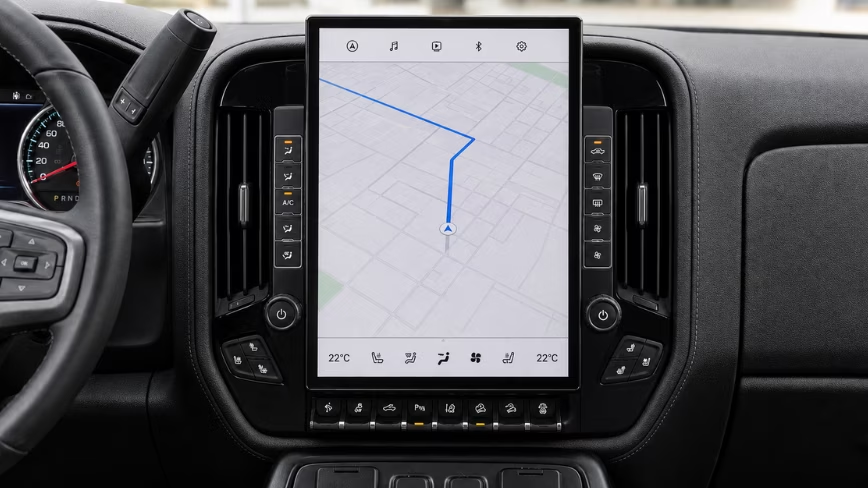
This change is demonstrated by the Chevrolet Silverado Tesla-style screen that Merge Screens is offering. The company enumerates the configurations of Silverado model years spanning 2007 to 2026 with the hardware specifications depending on the age of truck and configuration.
The 2007 13.8 inch display is used in the Premium system of 2007-2013, whereas the 2014 15.6 inch display is utilized in the 2014-2026 Premium. For 2019–2026 trucks, a 17.2-inch Elite option is listed. The Premium systems are powered by Android 13, and Elite by Android 14. The three have 8GB of RAM and 128GB of storage.
The specifications in question render the product as an enormous Android tablet but incorporation is the more challenging aspect. The company says that compatible installations have steering-wheel controls, factory cameras, climate functions, supported seat controls, and factory or aftermarket audio systems. There are also Apple CarPlay and Android auto.
Merge Screens requests the customers to send pictures of the current radio and climate-control panel upon ordering. The firm then analyzes these pictures and vehicle data to confirm compatibility and assemble the unit. Another important limitation is also present in its product documentation: the original factory radio system needs to be present since the new interface will only connect with the current systems of the vehicle, not fix it.
The mentioned caveat assists in characterizing the product type. It is not a universal substitute to damaged electronics. It is an interface layer that is new and over a working vehicle architecture.
“Even a truck that is ten years old can still drive like it was only ten years old because the dashboard is the part that the owner interacts with on a daily basis, a process that can be made more useful by updating the interface to provide the owner with more years of service out of a vehicle that he or she is already familiar with and trusted.”
The Aftermarket Is Assuming A Software-Support Function
As soon as a product is turned into software-dependent, the association with the customer is altered. A conventional radio would be able to operate without frequent maintenance. The Android-based vehicle interface has applications, operating-system behaviour, phone compatibility, and software dependencies which can vary following installation.
It is no longer the device in the box that is useful. The value of the system is added with documentation, compatibility checks, installation instructions, troubleshooting and future updates.
Merge Screens claims to provide installation instructions and videos, support with email and one on one video calls, and lifetime software updates. It also provides professional installation to the owner who is not keen on doing the work on his/her own.
This service layer is a response to one of the most protracted weaknesses of the aftermarket industry. The generic hardware may be cheap to sell since a lot of the risk of integration is passed to the buyer or installer. The preparation of vehicles puts a larger share of that burden on the vendor.
It also develops a more justifiable business model. Copies can be made of hardware components and prices can be reduced, but it is more difficult to duplicate a compatibility database, a repeatable process of verification, knowledge to install it, or post sale support.
A Longer Life For The Vehicle’s Digital Layer
Trade-offs do still exist. The loss of physical control to a touchscreen may diminish the physical feedback of controls. Any aftermarket system should also work reliably during temperature variations, vibration and years of daily wear. Owners must ensure that they confirm operations that their specific truck is capable of instead of believing that all functions will be the same over the next 20 years of Silverado manufacturing.
The bigger picture though does not just limit itself to one product. The automotive aftermarket is now changing its face to lessen dependency on mechanical replacement of parts to remain digital.
Mergescreens is hoping that truck operators will upgrade the interface of a truck they already have confidence in rather than purchasing a new one to gain access to newer technology in the cabin. The Silverado makes that proposal quite conspicuous since a single line of products has to cover nearly 20 years of development of dashboards.
The latter stage of vehicle life could thus not only be determined by ensuring that the engine is kept running. It can also need a layered driver to machine interface with an upgradeable and supported interface. The screen does not need to decide when a truck that is otherwise useful becomes unnecessary any more, when the layer that it is wrapped in can be modified, without abandoning the truck itself.


 Credit: Merge Screens