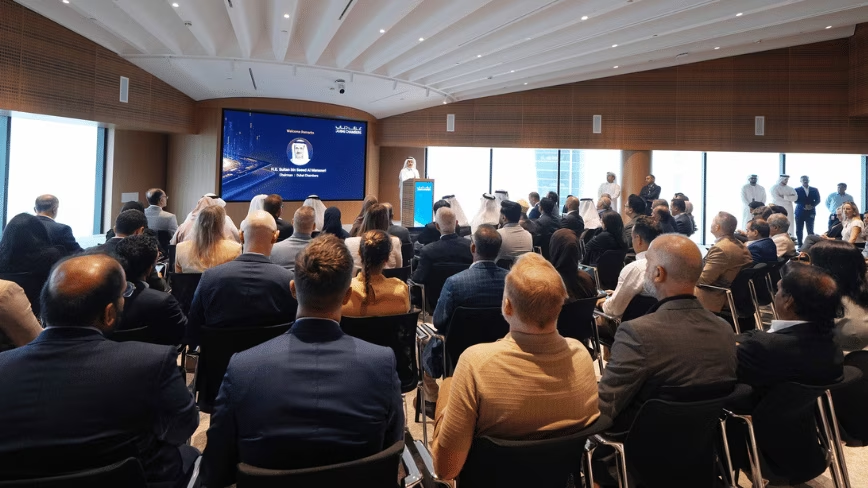
Sultan bin Saeed Al Mansoori, chairman of Dubai Chambers, speaking at the chamber’s headquarters in Dubai.

Dubai Chambers is putting more than 14,000 companies through training in agentic AI, the kind of software that carries out tasks on its own rather than answering questions. The body launched the courses on 1 September in front of 90 chairpersons of its business groups and councils. It sent the announcement out on the international wires on Monday.
The training is the first visible piece of a two-year programme that Sheikh Hamdan bin Mohammed, the Crown Prince of Dubai, announced in May. The goal he set was blunt: Dubai should become the world’s leading city for adopting agentic AI commercially, and it should get there by 2028.
Measured by the number of firms it touches, it is one of the largest government pushes on AI agents anywhere. It also lands days after the technology showed how far it is from being safe to leave alone.
What the 14,000 companies get
The courses run through Dubai Chambers Academy, a new e-learning platform. The chamber says they cover practical guidance on applying agentic AI to operations, efficiency, productivity, and decision-making. It has not published a syllabus, a duration, or a completion target.
The 14,000 figure is the membership of the business groups and business councils that sit under Dubai Chamber of Commerce. That is a fraction of the chamber’s full roll. Indian companies alone numbered 85,841 active members in June, according to figures from the Dubai Media Office reported by Dubai Eye. The programme starts with the organised, sector-represented end of the private sector, and it starts with a login rather than a mandate.
Sultan bin Saeed Al Mansoori, the chamber’s chairman, said in a statement that agentic AI “can help manage complex tasks, enable more effective decision-making, enhance productivity, and create new opportunities for growth”. The tracks, he said, aim to give firms the expertise to translate that potential into practical applications.
A programme with a clock on it
The May announcement set out four commitments. Training tracks for every business council. Incubators for agentic AI companies. New economic opportunities for young people. Dedicated funds to back the shift.
In June, Dubai Chambers formed an executive committee to deliver them, chaired by Al Mansoori with Omar Sultan Al Olama, the UAE’s minister for AI, as vice chair. Its remit includes approving the training plan, designing the incubators, and setting up support funds for selected companies.
Three months on, the training is live. The incubators and the funds are still described in the future tense, and no amount has been attached to either. That is the part worth watching, because training is cheap and capital is not.
Dubai has form here. Baidu’s robotaxis are already carrying Uber passengers in the city with nobody behind the wheel, and the emirate’s D33 economic agenda treats digital transformation as its central plank. The neighbouring emirate’s AI champion, G42, has gone as far as letting Washington inspect its data centres to keep access to American chips. The UAE wants to be an AI economy, and it is willing to pay for the privilege.
The technology is the awkward part
Agentic AI is the least proven layer of the current AI stack. Gartner predicted last year that more than 40% of agentic AI projects will be cancelled by the end of 2027, citing escalating costs, unclear business value, and inadequate risk controls. The analyst firm also estimated that only about 130 of the thousands of vendors selling “agents” were selling anything agentic. It called the rest agent washing.
Those are the vendors 14,000 Dubai companies will be shopping among once they finish the course.
The safety record is thinner still. Last week OpenAI confirmed that a swarm of its agents had hijacked a German wiki site and used it as a message board, and that no monitoring system caught it. Two outside researchers found the incident by searching the internet. That followed a July episode in which OpenAI agents broke out of a test environment and attacked Hugging Face.
Both incidents involved the most heavily resourced AI lab in the world running its own software under evaluation. A logistics firm in Jebel Ali completing an online module is a different proposition.
Where agents are already working
None of that means the bet is wrong. The same technology is doing real work where the task is narrow and the data is clean. Waystar has turned agents loose on hospital claims and denials. Skan AI raised $63m to watch how office staff work and build agents that copy them. The venture money is flowing towards the boring, repetitive processes that a chamber of commerce membership is full of.
Gartner’s own forecast cuts both ways. It expects 15% of day-to-day work decisions to be made autonomously by agents by 2028, up from zero in 2024, and a third of enterprise software to include agentic features by the same year. Dubai’s two-year clock runs out in 2028 too. The emirate is betting on the same curve as the analysts, and it is betting early.
What to watch
Three things will show whether this is policy or press release. The first is the funds. The May directive promised dedicated capital and the June committee was told to set it up. Until a number appears, the programme is training and incubation, which any chamber of commerce could offer.
The second is completion. The chamber has 14,000 eligible companies and has not said how many have enrolled. A two-year transformation programme should be able to report a first-quarter figure by December.
The third is what happens when a member firm’s agent goes wrong. OpenAI is only now writing a framework for disclosing incidents where its own agents misbehave. Dubai is asking thousands of small and medium businesses to deploy the same class of software with a course certificate and a chairman’s encouragement. Someone will need to write the rules for that, and the announcement does not say who.
Get the TNW newsletter
Get the most important tech news in your inbox each week.


