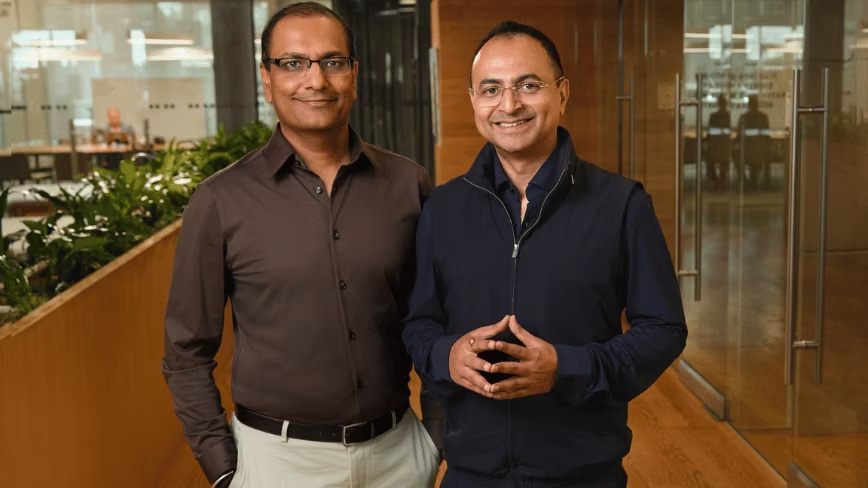
Skan AI announced $63m in funding on Wednesday, co-led by Cathay Innovation and Dell Technologies Capital. What the money is buying is not a model. It is a record of how people at large companies actually do their jobs. Skan builds that record by watching them work.
Avinash Misra, the co-founder and chief executive, reached for a metaphor. Everyone is chasing the model, he argued, when the harder problem sits elsewhere. “Everyone is obsessed with building a better car,” he said. “We think the bigger opportunity is building a better navigation system.”
What the software actually watches
The mechanics matter more than the metaphor. Skan puts software on employee desktops and takes screenshots. Those images are read on the machine and stay there. “Only anonymized, abstracted metadata is transmitted to the analytics platform,” the company says in its privacy guide.
What leaves is a list rather than a recording. Application usage and switching patterns. Time allocation by process, plus workflow sequences and decision paths. Skan swaps employee identifiers for tokens before any of it goes anywhere. Skan’s security page says personal messages and passwords are never captured.
The numbers are large and they are all Skan’s own
The company says revenue grew more than 300% year on year. Net dollar retention averages 150%. It has processed more than 25 billion work signals. A quarter of the Fortune 50 are customers. So are seven of the ten biggest US banks, and three of the five biggest insurers.
Then there is a bank example, given in detail. Skan observed 11.2 million context switches across 1,500 finance professionals. It says that surfaced $37m of operational friction. Agents built on those observations cut cost per transaction by 32% and lifted throughput by 41%. The stated result is $18m in annualised savings.
The observation layer is the training layer
One line in the release explains the entire business, and no executive says it. “What began as 11.2 million observations of human work became the context for AI to perform that work.”
That is the loop. Watch people do the job. Turn the watching into a model of the job. Point an agent at the model. The staff supply the specification. The agent supplies the implementation.
None of this is a new category, only a new claim about one. Process and task mining have sold enterprise visibility for a decade. UiPath built a public company on automating whatever that visibility found. The difference is what now sits at the end of the pipe. It is an agent rather than a script.
Why the timing works
Skan cites Gartner for the gap it is selling into. Only eight percent of enterprises have agents in production, the research says. It also finds that 95% of early implementations will need a complete redesign. That document sits behind a subscription, so nobody outside Gartner can check it.
Misra frames the whole thing as a data problem rather than a model problem. “You cannot fix a source data problem downstream,” he wrote in a blog post. “Better models will not solve it. Better prompts will not solve it.”
What the announcement leaves out
Every figure above comes from the company. Skan calls the $500m in cumulative customer value measured. It names no auditor. Claimed AI productivity gains have a poor record under inspection. One widely cited study found 95% of organisations got no measurable return at all.
The bigger absence is a plain word for what this is. Banks and insurers now buy screen observation of their own employees, at scale. TD Bank in Canada scaled back a monitoring rollout after workplace surveillance objections from staff. Meta paused a programme collecting keystrokes for AI training in June.
Europe is where this gets tested
Two names attached to the round are European. Cathay Innovation, one of the co-leads, is French. Mitie, the British facilities group with 75,000 staff, supplies the customer quote. Its chief technology officer Cijo Joseph credits Skan with “unprecedented operational visibility”.
Europe is also where the consent question has teeth. Skan’s privacy guide names Allianz in Munich as a deployment that won full works council approval. That is a real answer to a real objection. It is also Skan’s account rather than Allianz’s, and Allianz has separately announced 1,800 job cuts.
The checkable test is a year away. Skan says agents built on observed work are running in production at large banks right now. By this time next year either those agents are still running, or they joined the 95% that needed rebuilding. The other question carries no deadline at all. What does an employer do with a complete record of how its staff work, once the agents have learned it?
Get the TNW newsletter
Get the most important tech news in your inbox each week.


