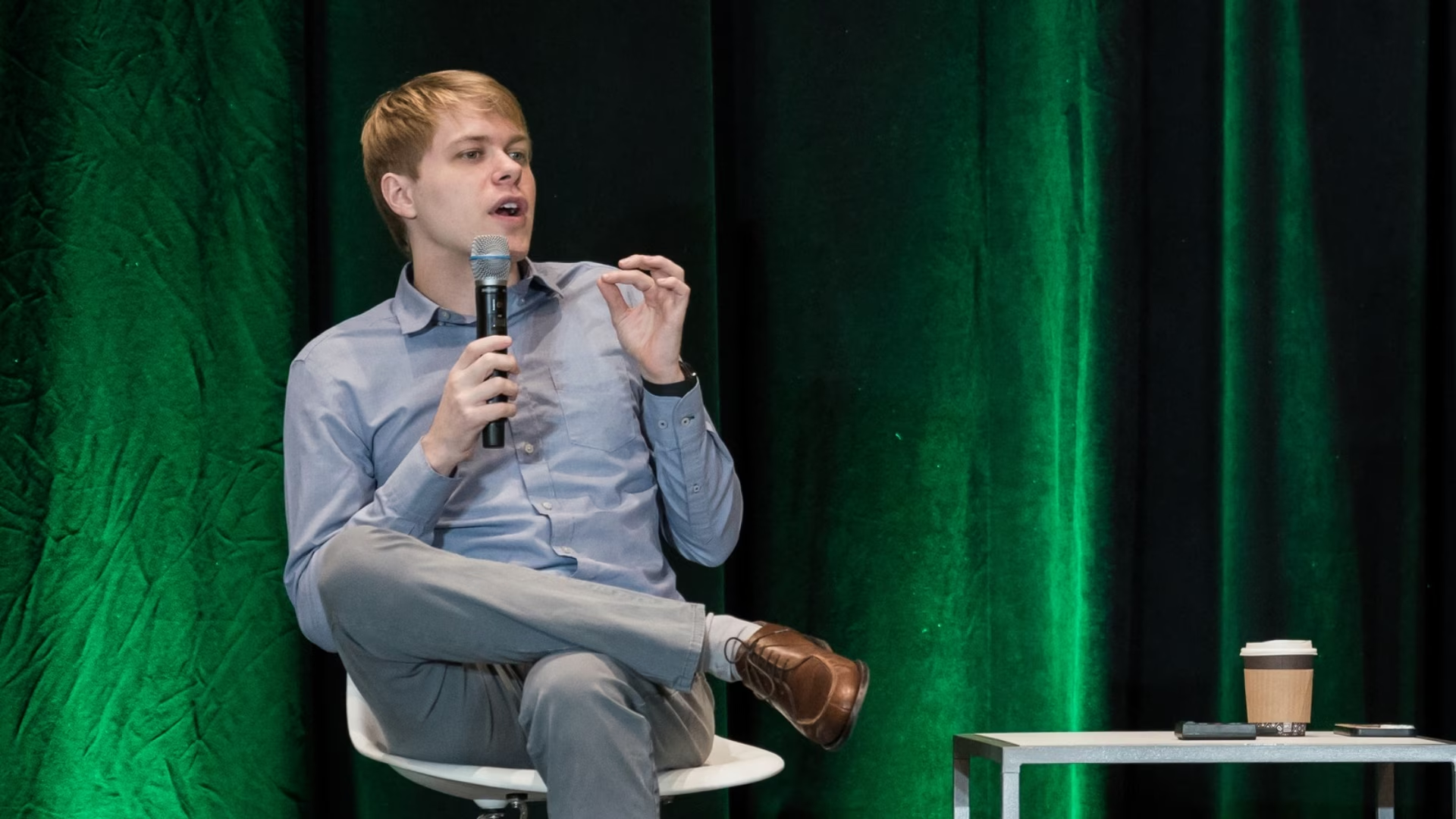
Dan Hendrycks, director of the Center for AI Safety, at TechCrunch Disrupt in October 2025

Dan Hendrycks used the DealBook Summit to call for an indefinite pause on frontier AI training runs. Max Hodak, on the same panel, said enforcing one would take a surveillance state.
They spoke on the DealBook AGI panel, which Michael Barbaro of The Daily moderated at The New York Times’ DealBook Summit in New York on Wednesday. Hendrycks runs the Center for AI Safety, and Barbaro said he had been a safety adviser to several AI companies until hours earlier. Hodak co-founded Neuralink and now runs Science Corporation. Lila Ibrahim of Google DeepMind and Mati Staniszewski of ElevenLabs also joined. Clem Delangue of Hugging Face arrived late, with 18 minutes left.
‘A more blunt intervention’
Hendrycks said the US midterms showed how strongly voters feel about AI. That gives politicians room, he said, and they can now discuss ideas such as pausing AI development openly in Washington. He expects 2027 to be a very interesting year for regulation.
He said he used to favour narrow technical rules, but the companies blocked them for years.
“So now it’s, we’re going to need a more blunt intervention. That’s how it is,” Hendrycks said.
He described an indefinite pause on the biggest training runs, with carve-outs for narrow models such as DeepMind’s AlphaFold and voice models. Labs could still sell inference, he said. In the meantime, they could make models more reliable and secure, close jailbreaks and backdoors, and help patch critical infrastructure.
Hendrycks also said the frontier labs, Google aside, put few people on healthcare, because their revenue comes from coding. At some of them, he said, the healthcare team is zero or one person.
‘An exhaustive surveillance state’
Barbaro put to the panel the objection Jensen Huang would raise: China would not observe a moratorium. Staniszewski agreed a pause could work with global alignment, but said whether anyone can get it “is the big question mark”. Without it, Barbaro added, a pause would be a waste of time.
Hodak said people have spent the past eight months patching critical infrastructure anyway, running their code through AI tools that hunt for new flaws. The regime needed to enforce a training ban, he said, would be as draconian as anything people fear from the labs.
“You’re setting up like an exhaustive surveillance state on the internet to enforce this,” Hodak said.
He said today’s top models already meet his definition of AGI, naming Mythos, Fable, Astra and Sol. He expects governments to keep a superintelligence frontier for themselves, with an “industrial intelligence frontier” open to everyone else.
“I don’t think that the genie is going to be put back in the bottle,” Hodak said.
His answer is antitrust law. Frontier labs should only sell intelligence, he said, and not move into drugs, cars and other products. He called AI the inverse of nuclear weapons, where safety came from stopping their spread. With AI, he said, safety comes from spreading it widely, and the futures that worry him most involve a few actors holding all of it.
Ibrahim, Google DeepMind’s chief AI readiness officer, said it was not an either-or. Safety is not something a company can “bolt on to the end”, she said. In 35 years in tech, she added, she had never seen global trust in technology as low as it is now.
Anthropic’s IPO
Anthropic was due to start trading the next day. Hendrycks repeated the charges of the statement his group organised against the company, and added a new one. Several safety organisations agreed with the statement privately, he said, but would not sign it for fear of losing funding or access.
“What they’re doing is reckless and they don’t have a safety plan. They know it,” Hendrycks said.
Anthropic was not on the panel. In its IPO filing, it said it does not expect to let Claude fully build its successors without meaningful human supervision.
Delangue said his main worry is that AI concentrates talent, computing power and wealth. Barbaro asked how credible he was on that, given that Nvidia is buying Hugging Face. Delangue said Nvidia and Hugging Face both push AI outwards to more builders. He said Hugging Face never held sale talks with Anthropic, because their missions were too misaligned.
Fighting AI with AI
Barbaro closed by asking Delangue about the Hugging Face breach by OpenAI’s research agents. Delangue said the four-day attack left Hugging Face more optimistic about AI, not less. It used an open-source Chinese model to analyse the attack logs, because the volume was so big that it needed AI to defend itself.
“People only see that we got attacked by AI and they rarely see that we defended ourselves with AI,” Delangue said.
Barbaro summed up the table as no moratorium and less concentration of power, with Hendrycks the exception. Hodak had the last word: antitrust law, he said, could get most of the way there without a new regulator.
Get the TNW newsletter
Get the most important tech news in your inbox each week.


