 Credit: UiPath
Daniel Dines has published The Work That Remains, arguing that enterprises should let AI agents prepare work while humans own consequential decisions and deterministic automation carries them out. He stakes the framework on a dated prediction and names the evidence that would weaken it.
Daniel Dines has written a book, and its most useful sentence is a bet with a date on it. He predicts that by the end of 2028, any large regulated enterprise running a high-consequence workflow autonomously will do it inside an engineered environment, not with a general agent dropped into legacy systems.
He then does something vendor books rarely do. “If broad enterprise deployment proves otherwise, this framework weakens,” he writes, naming the evidence that would sink his own argument.
The thesis fits on a line. AI proposes, humans decide, automation executes, with agents planning and preparing, people owning anything carrying consequence, and deterministic systems doing what was approved.
His vocabulary for the missing layer is the map and the rails. The map is a governed description of how a business actually works, and the rails are the machinery that executes the stable parts exactly.
The most interesting claim is that expectations inverted. Agents were the supposed quick win and automation the expensive legacy, yet the agent at the point of consequence proved the hard part while reliable code got cheap.
The premise is not only his. TNW reported in July that Forrester puts 75% of projects stalling before production, which is the gap the book says orchestration fills.
What lifts it above marketing is the disclosure. “I run an automation company. That is my declared bias,” Dines writes, adding that firms like his benefit from the conclusion, and asking readers not to accept or reject it on that basis.
He has been sketching this publicly for months. He told TNW in July that cutting junior hiring starves the enterprise of future leaders, and named the cartographer role the book now builds out.
On people the argument is about density, not headcount. Fewer passengers and more drivers, he writes, in a workforce where talent density stops being a philosophy and becomes arithmetic.
The workflows he names are also his market. Claims adjudication, loan approvals and payment approvals are the territory UiPath bought into with WorkFusion, worth remembering while reading.
The origin story is European and specific. After five years at Microsoft in Seattle, Dines returned to Romania in 2005 and started the company from his Bucharest apartment. It now trades on the NYSE.
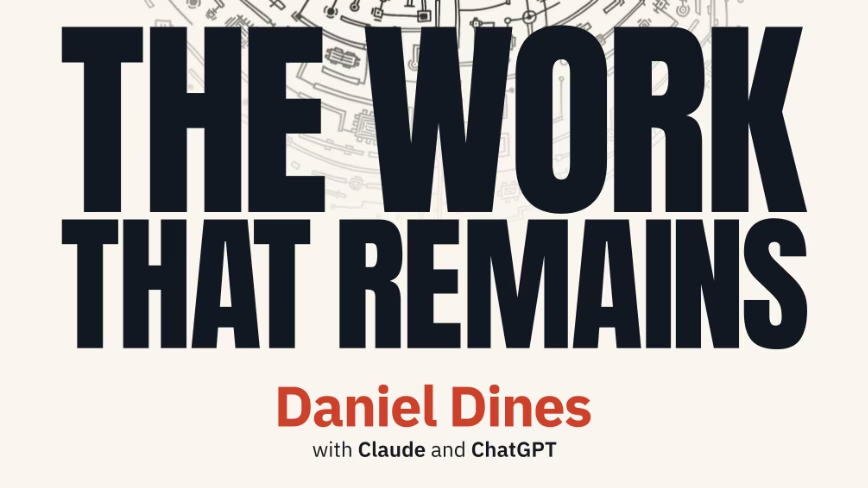
Two other names appear on the cover. It reads “with Claude and ChatGPT,” which is either the argument demonstrating itself or the neatest illustration of it yet.
Get the TNW newsletter
Get the most important tech news in your inbox each week.


