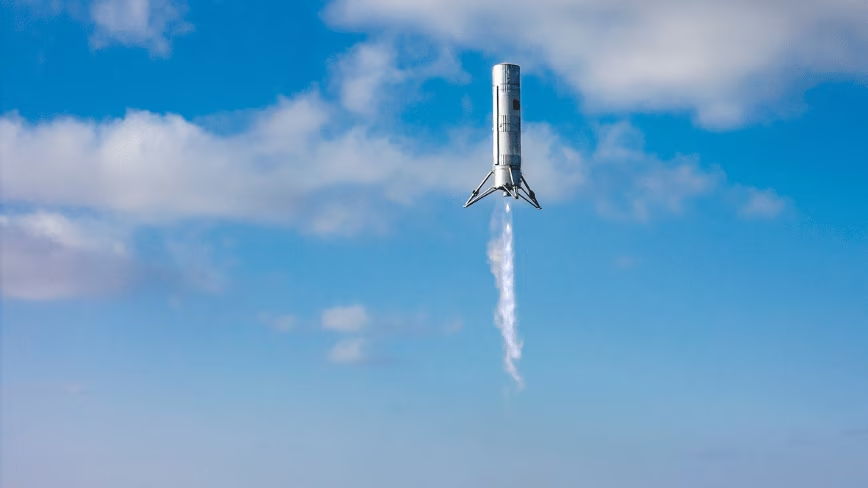

The Chinese startup LandSpace recovered the first stage of its Zhuque-3 rocket on Wednesday. It is one of only a handful of private companies to land an orbital-class booster. Reuters reported that the feat places LandSpace alongside SpaceX and Blue Origin, and narrows China’s gap with the US in reusable rockets.
The booster came back on its legs in the northwestern province of Gansu, after helping send a satellite into orbit. That account came from the state news agency Xinhua, cited by Bloomberg. The rocket lifted off from Jiuquan, one of China’s main launch centres. The first stage then touched down about 390km away, according to Reuters.
It is the first time China has recovered a rocket booster on land. The country pulled off a recovery last month, but did so at sea, using a net on a floating platform.
Why landing a booster matters
The ability to return, recover and reuse a first stage is central to lowering the cost of reaching orbit. Reusing the most expensive part of a rocket makes launches more repeatable. It shifts them away from a series of one-off flights. Reuters described it as a step towards making space launches commercially viable, similar to civil aviation.
LandSpace bills the Zhuque-3 as China’s answer to SpaceX’s Falcon 9. The rocket stands 66.1 metres tall and its first stage carries nine engines, according to Reuters. LandSpace said the vehicle is built from stainless steel. That, it said, offers more heat resistance and potentially lower production costs than the aluminium-lithium body of the Falcon 9.
The Zhuque-3 runs on methane and liquid oxygen. That mix can burn cleaner than the kerosene the Falcon 9 uses, LandSpace said. It can carry 14.2 metric tons to low Earth orbit on a one-way flight, the company said. The Falcon 9 carries 22.8 tons.
A fourth attempt
Wednesday’s flight was the second try at landing the Zhuque-3, Reuters reported. It was China’s fourth attempt overall at recovering an orbital booster. LandSpace ran the country’s first reusable-rocket test in December 2025. That rocket reached orbit as planned, but its first stage did not complete a controlled landing.
Weeks later, the state-developed Long March 12A also reached orbit and then failed its recovery, according to Reuters. In July, China tested a booster-retrieval system that used a net on a floating platform at sea. That made it the second country to land an orbital-class rocket, Reuters said. Wednesday’s flight is China’s first successful ground-based, leg-landed recovery of such a booster.
That July test used a different method from Wednesday’s. Rather than deployable legs, the Long March 10B used four lightweight hooks to grab steel cables on the platform’s net, Reuters reported. Beijing said the approach simplified the rocket’s structure, cut its mass and raised how much it could carry. Wednesday’s landing showed China can now bring a booster down on legs on solid ground, the harder of the two feats.
LandSpace said it plans to reuse a recovered first stage within the next six months. That step would lay the groundwork for cheaper, more frequent launches, it said. It is aiming to fly each booster up to 20 times.
That target is still far below SpaceX. The US firm reuses individual Falcon 9 boosters many more times, and flies far more often. LandSpace has yet to refly any recovered stage, so the six-month plan is the next real test of the design.
The gap with SpaceX
SpaceX remains well ahead. The US company has been recovering and reusing Falcon 9 boosters since 2017, Bloomberg reported. It now launches the rocket around 150 times a year, reusing boosters dozens of times. That reuse helped it build a near-monopoly in heavy-lift launches and deploy its Starlink network. SpaceX is separately working to catch a Starship in mid-air.
Eric Zhu, an analyst at Bloomberg Intelligence, called the recovery “a watershed moment for China’s commercial space sector”. He added that LandSpace now faces a harder task. It must show it can refurbish and refly the hardware quickly and cheaply, which he said took SpaceX several years to master.
China has had setbacks too. A Chinese rocket exploded during a launch earlier this month, Bloomberg reported. The recovery also feeds a wider goal. China is building its own internet satellite network, which has so far relied on single-use rockets to reach orbit.
The commercial race
LandSpace is one of the leading startups to emerge since China opened its space industry to private firms about a decade ago. In 2023, it became the first company in the world to launch a rocket fuelled by methane, beating SpaceX to that milestone, according to Bloomberg.
The landing may also help LandSpace’s fundraising. The company is pursuing a listing in Shanghai on the STAR Market, where it is seeking to raise 7.5 billion yuan, or about $1.11 billion, Reuters reported. LandSpace filed an updated prospectus in June that said it aimed to be profitable by 2029.
Reuters framed the wider stakes as an effort to break what it called a US lead in reusable rockets. SpaceX has held that lead for years, and Blue Origin, backed by Jeff Bezos, is the other private firm to have landed an orbital-class booster.
China is not the only country chasing SpaceX. Indian firms are also working on reusable rockets, Bloomberg reported, with the startup AgniKul Cosmos preparing a mission in early 2027 that aims to recover a first stage after delivering its payload.
Get the TNW newsletter
Get the most important tech news in your inbox each week.


