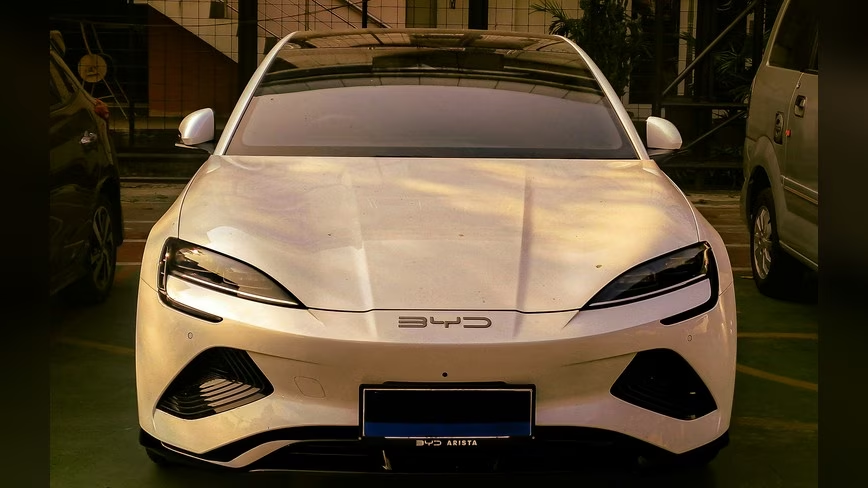

China has agreed to moderate its exports of hybrid and plug-in hybrid cars to the EU, which EU trade commissioner Maroš Šefčovič said could cut them by more than half. He announced it on Friday in press remarks in Beijing, after the second round of EU-China trade and investment consultations.
“It is unsustainable and it demands a credible path to rebalancing,” Šefčovič said of the EU’s trade deficit with China.
He called the results three “shared understandings”. China will also cut its tariffs on some EU goods, including car parts, olive oil and footwear. Those exports are worth almost €4bn, and the cuts would save at least €225m in duties.
China will further ease export licensing for rare earths and permanent magnets, Šefčovič said.
No volumes or timeline yet
The Commission has not published a written agreement. Its statement gives no volumes, timeframe or mechanism for the cut in car exports.
Šefčovič also spoke to reporters in Beijing, the Associated Press reported.
“By this step we are actually preventing several millions of car exports from China to the European Union,” Šefčovič said.
AP described the cut as covering electric and plug-in hybrid imports. The Commission’s statement names only hybrids and plug-in hybrids.
The consultations began at a meeting with China’s commerce minister, Wang Wentao, in Brussels on 29 June. In Beijing, Šefčovič also met Vice Premier He Lifeng.
EU leaders have the final say
Commission President Ursula von der Leyen will assess the results and discuss next steps with EU leaders at the upcoming European Council. The final decision lies with the leaders, Šefčovič said, and he called the results “only a first step”.
Where talks cannot deliver, the EU will use its tools to force a rebalancing, he said. Officials will meet again by January, and a third round of consultations is planned for March.
Šefčovič has pushed for a new tool to cut Europe’s dependence on Chinese supply chains. In September he said he would ask CEOs how much decoupling they can afford.
China and carmakers respond
Wang expressed concerns about the EU’s recent restrictive measures, China’s Commerce Ministry said. He said China is not the root of the EU’s problems but a partner in solving them, AP reported.
China has also pushed the EU to stop blocking its imports of advanced chipmaking machines, AP reported. The EU imposed those limits on national security grounds at Washington’s request.
Sigrid de Vries, head of the European Automobile Manufacturers’ Association, said the deal appears to avert further instability.
“It can help facilitate the transition to a new era of Chinese presence in the European market in an orderly way,” de Vries said.
China’s trade surplus with the EU reached €360bn last year, according to AP. In Europe, hybrids are outselling every other powertrain.
Get the TNW newsletter
Get the most important tech news in your inbox each week.


