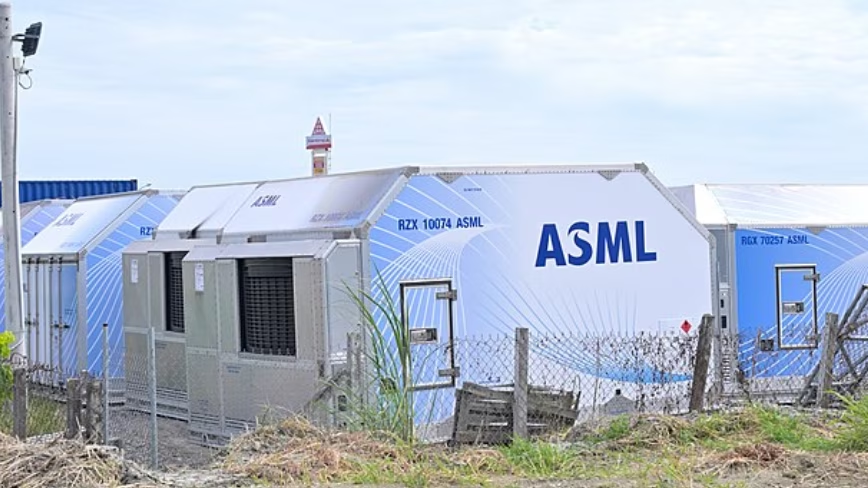
ASML air freight containers in Tainan, May 2025
 Credit: 4300streetcar
UBS analysts say China’s lithography programme is at roughly the stage ASML reached in 2004 and will not produce a viable EUV alternative within a decade. They also expect China to reach high-volume manufacturing of immersion DUV machines in two to five years, which is the category the Dutch government controls through export licences.
China will not match ASML’s most advanced machine this decade. Its lithography programme sits roughly where ASML stood in 2004, UBS analysts said, Bloomberg reported.
The comparison comes from patents. Analysts led by Francois-Xavier Bouvignies looked at light source and laser subsystems and found maturity comparable to ASML fifteen years before it mass produced extreme ultraviolet tools.
The second finding matters more in Europe. UBS expects China to reach high-volume manufacturing of immersion deep ultraviolet machines within two to five years, in a bloc TNW has reported has no chance of chip independence.
The price gap explains the appetite. ASML sells immersion DUV systems at close to $90M, against more than $200M for its EUV gear.
Europe’s leverage was never really the EUV machine. It is a licence issued in The Hague, which since 7 September 2024 has covered the NXT:1970i and 1980i.
That was the moment the Netherlands took the file back. Licensing for those two models had run through Washington, while the NXT:2000i and later immersion systems were already Dutch controlled.
ASML’s own chief executive was uneasy about the direction. Christophe Fouquet said in 2024 that the case for national security was getting harder to make and the curbs were economically motivated.
The commercial stake is not small. China accounted for 42% of net sales in the third quarter of 2025, and the company has warned of a sharp fall this year.
It is not suffering for it yet. ASML reported €8.8B in net sales and €2.8B in net income for the first quarter, with full-year guidance of €36B to €40B.
The dependency also runs the other way. Every advanced chip in the world is printed by machines built by one company in Veldhoven, and there is no second supplier anywhere.
Around that one company Europe has remarkably little. The bloc makes under 10% of the world’s semiconductors, which is why the Commission proposed a second Chips Act in June, after TNW reported the sector facing a bleak future.
Which is the timing worth noticing. The tool China cannot copy is a decade away, and the tool the Dutch licence actually restricts is two to five years away.
Both clocks run on the same instrument. Europe’s strongest lever over Chinese chipmaking looks likely to expire well before the technology gap it was built to protect.
Get the TNW newsletter
Get the most important tech news in your inbox each week.


