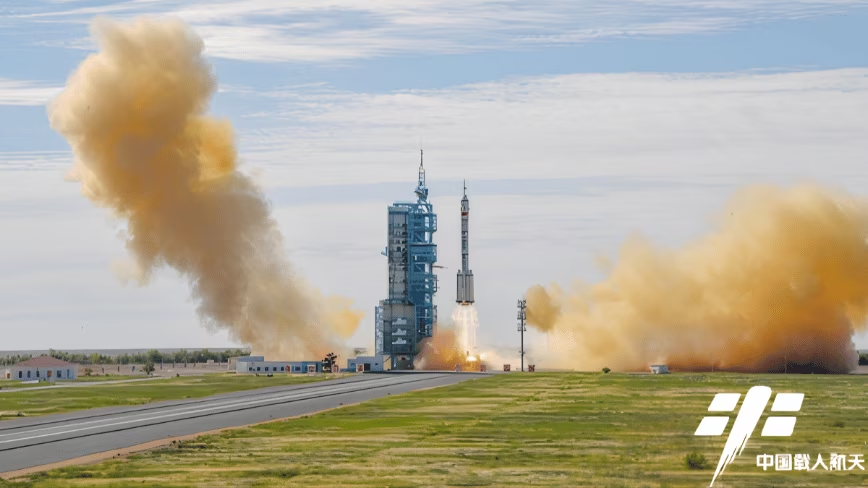
The launch of the Shenzhou-12 mission.
 Credit: China Manned Space Engineering Office
China called off its most ambitious Moon mission the day before it was due to fly.
The announcement runs to a single sentence. Chang’e 7 does not meet the conditions for launch, the China Manned Space Agency said on Sunday. It cannot go ahead in this year’s scheduled window.
It gave no reason.
What the statement does say
The decision followed a comprehensive assessment, the agency wrote, made in accordance with a principle of proceeding prudently and reliably.
The phrase ends on a Chinese idiom. Outlets have rendered it as both absolute success and absolute safety. It means leaving no room for failure.
That is the whole notice.
What was sitting on the rocket
Chang’e 7 is four spacecraft. An orbiter, a lander, a wheeled rover and a small hopper.
They were stacked on a Long March 5 at the Wenchang launch site, on Hainan island in the South China Sea. The rocket had already been rolled out vertically to the pad.
Preparations had been running at Wenchang for weeks. Xinhua had described the mission as aiming at breakthroughs in key technologies.
The orbiter relays data home and carries out its own observations, Simon Sharwood reported for The Register.
The hopper is the interesting part
China wants to find out whether the hopper can jump over a crater rim and look for ice inside. Then hop back out and carry on exploring.
Nothing has done that at the Moon. The vehicles are also built to survive several lunar nights, stretches of two weeks or more without sunlight. Shadowed ground can fall below minus 200 Celsius.
The lander carries equipment for a precision autonomous landing, which the terrain makes difficult.
Where it was going
The target is near Shackleton Crater, almost exactly at the lunar South Pole. The crater runs about 21km across.
High rims keep parts of the floor in permanent shadow. Scientists think water ice has gathered inside those cold traps over billions of years.
No country has soft-landed a spacecraft at either lunar pole. They are harder to reach than the equator.
The mission was about use, not discovery
Richard de Grijs is an astrophysics professor at Macquarie University in Australia. Chang’e 7 marks a transition from exploring the Moon to working out whether its resources can be used, he wrote.
Chinese scientists are not looking for signs of water, he said, because compelling evidence for lunar polar water already exists.
The question is where exactly it sits, in what form and concentration, and whether anyone could realistically get at it.
The reason nobody official has given
Typhoon Narra was sitting in the water between Hainan and mainland China, Eric Berger noted for Ars Technica. Winds ran around 45mph. Berger is a certified meteorologist as well as a space editor.
The Joint Typhoon Warning Center expected the storm to keep circling the area for another two or three days.
Some Chinese outlets reported bad weather as the cause. State media warned of torrential rain in Hainan. The agency itself said nothing about it.
The other possibility
Berger raised a lesser one. A Long March 7A failed during ascent two weeks ago, and the Long March 5 uses the same YF-100 engine.
He rates an engine problem unlikely, because China had been moving steadily towards launch in the days beforehand.
Why a scrub costs a year
Windows that allow a flight to the lunar South Pole open only once or twice a year. None is left in 2026.
Social media chatter puts the next one in February or March, Berger reported, though nothing official confirms that.
Two things stretch it out. Sunlight conditions have to work at the polar landing site. The mission plan also requires 90 days of reconnaissance from lunar orbit before the lander goes down.
What the delay opens up
NASA could now reach that ground first, through Blue Origin’s Blue Moon Mark 1 lander, which is carrying two NASA probes to the South Pole.
Blue Moon was on track for this year until Blue Origin lost its only pad in a static fire test in May, along with the New Glenn rocket standing on it. A month later the company still had no root cause.
It has been rebuilding Launch Complex 36A since, on top of another $600m committed to its Florida campus.
Blue Origin aims to fly New Glenn again before the end of this year, which Berger calls probably ambitious. Blue Moon could plausibly go in the first half of 2027.
That would make it close
If Chang’e 7 launches in February and spends three months in lunar orbit first, the two arrive at roughly the same time.
Neither carries people. Both are precursors for crewed landings that could follow within a few years, which is why the order matters to both governments.
The timelines each side is working to
China aims to put people on the lunar surface no later than 2030, and to start building the International Lunar Research Station with Russia from 2031.
NASA has Artemis IV tentatively set for early 2028, and a lunar colony pencilled in for 2036.
South Korea is targeting 2030 for a landing of its own. SpaceX has talked about factories on the Moon.
What China has not said
The agency has not confirmed a new launch date, or which window it is aiming for.
It has not said whether the problem was the weather, the rocket or the payload. Nor has it said what changes, if anything, before the next attempt.
Chang’e is a Chinese moon goddess, and the programme has carried her name through six flights. Chang’e 6 brought back samples from the far side of the Moon in 2024, a world first.
The seventh is now waiting on a sky that nobody has officially blamed.
Get the TNW newsletter
Get the most important tech news in your inbox each week.


