 Credit: Butterfly Network / Bridge Neurotech
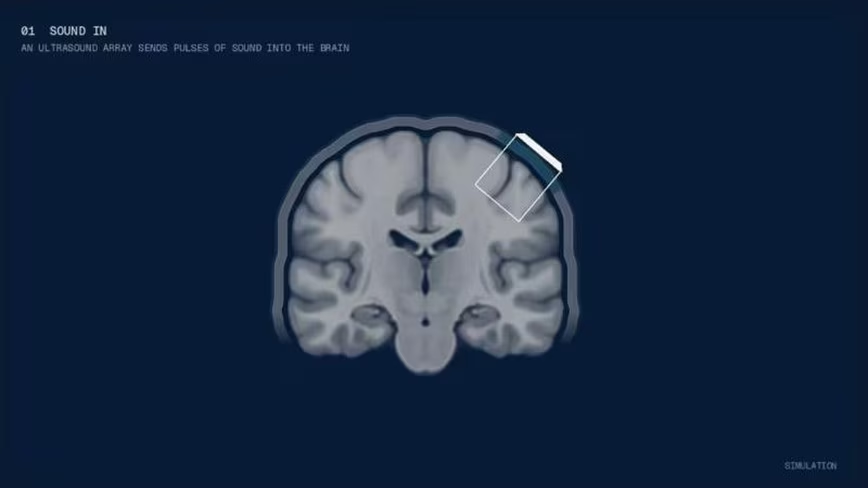
Bridge Neurotech came out of stealth on Tuesday with $13.5M in funding. It plans a brain-computer interface that needs no surgery and no implant. The startup wants to use ultrasound to read brain activity through the skull. It also signed a research deal with Butterfly Network, which makes chip-based ultrasound devices.
General Catalyst, reMind Capital, Sunflower Capital and Scott Sandell backed the round, Will Biederman wrote in a founder’s letter. WIRED, which reported the launch first, said Bridge plans a wearable device. Emily Mullin wrote for WIRED that this puts it up against Merge Labs. The Sam Altman-backed startup is also building an interface powered by ultrasound.
What Bridge is building
Bridge is developing a functional ultrasound imaging platform, known as fUSI. AI models then decode the brain signals it picks up. Biederman founded the company this year in Silicon Valley.
Its first human study is now enrolling in Redwood City, California. It is open to healthy adults aged 18 and older, the letter says. Adults who have had a cranioplasty with a PEEK or Longeviti implant can also take part. Participants do simple tasks while the device measures their brain activity, Bridge said on its website.
As a PhD student at Berkeley, Biederman developed the chip that Neuralink used for its first implants, he wrote. He then spent nearly a decade at Verily and Google working on health technology. Later, he co-founded Forest Neurotech. There, he led work on the first miniaturised fUSI device for imaging the human brain.
“Implanted BCIs have reached only around one hundred people,” Biederman wrote.
Implant makers such as Paradromics and Neuralink place electrodes in the brain. Others, including China’s BrainCo, sell wearable brain tech that reads signals from outside the head.
The Butterfly deal
Bridge will license Butterfly’s Ultrasound-on-Chip technology through Butterfly Embedded, the unit that licenses its chips to other companies. The multi-year agreement includes payments to Butterfly for technology access and for development milestones. Bridge has also committed to buy Butterfly hardware. The companies did not disclose the value of the deal.
“Butterfly has already brought ultrasound onto a fully integrated semiconductor chip, giving us a powerful and programmable foundation as we work toward real-time, non-invasive interaction with the brain,” Biederman said.
Butterfly sells the iQ3, a handheld whole-body ultrasound probe. Researchers have also used ultrasound to build a wristband that tracks fingers.
“Innovators like Bridge are exploring surgery-free approaches to broaden access, and we’re proud our Ultrasound-on-Chip technology can help advance that pursuit,” said Joseph DeVivo, Butterfly’s chief executive.
Get the TNW newsletter
Get the most important tech news in your inbox each week.


