TL;DR
MIT built an ultrasound wristband that tracks 22 degrees of hand motion and controls a robot hand in real time with 120ms latency.
A team led by MIT professor Xuanhe Zhao published research in Nature Electronics showing a wearable ultrasound device that tracks 22 degrees of hand freedom, demonstrated all 26 ASL letters, and controlled a robotic hand wirelessly with 120-millisecond latency
Robot
 Credit: MIT
MIT built an ultrasound wristband that tracks 22 degrees of hand motion and controls a robot hand in real time with 120ms latency.
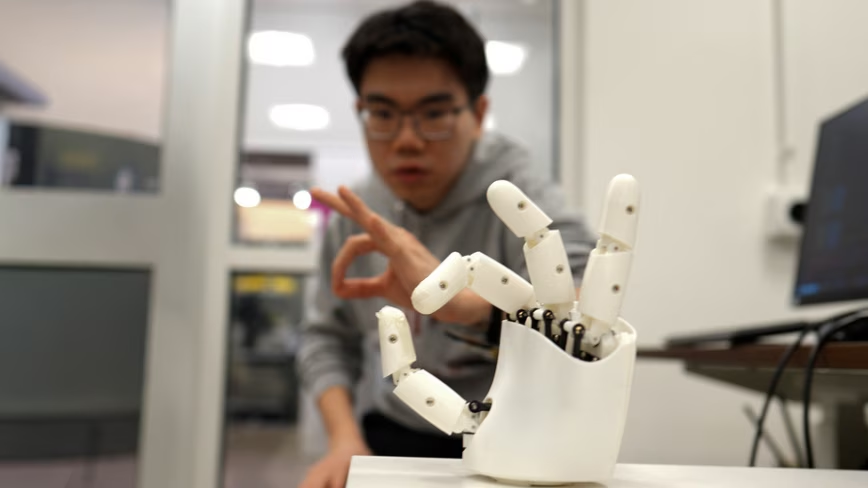
Engineers at MIT have built an ultrasound wristband that can track 22 degrees of freedom in the human hand and use that data to control a robotic hand in real time, according to research published in Nature Electronics in March 2026. The device uses a ring of small ultrasound transducers worn around the wrist to monitor the movement of tendons and muscles in the forearm, translating subtle shifts into a complete picture of finger and thumb position. In tests with eight volunteers, the system achieved continuous tracking with approximately 120-millisecond latency, fast enough to mirror a human hand’s movements on a robotic counterpart with what the researchers describe as near-natural responsiveness.
The research was led by Xuanhe Zhao, a professor of mechanical engineering at MIT, with co-authors including Gengxi Lu, Xiaoyu Chen, Shucong Li, Bolei Deng, SeongHyeon Kim, Dian Li, Shu Wang, Runze Li, and Anantha Chandrakasan, MIT’s dean of engineering. The team demonstrated the wristband’s precision by having all eight participants perform the full American Sign Language alphabet, successfully recognising all 26 letters. The device operates wirelessly and does not require cameras, gloves, or any sensors attached to the fingers themselves.
Existing hand-tracking systems typically rely on cameras, which fail when fingers are occluded, or instrumented gloves, which restrict natural movement and are impractical for extended wear. The MIT approach works by reading the body’s own mechanics from the outside. When a finger moves, the tendons and muscles in the forearm shift in patterns that are specific to each movement.
The ultrasound transducers detect those shifts and a machine learning model maps them to the 22 degrees of freedom that define hand posture, covering individual joint angles across all five fingers and the thumb’s opposition. No cameras or finger-mounted sensors are involved. The entire system sits on the wrist.
The 120-millisecond latency figure is significant because it falls within the range that humans perceive as responsive in manual control tasks. The team demonstrated this by having participants control a dexterous robotic hand through the wristband, performing grasping and manipulation tasks. The robotic hand mirrored the operator’s movements closely enough that the researchers describe the interaction as suitable for teleoperation applications, where a human operator controls a remote robot to perform tasks in environments that are dangerous, sterile, or otherwise inaccessible.
The implications extend well beyond laboratory teleoperation. Dexterous hand control remains one of the most persistent unsolved problems in humanoid robotics, where even well-funded companies producing thousands of units struggle with fine manipulation. A wristband that lets a human operator lend their dexterity to a robot hand in real time could serve as a bridge technology, enabling robots to perform complex manual tasks under human guidance while autonomous manipulation capabilities continue to develop.
The research was funded by the National Institutes of Health, the National Science Foundation, the Department of Defense, and the Singapore National Research Foundation. The funding mix reflects interest from both medical and defence communities, where remote dexterous manipulation has obvious applications in surgery, bomb disposal, and handling hazardous materials. The paper does not describe a commercial product or announce a startup, and the device as published is a research prototype.
It is worth noting that the Nature Electronics paper was published in March 2026, making the underlying research roughly three months old at the time of wider media coverage. The AP wire story that brought broader attention to the work is a delayed feature, not a report on a new announcement. The core findings have been in the public record since March.
As major companies like Nvidia and Hyundai race to industrialise robotics and bring humanoid machines to factory floors, the question of how humans will interact with and control those machines remains largely unanswered. MIT’s wristband suggests that the interface might not be a screen or a joystick but the operator’s own hand, read through the skin.
Whether the device moves from a research lab to a product depends on challenges the paper does not address, including manufacturing cost, durability, and whether the machine learning model generalises across a wide population of hand anatomies without per-user calibration. The eight-volunteer study is a proof of concept, not a clinical trial. But as a demonstration of what is physically possible, a wearable that turns any human hand into a robot controller without touching the hand itself is a meaningful step toward making teleoperation practical outside specialised laboratories.
Get the most important tech news in your inbox each week.


