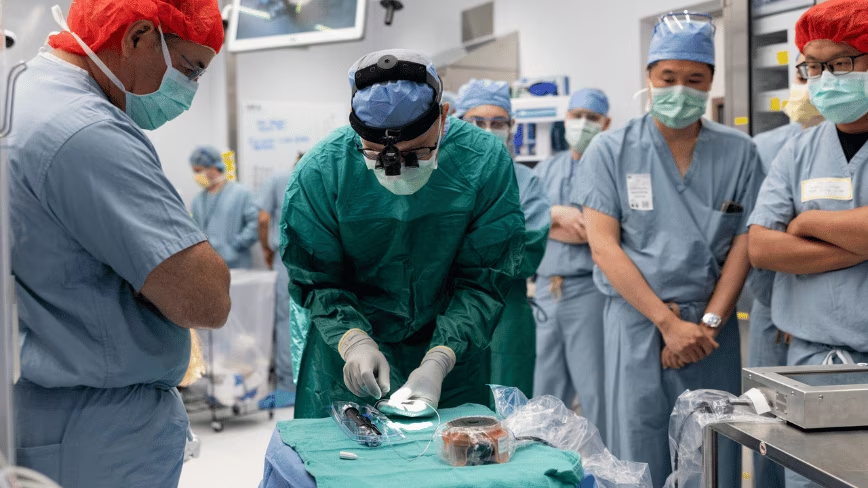
 Credit: Paradromics
Neuralink has dominated the brain-chip story for two years. It now has a serious challenger with a patient of its own.
Paradromics, an Austin neurotech firm, has implanted its Connexus brain-computer interface in the first participant of its FDA-approved clinical study, the company said. The patient, a Michigan woman who has lost the ability to speak clearly due to motor neuron disease, was operated on at University of Michigan Health and will be followed for six years.
“For people living with severe motor impairment, the ability to communicate is central to agency, identity, and connection,” said founder and chief executive Matt Angle.
How a speech chip actually works
Connexus does not repair the body. The patient attempts to speak, the implant records the neural activity behind that attempt, and software translates it into text or synthesised speech on a computer.
The hardware is striking: a dime-sized device that sits on the surface of the brain with 421 platinum-iridium microwires, each thinner than half a human hair, feeding into a transceiver implanted in the chest that beams data wirelessly through the skin.
Paradromics claims an industry-leading data rate, the measure of how much it can pull from the brain per second.
This is the company’s first chronic implant, the kind meant to stay in. It builds on a brief test in 2025, when the device was placed and removed during another patient’s surgery just to prove it could safely record.
The race it is running, against the kind of speech-decoding work already restoring voices in research settings, also includes Neuralink, Synchron and Precision Neuroscience.
The part to watch
The caveats matter. This is one early-feasibility patient, the device has not yet been shown working, and meaningful results will come over months and years, not days.
There is also the bigger question Paradromics raises itself. Its stated roadmap goes well beyond medicine, to “direct AI interaction”, advanced prosthetics and “human enhancement”. Angle argues that building devices able to enhance people “doesn’t have to be ethically fraught” but “has to be addressed”.
For now, though, the goal is narrower and more human: helping someone who cannot speak say what she means.
Get the TNW newsletter
Get the most important tech news in your inbox each week.


