TL;DR
BMW cut its car division’s expected operating margin to 1-3 per cent, down from 4-6 per cent, citing an accelerating decline in China and Middle East fallout. The warning highlights a two-front squeeze as Chinese carmakers erode European automakers’ profits in China while gaining nearly 10 per cent market share in Europe.
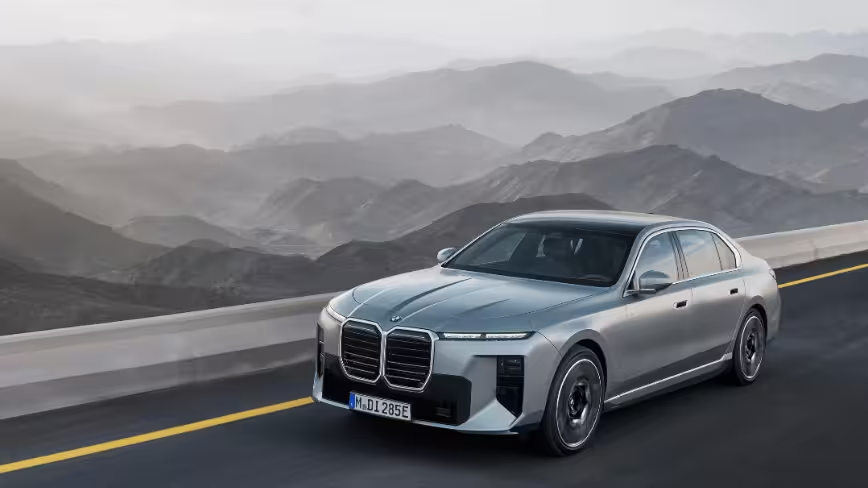
BMW on Tuesday cut its full-year profit forecast for the car business, lowering its expected automotive EBIT margin to a corridor of 1 to 3 per cent from prior guidance of 4 to 6 per cent. The company blamed an accelerating decline in the Chinese market and the widening economic fallout from the conflict in the Middle East.
BMW’s stock fell to its lowest level since 2020 on the news. Deliveries in China dropped 17.6 per cent in the first five months of the year as domestic brands including BYD, Xiaomi, and NIO undercut European premium pricing with comparable technology.
The vanishing China profit pool
BMW is not alone. European automakers have been progressively squeezed out of the Chinese market, where cheaper, domestically produced electric vehicles have gained share at the expense of the premium combustion-engined cars in which companies like BMW, Mercedes-Benz, and Volkswagen specialise.
Porsche, which has retreated from its all-electric strategy after a 93 per cent decline in operating profit last year, saw its China deliveries fall from 93,300 units in 2022 to roughly 41,900 in 2025. Citigroup analysts have noted that in peak years, the Chinese profit pool accounted for about half of the operating profit at both BMW and Mercedes-Benz.
Volkswagen’s operating profit from its Chinese joint ventures almost halved last year to €958 million, and the company has guided for just €200 million to €600 million from those ventures in 2026. The Chinese market itself is now shrinking as the economy sputters and subsidies are phased out, leaving domestic manufacturers with enormous spare capacity to export.
The European front
That spare capacity is landing in Europe. Chinese manufacturers have grown their market share on the continent from virtually nothing in 2021 to just under 10 per cent, according to industry data, and are approaching 16 per cent of the EV and plug-in hybrid segment.
Geely has already stopped building new factories and begun using Volvo’s European plants instead, a strategy that sidesteps EU tariffs while preserving Chinese cost advantages. BYD has begun trial production at a new facility in Hungary, with full-scale output expected this year.
European carmakers’ sales have revived modestly this year, helped by a slew of new lower-priced models and an EV sales surge driven by oil prices above $100 a barrel. But Europe is not a growth market, and aggressive new entrants cannot gain ground without shrinking incumbents’ sales.
The industry uses only about 70 per cent of its production capacity, according to S&P Global. That means it already bears outsized fixed costs relative to its revenue, and every additional shock, from US tariffs to disruption in the Middle East, hits margins disproportionately hard.
Some European carmakers are pivoting to defence contracts as EV demand fluctuates and military budgets soar. But those revenues remain a fraction of what the car business generates.
Protection and partnership
Brussels is responding with industrial policy. The EU’s proposed Industrial Accelerator Act would attach local content requirements to public procurement and subsidies, restricting access to vehicles assembled within the bloc with at least 70 per cent of non-battery components sourced from Europe.
At the same time, some European carmakers have started co-operating with their Chinese rivals rather than trying to outcompete them on cost. Stellantis and Dongfeng announced plans in May for a 51/49 European joint venture that could see Dongfeng’s electric vehicles built at Stellantis’s Rennes plant in France.
The logic is pragmatic. China’s manufacturing advantage is structural, not merely a product of subsidies, with BYD controlling its own battery supply chain, manufacturing its own semiconductors, and operating at volumes no European competitor approaches.
BMW’s profit warning is the latest confirmation that Europe’s auto industry faces a problem tariffs alone cannot solve. Chinese competition is eroding margins in China and gaining ground in Europe simultaneously, and the gap between what European carmakers charge and what Chinese rivals can deliver keeps widening.


 Credit: BMW