TL;DR
Four European automakers announced defence partnerships in one week. Ineos, Daimler, Mercedes, and Renault are retooling for military vehicles as EV demand fades.
Ineos, Daimler Truck, Mercedes-Benz, and Renault have all announced military vehicle partnerships in the past week. The skills transfer from factory to battlefield.
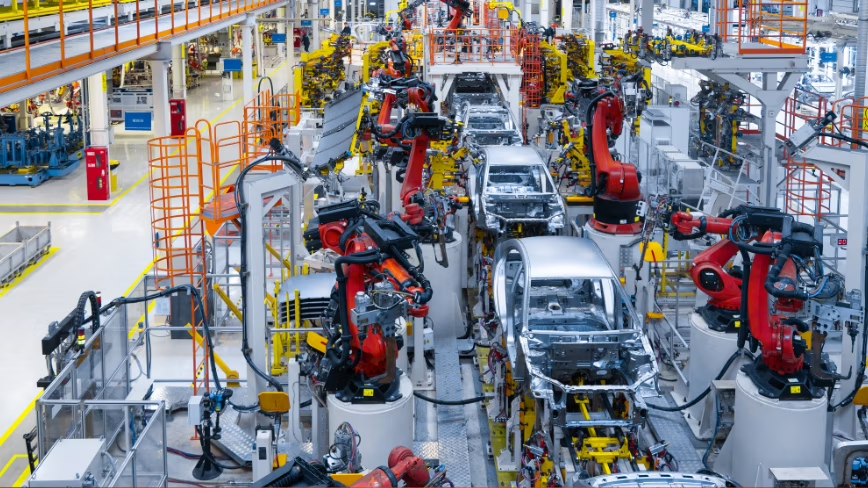
Car-factory
 Credit: Canva
Four European automakers announced defence partnerships in one week. Ineos, Daimler, Mercedes, and Renault are retooling for military vehicles as EV demand fades.
Four European automakers announced military vehicle partnerships in the past week. Ineos is bidding for a UK Ministry of Defence contract. Daimler Truck launched a dedicated defence brand. Renault partnered with Thales for armoured vehicles. Mercedes-Benz teamed up with a German startup to build anti-drone platforms. The European car industry is retooling for rearmament.
Ineos Automotive said on Tuesday it has formed “Team Grenadier,” a consortium with armoured vehicle producers SMT Defence and NMS UK, to submit its 4×4 Grenadier for the MoD’s Light Mobility Vehicle tender. The Grenadier’s four-wheel drive, beam axles, and high payload capacity make it a platform for military adaptation across multiple roles.
On Monday, Daimler Truck created Daimler Truck Defence, backed by several hundred million euros in investment. CEO Karin Radstrom called defence a “key pillar” of the company’s growth strategy. The unit already has orders for 1,500 trucks from the Canadian military and 7,000 from France, and aims for EUR 1 billion in revenue by 2028. Approximately 1,000 employees work in the defence business, with plans to hire more.
Renault partnered with French defence contractor Thales to produce a new armoured vehicle for reconnaissance, troop coordination, and UAV deployment. Mercedes-Benz teamed up with German startup Tytan Technologies to build drone-defence vehicles based on the G-Class and Sprinter, focused on protecting people and critical infrastructure.
The pivot makes economic sense. The European car industry is in a structural crisis. EV demand is slowing. Chinese competitors are eroding market share. Borrowing costs are high. Defence spending, by contrast, is surging across Europe after Russia’s full-scale invasion of Ukraine in 2022. NATO allies also face White House pressure to become more self-sufficient in defence production.
The transition works because the skills transfer. Manufacturing processes, supply chain management, and engineering capabilities developed for cars apply directly to military vehicles. Daimler expects its defence growth to create “additional demand for highly qualified specialists,” not redundancies. For an industry laying off workers elsewhere, defence offers a way to keep factories running and people employed.
The broader pattern is European industry repositioning around sovereignty and security. Chip companies are building fabs in Europe. Robotics startups are raising defence-focused rounds. Now automakers are following. The car industry’s crisis is not just about EVs or China. It is about what European manufacturing is for in a world where security spending is the growth market and consumer demand is not.
Get the most important tech news in your inbox each week.


