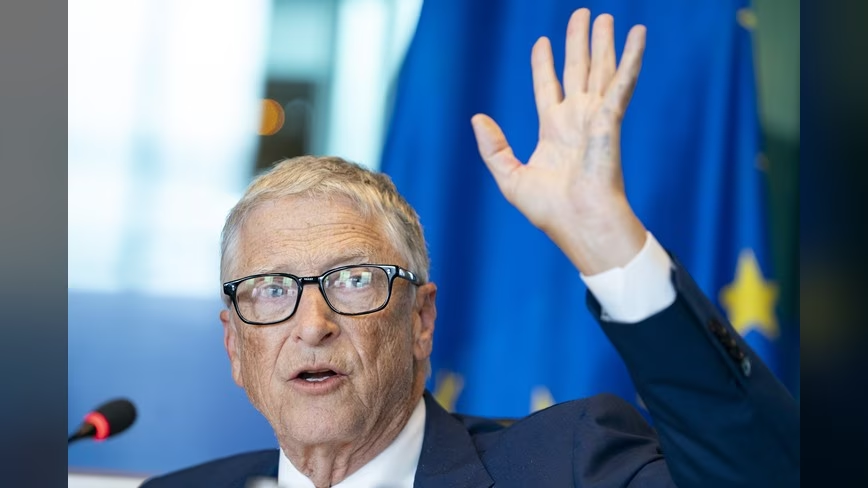
Bill Gates at a European Parliament Committee on Development meeting in Brussels, 24 June 2025

Bill Gates says AI crossed two danger thresholds early this year: it can now help a bioterrorist, and it can power a crippling cyberattack. He made the case on The Ezra Klein Show, in an interview published by The New York Times on Tuesday.
“We crossed the cyber threshold and we crossed the bio threshold early this year,” Gates told Klein.
On cyber, he pointed to models that find security bugs in code humans had checked for more than 20 years. He named the releases that led up to Anthropic’s Mythos. On bio, he said the power to design a new pathogen used to belong only to nation states. Now small groups using the latest AI tools have it, he said.
‘The most dangerous thing’
Klein put to Gates the view that product liability and companies’ own interests are enough to keep AI safe. Klein said it was the governing view in Washington. It is the view of President Trump and adviser David Sacks, he said, and to a degree of Nvidia’s Jensen Huang.
“Well, I almost can’t believe you’re asking that. This is the most dangerous thing that humans have ever gone near,” Gates said.
He compared AI with drugs, aircraft and cars, which all face safety rules rather than lawsuits alone. He added that anyone can take an open-source model and switch off its monitoring.
“You can’t rely on the industry to self-regulate here. I mean, it’s just insane,” he said.
A layer of safeguards
Gates called for a supervisory layer of safeguards and monitoring in all AI models. Its job would be to stop people using today’s systems to shut down economies or kill millions. Open-source models could stay free and customisable, he said. But they would have to run on platforms where governments can check the safeguards are still there.
He also said Anthropic had set the filters on Mythos and Fable too high. Users asking about cancer end up pushed down to its smaller models, he said.
Jobs and a payroll tax for robots
AI has so far created more jobs than it has destroyed, Gates said. But coding is the only profession where AI has clearly passed humans on reliability, in his view. He expects accounting, legal work, telesales and customer support to follow within a few years.
He wants companies to pay the same payroll tax on an AI or a robot as on the worker it replaces. He has also proposed “Human Reserved” jobs, such as child care and elder care, kept for people.
The Gates Foundation sets how it spends $10bn next year at strategy reviews in October. This year ChatGPT, Claude and Copilot will sit in on some of them, he said. Last week, Gates warned on NBC’s Meet the Press that AI could cause a billion deaths.
Get the TNW newsletter
Get the most important tech news in your inbox each week.


