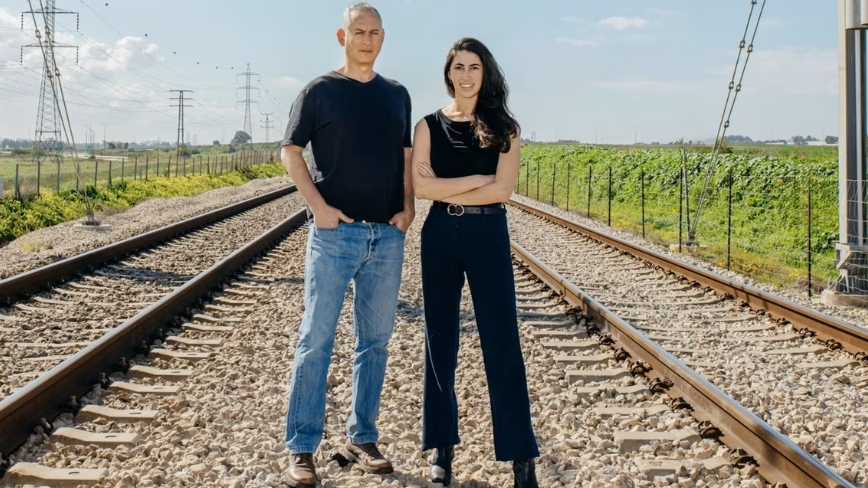
 Credit: Voltify
Freight rail is often described as the most energy-efficient way to move goods over land, yet it still runs on one of the dirtiest inputs in modern infrastructure: diesel. As rail operators face mounting pressure from volatile fuel costs, tightening emissions rules, and aging locomotive fleets, the question is no longer whether rail should decarbonize, but how.
One company argues the industry has been approaching the problem from the wrong direction. Voltify, co-founded by Daphna Langer, is pursuing a model that aims to leapfrog conventional electrification strategies, seeking to electrify freight rail without rebuilding the entire network or sacrificing operational range.
The Electrification Trap
On paper, the logic of electrifying rail is straightforward. Replace diesel locomotives with electric ones and connect them to clean power. In practice, freight rail in the United States spans roughly 140,000 miles of privately owned track, making full overhead electrification via catenary wire prohibitively expensive. This approach works for dense passenger corridors but collapses under the scale and fragmentation of freight networks.
The alternative use of battery-electric locomotives appears simpler but introduces a different constraint: energy density. Batteries store less energy per kilogram by over ten times than diesel fuel, which means a fully battery-dependent locomotive quickly runs into range limitations unless it is frequently recharged. That leads to an operational bottleneck: either stop often or carry too much battery weight to remain economically viable.
The industry, in other words, is stuck between two imperfect extremes: “wire everything” or “charge at a depot for hours.”
Leapfrogging Conventional Electrification
Voltify’s premise is that freight rail doesn’t need to choose between full network electrification and battery-only locomotives. Instead, it rethinks where electrification is actually needed, combining battery-electric locomotives with strategically placed charging infrastructure that powers trains while they’re in motion.
The key idea is scale compression. Rather than electrifying the entire rail network, Voltify’s model electrifies roughly a fraction of the track using high-power charging segments that can deliver energy while trains are in motion. The remaining route is covered by onboard battery storage. Static charging at depots complements this dynamic charging system, allowing locomotives to top up during natural breaks in operations.
This approach reframes electrification not as an all-or-nothing infrastructure overhaul, but as a selective augmentation of the highest-value segments of the rail network.
A Three-Pillar System
Voltify’s architecture is built around three tightly integrated layers: locomotives, charging infrastructure, and energy systems.
The first pillar is the locomotive itself. Rather than designing entirely new locomotives, Voltify retrofits existing diesel units into battery-electric locomotives. This approach reduces capital expenditure and leverages the rail industry’s existing asset base.
The second pillar is charging infrastructure. Voltify uses an overhead conductor bar and pantograph system capable of both static and dynamic charging, supported by an unmanned architecture designed for rail environments. A manual charger complements this system for depot-based energy replenishment. The goal is not continuous electrification but targeted, high-throughput energy transfer where trains naturally pass or pause.
The third pillar is power and optimization. Voltify integrates solar generation, grid power, and battery storage into localized microgrids. These are managed by proprietary software that dynamically decides when to buy, store, or dispatch electricity based on cost and demand conditions.
Together, these layers form a system designed not just for electrification, but for energy orchestration.
Where the Business Case Actually Works
While the decarbonization narrative is compelling, Voltify’s real traction point is economic.
Diesel is one of the largest and most volatile operating expenses for rail operators. Voltify argues that its system can reduce energy costs by up to 30%, reframing electrification as an operating margin improvement rather than only a sustainability initiative. For Class I railroads, where fuel is among the largest operating expenses, the opportunity to reduce energy costs without rebuilding the network is a compelling financial proposition.
Another driver is regulatory pressure tied to local air quality. Although freight rail contributes a relatively small share of global CO2 emissions, locomotives emit nitrogen oxides and diesel particulate matter that concentrate heavily in rail yards and port-adjacent communities. These facilities often sit next to densely populated, lower-income neighborhoods, making emissions a localized health burden rather than a diffuse global one.
The Concentration Problem
The critical nuance in rail emissions is not their total size, but their geography.
Rail yards operate around the clock, with switcher locomotives idling and maneuvering in fixed locations often adjacent to residential neighborhoods. This creates concentrated exposure to pollutants such as NOx and soot. Research on rail-related pollution has linked it to substantial public health costs nationwide, including thousands of premature deaths annually and tens of billions of dollars in health damages.
In California, studies of major rail yards have identified elevated cancer and asthma risk zones extending beyond facility boundaries, disproportionately affecting lower-income and minority communities. Compounding the issue, locomotive fleets are slow to modernize, with engines often remaining in service for nearly three decades under grandfathered emissions standards.
Beyond Carbon: A System Redesign
The result is a more complex reality than a simple climate narrative suggests. Rail emissions are significant in localized health outcomes. The problem is simultaneously technical, economic, and justice-oriented (environmental and economic).
Voltify’s approach sits at that intersection. By avoiding full-network electrification while still achieving meaningful decarbonization and cost reductions, it seeks to unlock a leapfrog path that traditional models have overlooked. Whether that model scales will depend not only on engineering execution, but on whether rail operators are ready to rethink electrification as a distributed system rather than a binary choice.
Get the TNW newsletter
Get the most important tech news in your inbox each week.
Contributed article. Not produced by the TNW newsroom and does not reflect the editorial stance of TNW.


