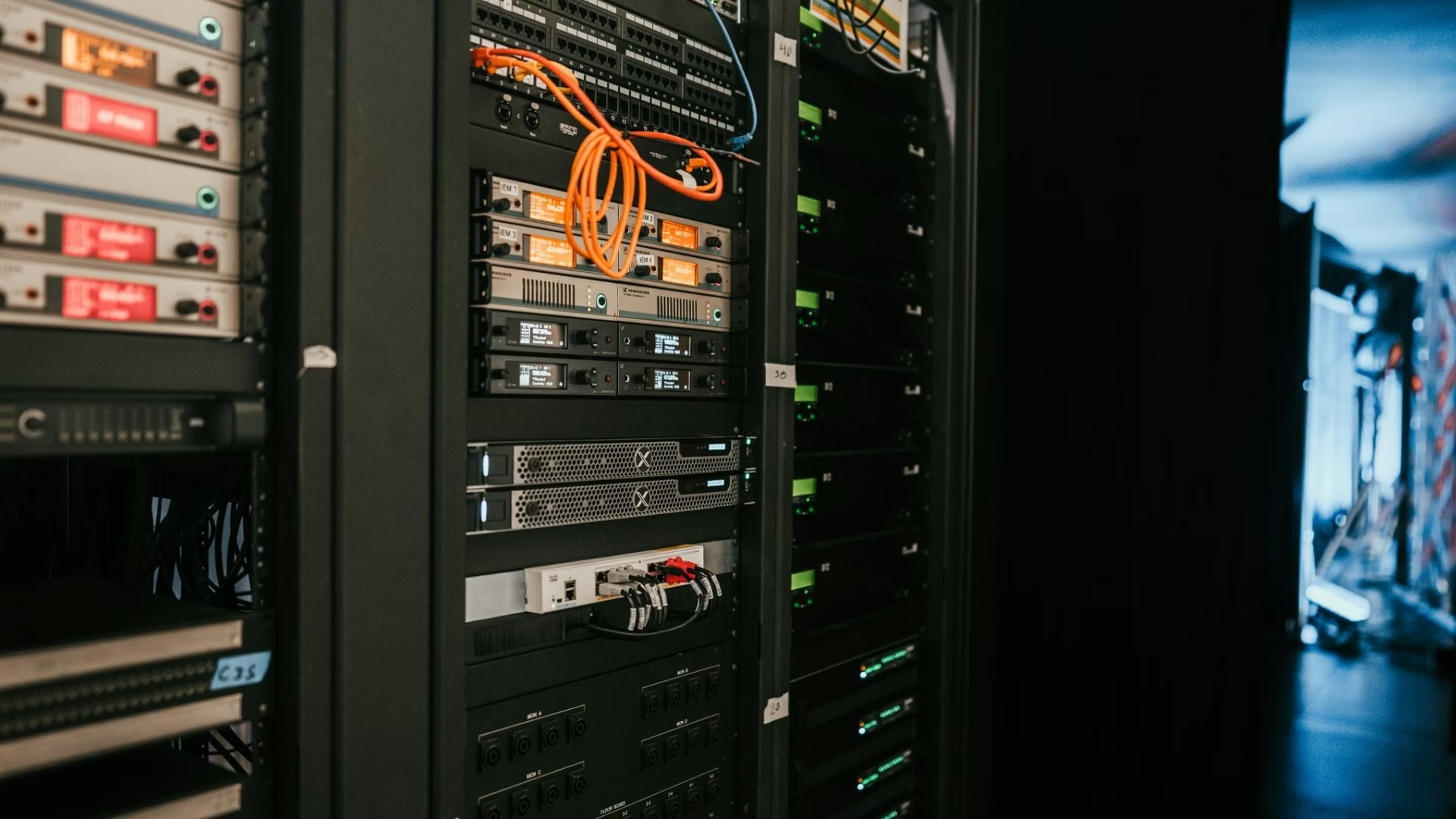
 Credit: Kevin Ache on Unsplash
Governments, households and businesses have a stake in how electricity networks accommodate the next wave of industrial growth. When someone proposes a major data centre development, the question extends beyond whether it can secure a connection to the grid. It also includes the additional cost of accommodating the connection. And it includes the need for generation capacity to supply it.
This raises the uncomfortable question of who pays for the supporting infrastructure. It also raises the question of what other opportunities that power system investment may serve beyond data centre load. Europe should apply that scrutiny to the expansion of artificial intelligence.
The potential scale warrants attention. In its 2025 base case, the International Energy Agency projected that global data center electricity consumption would reach around 945 terawatt-hours by 2030. That is more than twice its 2024 level. That forecast covers data centers broadly, not AI alone. The agency also noted that their concentration in particular locations can complicate grid integration. This only exacerbates the question of how to allocate costs to businesses and households.
I believe Europe should resist treating data centres and AI power demand as an automatic priority. An MIT study found that 95% of companies’ generative AI pilots had produced no measurable return. Further, the economics of AI data centres have not been shown to be profitable.
Data centers and AI developers seeking scarce grid capacity should demonstrate credible demand and accept the costs they create. They should also explain the public benefits when requesting regulatory and government approvals. The promise of future innovation deserves consideration. But such promise must be demonstrated and not assumed to be automatic.
Testing demand before building for it
The United States offers a useful lesson in testing whether proposed electricity demand reflects projects that developers are prepared to finance. In a 2026 update, AEP Ohio reported that an initial pool of roughly 30 gigawatts of data center requests narrowed to about 13 gigawatts. That happened after customers had to request and pay for engineering studies. Binding agreements subsequently covered approximately 5.6 gigawatts from that pool. Those figures excluded contracts signed before the new tariff.
The AEP Ohio evidence illustrates why expressions of interest should require financial backing and posting of credit. They should do so before they become the basis for expensive infrastructure decisions. A forecast becomes more useful when the party submitting it accepts meaningful financial responsibility.
The utility’s data center tariff provides a practical example. It requires posting of meaningful credit upfront and payment for study fees for qualifying projects. It also requires agreements obligating customers to reimburse buildout costs if they cancel or substantially delay before the planned service date. Europe need not copy that framework wholesale to adopt its underlying economic principle.
The opportunity cost
For me, the broader concern is the opportunity cost of using scarce power system infrastructure for activities that have not shown business value or profitability. Europe is facing a generational challenge regarding industry capacity and regional security.
Manufacturing, domestic production of energy equipment, and defense production can increase employment across Europe. They must not be sacrificed for AI data centre usage that has not been shown to provide commensurate value.
From a European grid operator and a government policy perspective, I would judge competing proposals by their credible contribution to employment, productive capacity, and energy security. I would weigh that alongside their infrastructure requirements.
This is not to say that bringing cloud services and some data centre services to Europe is not essential. For example, there is a movement to bring data centre and cloud services under European control, reducing political uncertainty and dependence on US-based providers. A responsible assessment would recognize those benefits. It would also distinguish a developer’s commercial expectations from benefits that justify public assistance or preferential access.
Timing matters
Building more power generation supply can help. But timing matters. The IEA notes that data centers can become operational in two to three years. The energy infrastructure supporting them generally requires longer development periods. Currently, the wait time for new natural gas turbines is as long as five years. The wait time for step-up transformers is as much as three years.
Shorter lead time resources such as solar and battery energy storage take less time. But they cannot solve all of the problems of growing loads at this time. Promising future power generation build out therefore does not, by itself, solve the constraints of additional resources in the near term.
What regulators should require
I would ask regulators and government policy makers to require credible development milestones and financial commitments. They should do so before incorporating large proposed loads into infrastructure plans. Developers should pay the grid upgrade costs attributable to their projects. Where immediate firm service is unavailable, contracts should clearly establish whether, when, and how their electricity use can be reduced during periods of system stress.
Local approval should also examine water requirements and the ability to meet them without undermining existing community needs. That matters especially considering the recent drought conditions that Europe has experienced. Where governments offer subsidies or other advantages, they should publish the expected public benefits and the conditions attached. Such scrutiny could help viable projects proceed on terms that communities can understand and support.
Without these safeguards, customers could face costs associated with infrastructure built around demand that never materializes. Further, Europe would be giving up on needed manufacturing to support energy infrastructure build out and national/regional security needs. It would do so for the sake of data centres and AI that have not brought the value promised.
With such safeguards, planners would have firmer commitments on which to base investment. Developers would know their obligations before proceeding. That is a more defensible foundation for growth than treating every announced project as an urgent national necessity.
European policymakers should make those requirements part of connection rules and public funding decisions now. AI should earn its place in the energy system through credible commitments and demonstrable value. The strength of the promise should be matched by the willingness to pay for it.
Get the TNW newsletter
Get the most important tech news in your inbox each week.


