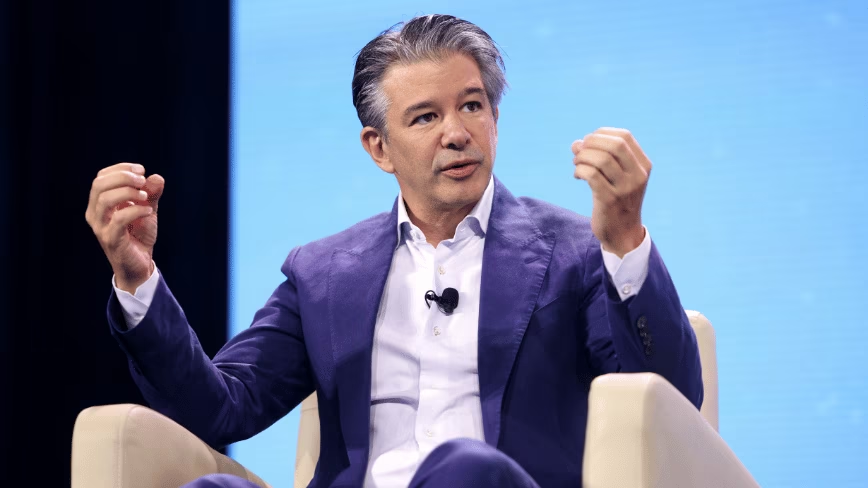
Travis Kalanick, who founded Atoms after leaving Uber, speaking at the Chapter Leadership Summit in National Harbor, Maryland, in July 2026 – Cropped. Via Wikimedia Commons.

Uber has put $100m into a company that just hired Anthony Levandowski. His theft of Google’s self-driving secrets cost Uber a fortune, and it helped end Travis Kalanick’s time as chief executive.
The company is Atoms, Kalanick’s new venture. Rafe Rosner-Uddin reported the arrangement for the Financial Times on Sunday. He cited people familiar with the plans, plus interviews with current and former Atoms and Uber staff.
Those sources say Atoms is developing robotaxi technology and that Levandowski is leading the work. They also say the company has held preliminary talks with Uber about running it on Uber’s network. Uber declined to comment.
Atoms says it is doing no such thing
The company gave the FT a flat denial. Atoms described itself as “an industrial software company” and said it has “no plans to enter the saturated robotaxi market”.
It added that Uber is a partner and may use Atoms technology for its ridesharing business if that proves helpful. That is a narrower claim than the denial preceding it, and the two sit oddly together.
Print both versions and let them stand. Sourced reporting says one thing, the company says another, and nothing published so far settles it.
What the FT says Uber paid for
Levandowski co-founded Waymo and ran Uber’s self-driving programme. Google sued over trade secrets he took from its self-driving unit. The FT puts Uber’s cost of that litigation at close to $350m. It says the affair contributed to Kalanick’s removal.
The chain is worth stating slowly. An engineer took files from Google, joined Uber, and triggered a lawsuit that helped remove Uber’s founder. Nine years on, Uber is a shareholder in the company that employs him, run by the founder it removed.
Levandowski was convicted and faced 18 months in prison. Donald Trump pardoned him in 2021.
Atoms acquired his startup Pronto, an automation company working in heavy industry and mining, in March. That is how he arrived. It is also the tidiest illustration of what the company says it is, because Pronto automates mining equipment rather than taxis.
The rest of the roster came from Uber too
Kalanick has been rebuilding his old bench. Gautam Gupta, Uber’s former finance chief, is Atoms’ CFO, as we reported last month.
Eric Meyhofer, who took over Uber’s robotaxi development after Levandowski left, now runs Lab37, the arm automating commercial kitchens. The FT says he has hired several dozen former Uber staff and recruited from Zoox, Tesla and Waymo.
Atoms has more than 2,000 employees across its various arms. Most sit in the food division, with a growing number on autonomous vehicles.
The model the FT describes matches Wayve and Nuro: build the software for robotaxis, leave the vehicles to somebody else.
The money was never a secret
Atoms lists Uber among its equity partners on its own investor page. So are a16z, Bain Capital Ventures, Fifth Wall and SV Angel. Five banks appear as debt partners, including JPMorgan and Goldman Sachs.
What the FT adds is the figure. We reported in July that Uber chipped into the $1.7bn round led by Andreessen Horowitz. The amount is $100m.
Ben Horowitz joined the board and told an a16z event it was “certainly the biggest cheque I’ve ever written”. Saudi Arabia’s Public Investment Fund is also among the backers, according to people familiar with the matter.
Uber is spending in two directions
The timing sharpens the story. Uber cut about 3,300 jobs on 2 September, roughly a tenth of its workforce. It also pulled out of Nigeria and Uganda.
It is simultaneously funding several routes to the same technology. It launched London’s first robotaxi service with Wayve last week, though not by the legal route Britain built for it. It agreed in August to put more than 2,000 Pony.ai robotaxis on European streets.
The Pony.ai connection runs deeper than the deal. Dara Khosrowshahi and Kalanick stay in regular contact, the FT reports. The two appeared together at a US-Saudi business summit in Riyadh in May 2025, while discussing a deal involving Pony.ai’s American arm. Those talks fizzled.
Silicon Valley changed its mind about him
Kalanick left the chief executive role in 2017. Behind it were allegations of managerial dysfunction, claims that the company ignored sexual harassment and discrimination, regulatory investigations in several markets, and the Google lawsuit. He left the board in 2019.
He now speaks at a16z events. Horowitz told one of them that his favourite thing about Uber’s guiding principles was meritocracy and toe-stepping. That, he said, was the part diluted when Kalanick left.
David Erickson of Columbia Business School gave the FT the market’s view. Around ten people have created as much private value as Kalanick, he said, and certain entrepreneurs will always be acceptable to investors.
One investor put it more carefully, telling the FT that they were aware of his background and that views differ on whether he should have gone.
He titled the letter himself
Kalanick told the a16z audience that things which would have happened at Uber over time are things he is doing now. He also said that when you fall in love again, you do not think about the ex very much.
Atoms declined to put a robotaxi in that description. Uber, which has spent this year backing Wayve in London and Pony.ai in Europe, has not said what its $100m buys.
The essay announcing the a16z round is called Unfinished Business. It describes a sixteen-year project to digitise the physical world, running from Uber through CloudKitchens to Atoms, and closes by saying it is time to close the loop.
The letter is about industrial AI, mining and construction. It does not mention robotaxis once.
Get the TNW newsletter
Get the most important tech news in your inbox each week.
Also tagged with


