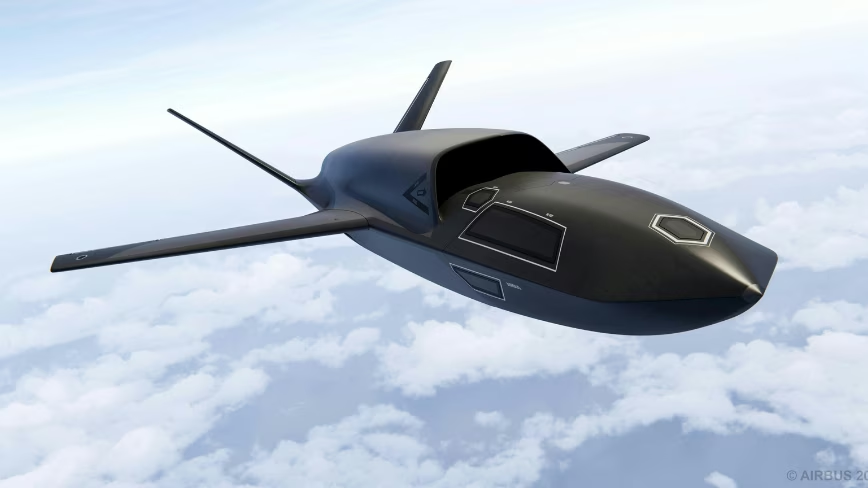
The aircraft drawing crowds at last week’s Berlin airshow was not the one with a pilot in it. The “loyal wingman,” an uncrewed jet built to fly beside a manned fighter and carry the extra sensors, jammers, and weapons the fighter cannot, has become Europe’s defence obsession, and four companies turned up to sell it.
Airbus, Boeing, Helsing, and General Atomics each brought a version of the same idea to Germany’s military and the watching procurement officials of its neighbours.
The premise is consistent across all of them: pair a small number of expensive crewed jets with a larger number of cheaper autonomous aircraft, let the drones absorb the risk on air-to-air, air-to-ground, and electronic-warfare missions, and multiply what a single pilot can do.
The war in Ukraine, where drones and electronic warfare have reshaped the battlefield faster than any doctrine anticipated, is the argument behind the whole category.
Airbus made the loudest entrance, unveiling its U760 Ravenstorm, an uncrewed collaborative combat aircraft designed to operate alongside crewed fighters such as the Eurofighter Typhoon.
The European group is, in effect, running two programmes at once: a near-term option called the U740 Valkyrie, a version of the American XQ-58A intended to reach German service by 2029, and the more ambitious Ravenstorm as the long-term play, expected in the early 2030s.
That split, fast-and-borrowed now, sovereign-and-advanced later, captures the bind Europe is in. The continent wants its own frontier defence technology, and it wants capability in the field before the decade is out, and those two goals do not run on the same timetable. The result is a market crowded with competing designs at competing stages of maturity.
The most striking entrant is the one without an aircraft heritage at all. Helsing, the Munich software firm, has ridden the rearmament wave to become one of Europe’s five most valuable private tech companies, valued at around €12bn, on the argument that the decisive component of a modern combat aircraft is its software rather than its airframe.
Helsing has already paired with Mistral to build a European defence-AI alliance, and its presence in Berlin put a software company on the same floor as the airframers it intends to outpace.
The incumbents are not standing still. Boeing has been upgrading its Ghost Bat drone to compete in Germany specifically against the newcomers, and General Atomics, which builds the Predator lineage, is adapting an American loyal-wingman prototype for European requirements. The competition is the point. Berlin and its neighbours would rather have several suppliers bidding than one with pricing power.
None of the aircraft is in frontline service yet. The Valkyrie carries a 2029 target, the Ravenstorm an early-2030s one, and most rival programmes sit somewhere on that same horizon. What Berlin showed was less a fleet than a field of contenders, and a Europe that has decided, after Ukraine, that it cannot afford to buy this category from abroad.
Get the TNW newsletter
Get the most important tech news in your inbox each week.


