TL;DR
Boeing upgraded the MQ-28 Ghost Bat with internal weapons and longer range, unveiled at ILA Berlin. It is competing with Helsing’s CA-1 Europa for German combat drone orders.
The MQ-28 can now carry four bombs or two air-to-air missiles internally. Rheinmetall’s CEO expects final contract talks with Berlin next year.
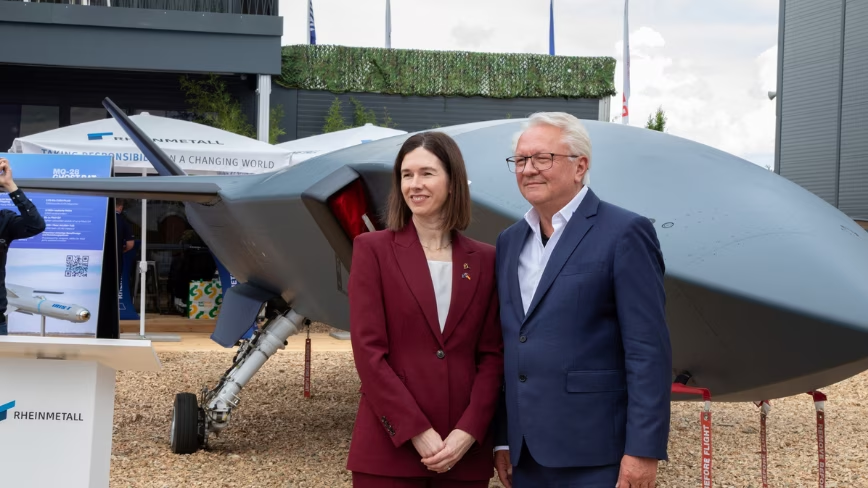
 Credit: Boeing
Boeing upgraded the MQ-28 Ghost Bat with internal weapons and longer range, unveiled at ILA Berlin. It is competing with Helsing’s CA-1 Europa for German combat drone orders.TL;DR
Boeing unveiled an upgraded version of its MQ-28 Ghost Bat uncrewed combat aircraft at the ILA Berlin air show on Wednesday, adding an internal weapons bay, a 25% larger wing, and 2,000 pounds of additional payload capacity. The upgrades are designed to give Boeing the edge over Helsing, the German AI defence startup whose CA-1 Europa autonomous drone is competing for the same German military contract.
The internal weapons bay can fit four Small Diameter Bombs or two Raytheon AMRAAM air-to-air missiles, according to Glen Ferguson, director of the Ghost Bat’s global programme at Boeing. The expanded wing area extends range and fuel capacity significantly beyond the original design.
Boeing is working with Rheinmetall as the lead systems integration partner for the German version of the MQ-28. Two more German partners were announced on Wednesday: Diehl Defence, which will integrate German air-to-ground weapons and guided missiles into the aircraft, and Rohde & Schwarz, which will contribute its NEMACS broadband communications system for combat cloud connectivity.
“We’re bringing together the best of Australian and German innovation to be able to deliver the MQ-28 to the Luftwaffe by 2029,” said Amy List, Boeing Defence Australia’s vice president. Rheinmetall CEO Armin Papperger said final contract talks with Berlin need to begin next year to meet that deadline.
Germany may also award Helsing a contract for its CA-1 Europa, an autonomous combat drone in the three-to-five-tonne class, to keep multiple options open. Helsing is valued at approximately €18 billion after a recent $1.2 billion raise led by Dragoneer, making it one of Europe’s most valuable tech firms.
The Bundestag budget committee has already approved an initial €269 million contract with Helsing for HX-2 loitering munitions, with framework options reaching €1.46 billion over seven years. In strike drone contracts this year, Germany has awarded deals to three competing systems, suggesting it may take the same multi-vendor approach with collaborative combat aircraft.
Initial Ghost Bat production would take place in Australia, where the aircraft was developed, but would eventually move to Germany to ensure sovereign capability. Rheinmetall and the other German partners would supply and integrate components from the start, with Rohde & Schwarz providing operational, maintenance, and logistical support for its communications systems.
The MQ-28 is expected to be operational for the Royal Australian Air Force in 2028. German lawmakers and defence ministry officials visited the production facilities in Australia this month, with parliament expected to approve procurement next year at the latest.
The concept behind the Ghost Bat and similar aircraft is to extend the capability of crewed fighter jets without putting additional pilots at risk. Collaborative combat aircraft carry extra weapons, extend sensor ranges, and can be sent on riskier missions that would be unacceptable for crewed jets.
Ferguson pushed back on calling the Ghost Bat “attritable,” or expendable. “Would you change your course of action if you happen to lose one? And the answer is no, where maybe if you lost an F-35 in an operation, you might do something different,” he said.
The price per Ghost Bat has not been disclosed. The simpler, propeller-driven MQ-9 Reaper costs approximately $30 million per unit, so a jet-powered stealth combat drone with internal weapons will reportedly cost tens of millions of dollars.
Boeing is competing for a contract that Germany has not yet committed to awarding, and the timeline depends on parliamentary approval next year. Whether Germany chooses Boeing’s MQ-28, Helsing’s CA-1 Europa, or both remains an open question, and awarding both would split procurement funding across two platforms.
Get the most important tech news in your inbox each week.


