TL;DR
Mark Gurman reports Apple is in late-stage testing on three Apple Watch models for autumn, none of which is an SE, alongside no design overhaul and the first new chip since 2023. Apple appears to be vacating the budget end of the watch market just as Google ships a $99 Fitbit Air and screenless rivals take the health category.
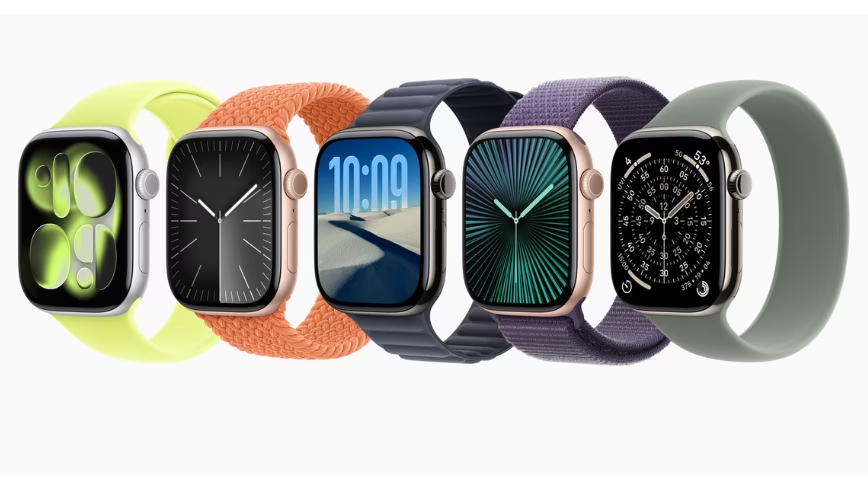
Apple is in late-stage testing on three Apple Watch models for this autumn, Bloomberg’s Mark Gurman reported: the Series 12 in Wi-Fi and cellular versions, plus the Ultra 4. He has not heard of a new Apple Watch SE planned for 2026.
That absence is the actual news. The SE is the model that put an Apple Watch on wrists at a price that competes with everyone else.
What is coming instead
Neither the Series 12 nor the Ultra 4 will get a design overhaul. The upgrades are internal: the first new chip since 2023, ending a three-generation performance freeze, alongside health and fitness improvements.
Apple is working on wrist-based blood pressure monitoring, where the obstacle is regulatory clearance rather than the sensor. Blood sugar detection, a project conceived in the Jobs era, remains targeted for later this decade.
The real overhaul is further out. Gurman says there is ongoing work on a bigger rethink, but not for another year or two.
A holding year dressed as a launch
Strip it back and 2026 is a chip bump and a health update on a five-year-old design, with the entry model quietly missing. That is a strange posture for a product facing its most serious competition yet.
The Apple Watch is 11 years old and losing momentum, with Whoop, Oura, and Google’s Fitbit Air building substantial businesses around screenless bands and rings focused on recovery and sleep.
The price gap it is opening
Dropping the SE creates room at exactly the wrong moment. Google launched the Fitbit Air at $99 with a Gemini health coach, while Whoop added licensed clinician consultations.
Apple has cleared the low end before and profited. It destroyed the mid-tier watch market and is now applying the same playbook to eyewear, so ceding the bottom may be deliberate rather than careless.
The risk is that health tracking is where the growth is, and health tracking is precisely what a $99 band now does adequately.
Squeezed from inside too
The Watch is losing ground within Apple’s own lineup. AirPods Pro 3 heart rate monitoring nearly matched the Apple Watch in accuracy testing, which raises an awkward question about what the wrist is for.
If earbuds handle heart rate and a ring handles sleep, the Watch has to justify itself on something else. Blood pressure would do it, but that needs clearances Apple does not yet have.
The wider September picture
The Watch is a small part of what Gurman calls the widest array of new devices Apple has ever introduced, with the event most likely on 8 or 9 September. The iPhone 18 Pro and Pro Max lead it.
Apple’s first foldable iPhone is on track for the same launch, expected to start around $2,000 and put Apple directly against Samsung’s Galaxy Z Fold.
Prices are going up across the range. Gurman expects increases of $100 to $200 on the new iPhones, driven by chip shortages and camera components.
What it adds up to
Apple is raising prices at the top and vacating the bottom in the same season. For the iPhone, where switching costs are enormous, that is a defensible bet.
For a watch competing against $99 bands and $200 rings, with the redesign still two years away, it is a harder one to explain.


 Credit: Apple