TL;DR
CNET Labs found AirPods Pro 3 averaged 1.67% heart rate error vs a Polar H10 chest strap, second only to Apple Watch at 0.98%.
CNET Labs tested the earbuds' PPG sensor against a Polar H10 chest strap and found 1.67% average error, backed by a peer-reviewed study that independently measured 2.02% deviation
 Credit: Canva
CNET Labs found AirPods Pro 3 averaged 1.67% heart rate error vs a Polar H10 chest strap, second only to Apple Watch at 0.98%.
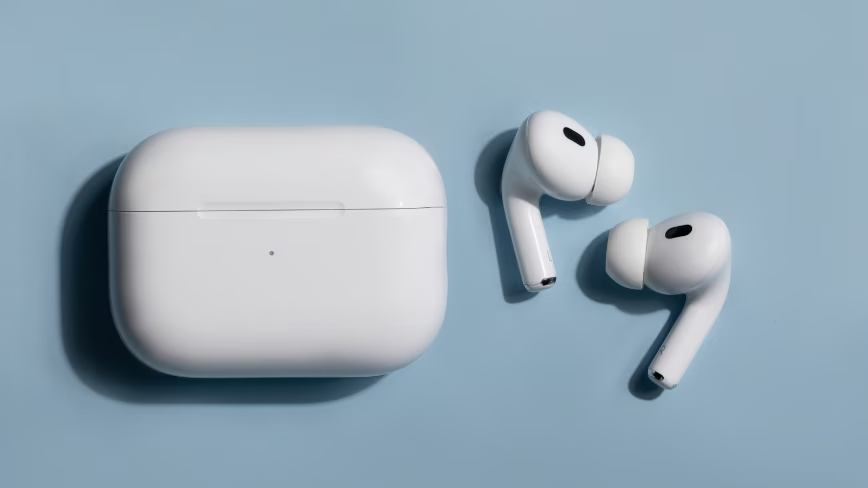
Apple’s AirPods Pro 3 heart rate sensor averaged 1.67% error compared to a medical-grade Polar H10 chest strap in testing by CNET Labs, making the earbuds the second most accurate consumer heart rate device the publication has measured. Only the Apple Watch Series 11 performed better, averaging 0.98% error in the same test protocol.
The results, published by CNET this week, place AirPods Pro 3 ahead of every smartwatch and fitness tracker the lab has tested except Apple’s own watch. CNET’s methodology used a four-lap track protocol with the Polar H10 as the gold standard reference, a setup consistent with how exercise physiology labs validate optical heart rate sensors.
The AirPods Pro 3 use a photoplethysmography (PPG) sensor that fires infrared light at 256 times per second to detect blood volume changes in the ear canal. Apple says the sensor was trained on more than 50 million hours of data from the Apple Health Study, and the company describes it as the smallest heart rate sensor it has ever built.
A peer-reviewed study published in PLOS Digital Health in April 2026 independently corroborates the accuracy claims. Researchers tested 40 adults across 16,735 paired heart rate measurements and found the AirPods Pro 3 averaged 2.02% deviation from a reference device. The study noted that the ear canal offers a more stable optical reading environment than the wrist because there is less ambient light interference and less motion artifact during exercise.
The PLOS study did flag wider epoch-to-epoch variability at higher exercise intensities, meaning individual readings became less consistent even as the overall average remained close to the reference. This is a known limitation of all optical heart rate sensors, including wrist-worn devices, and it means the AirPods are more reliable for steady-state activities than for interval training with rapid heart rate swings.
CNET’s testing has important caveats. The publication completed only two full AirPods runs in its protocol, a smaller sample than it typically uses for smartwatch reviews. CNET is also the primary source for the comparative ranking that places AirPods Pro 3 above other smartwatches, as no other lab has published equivalent side-by-side testing across this many devices using the same methodology.
The ear as a location for biometric sensing is not new in research, but Apple is the first company to ship it at mass-market scale in a consumer audio product. The ear canal’s vasculature sits closer to the skin surface than the wrist, which is why PPG sensors placed there can achieve comparable or better accuracy with a smaller sensor footprint. The trade-off is that health tracking is expanding beyond the wrist into ears, fingers, and other body locations, each with distinct physiological advantages.
At $250, the AirPods Pro 3 are $150 cheaper than the $400 Apple Watch Series 11, and they serve a primary function as earbuds. For users who want heart rate data during workouts but do not want a smartwatch, the accuracy gap between the two devices is small enough that the AirPods represent a credible alternative.
Apple does not position the AirPods as a medical device and the heart rate feature is not FDA-cleared for clinical use. The Apple Watch, by contrast, has FDA clearance for its ECG and irregular rhythm notification features, capabilities the AirPods lack entirely. The AirPods measure heart rate only, they do not detect arrhythmias, blood oxygen levels, or other clinical markers.
The broader trend is that health wearables are shrinking and diversifying in form factor. Oura’s Ring 5 measures heart rate, temperature, and respiratory rate from a finger. Whoop tracks recovery from a screenless wrist band, and Google’s Fitbit Air launched at $99 with AI health coaching.
Apple now has accurate heart rate sensing in both a watch and a pair of earbuds, giving it two data collection points on the same user.
The dual-device approach matters because heart rate data from two locations can improve accuracy through cross-referencing. Apple has not announced plans to fuse data from AirPods and Apple Watch in real time, but the infrastructure exists. The Apple Health app already aggregates heart rate data from multiple sources, and the company’s machine learning teams have published research on multi-sensor fusion.
For competitors, the AirPods result raises the bar. Samsung, Google, and Xiaomi all sell earbuds, and none currently offer heart rate monitoring that approaches the accuracy Apple has demonstrated. The PPG technology underlying all optical heart rate sensors is well understood, but Apple’s advantage appears to come from the training data volume and the sensor’s sampling rate rather than a fundamentally different approach.
Whether earbuds can eventually replace a smartwatch for health tracking depends on what users actually need. Heart rate is one metric. The Apple Watch also measures blood oxygen, skin temperature, and takes electrocardiograms.
AirPods cannot do any of those things today. But for the single most requested health metric, heart rate during exercise, the AirPods Pro 3 deliver results that are close enough to the Apple Watch to matter.
Get the most important tech news in your inbox each week.


