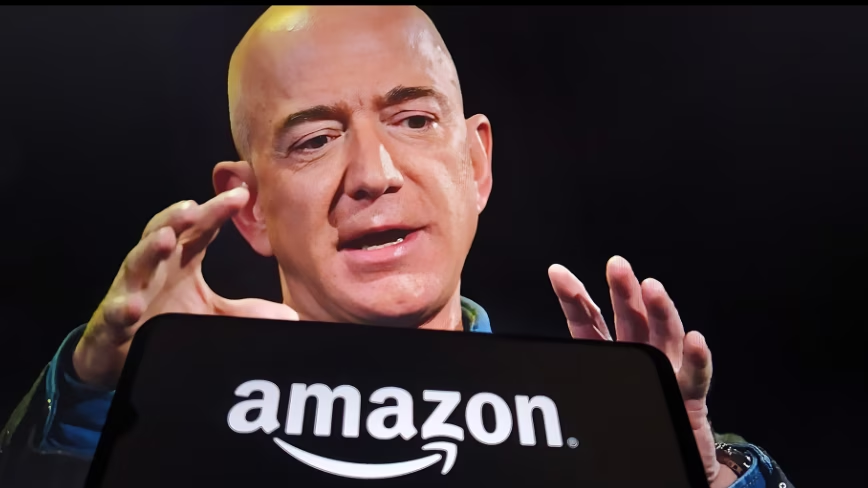
Amazon founder Jeff Bezos, now executive chairman.
 Credit: via Shutterstock
Amazon has opened books on its first sterling bonds, a four-part deal running from three to 19 years, adding another currency to a borrowing programme that has already raised the equivalent of more than $92bn this year.
The sale was reported by Reuters on Wednesday, with pricing expected the same day. Initial guidance put the three-year tranche at around 70 basis points over gilts, the six-year at about 90, the 12-year at about 105 and the 19-year at roughly 110.
Sterling is the fourth currency Amazon has added in 2026. It debuted in euros in March, followed by a Swiss franc deal across a record six tranches.
Then it raised the largest corporate bond ever denominated in Canadian dollars, having already returned to the US market for a $25bn sale. It is now the largest bond issuer among the hyperscalers.
A company raising this much cannot take it from one market without moving the price against itself, so it works through them in sequence, taking what each will absorb at an acceptable spread.
Amazon’s Swiss franc issue ran to six tranches for the same reason. Every new currency is a new pool of buyers who are not yet full.
The spreads are the part a credit investor reads first, and they are not distressed.
Around 70 basis points over gilts for three-year money from a company of Amazon’s standing is a normal premium, and the curve out to 110 basis points at 19 years is a shape lenders recognise rather than a warning. What the numbers say is that the market is still comfortable, at a price.
The question the Bloomberg Intelligence note raises is not whether this deal clears but what happens on the fifteenth one, when the same buyers are asked again by the same handful of companies chasing the same build-out.
The 19-year tranche is where it gets interesting.
“The 19-year tranche is a test of investors’ willingness to extend duration for AI-linked capital needs,” wrote Robert Schiffman and Suchi Trivedi of Bloomberg Intelligence, who framed the deal as raising a broader question about how much debt investors can absorb while AI investment drives repeated issuance.
Stated plainly, the mismatch is stark. The accelerators this money buys have a useful life measured in a handful of years before they are superseded, and the buildings around them are being designed for hardware that does not exist yet.
The paper matures in 2045. Amazon is a very strong credit and services its debt from the whole business rather than from the assets it happens to be buying, so this is not project financing and nobody is lending against a rack of GPUs.
But the buyer of a 19-year bond is underwriting the proposition that Amazon still looks like Amazon in the 2040s, which is a longer bet than the one the capital expenditure itself represents.
There is a specifically British angle to who takes the far end of a sterling curve. Long-dated corporate sterling is the natural territory of UK pension schemes and insurers, which buy duration to match liabilities stretching decades ahead.
Nobody has said who bought this deal, but the structural buyers of 19-year sterling paper are the institutions holding the country’s retirement money. The American AI build-out is now being part-financed by exactly that kind of capital.
We reported in the summer that Big Tech’s AI borrowing had reached $350bn and that Europe would feel it.
Amazon’s total borrowing has since passed $225bn. A debut sterling deal in September is what that forecast looks like when it arrives, and the remaining question is not whether the market will take it but what it charges the next issuer through the door.
Get the TNW newsletter
Get the most important tech news in your inbox each week.
Also tagged with


