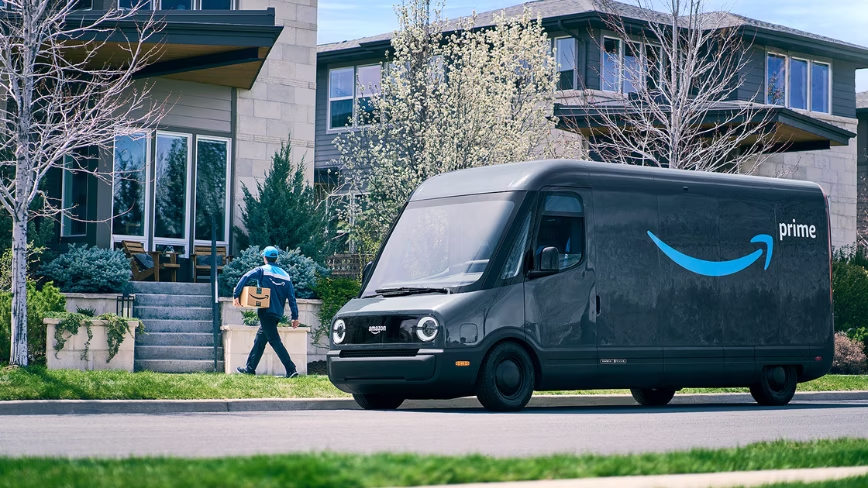
Amazon is expanding its delivery and fulfillment network in Canada.
 Credit: Amazon
Amazon expects package volume in Canada to rise by more than 40% between 2026 and 2029, outpacing its US growth every year, according to internal documents reviewed by Business Insider.
One of the more striking details is a March planning document recording that Amazon shifted some Canadian direct-import sourcing away from the United States and towards China, in the document’s own words, “to avoid tariffs”, which is a US company routing around US trade policy by buying less American.
The company was still setting out expansion plans in late July, after Donald Trump announced an additional 50% tariff on certain Canadian imports on 20 July. Those tariffs, which took effect this month, cover some goods that had qualified for protection under the US-Mexico-Canada Agreement.
Amazon’s own view of the risk was documented earlier. In March it assessed the tariff impact as smaller in Canada than in the US because of USMCA coverage, while warning that “the risk of a Canadian recession is higher than usual due to US trade policy uncertainty”.
Exposure now runs in both directions. Canada has announced retaliatory tariffs on US imports from 8 September covering consumer categories including appliances and electronics, which reaches a specific piece of Amazon plumbing.
That piece is Remote Fulfillment, the programme letting third-party sellers list on the Canadian marketplace while holding inventory in US warehouses, with goods crossing the border only after a Canadian customer orders. A tariff on US consumer goods entering Canada applies to precisely those parcels.
An Amazon spokesperson said prices in its Canadian store “have not increased outside of normal fluctuations” and that the company is monitoring the new tariffs for potential impacts.
Amazon says it has invested more than C$65bn, around $47bn, in Canada since 2010 and employs over 46,000 people there.
The reason for pressing ahead is competitive rather than macroeconomic. “Amazon Canada faces a critical competitive challenge as major retailers are outpacing our delivery capabilities, putting future growth at risk,” the March document said, naming Walmart, Loblaws, and Best Buy.
The numbers behind that are worth reading carefully. Amazon offered same-day delivery to about 54.5% of Canadian Prime members, while the document says competitors reach 70% to 85% of Canadian households within two to four hours.
Those figures use different denominators and different speeds, so they are not a like-for-like comparison, though the direction is clear enough for Amazon’s own planners to have written the sentence they did.
Walmart has since launched Walmart+ in Canada with unlimited same-day delivery, which is the sort of thing that turns a slide into a budget.
Fulfilment capacity is the other half of the answer, and it is where warehouse automation earns its keep. European retailers have been squeezing more throughput out of existing buildings rather than adding new ones, with Decathlon doubling output across seven sites using robotics rather than concrete.
Amazon’s answer is proximity. Its plans project 63% of Canadian shipments fulfilled within 160 miles of the customer and 93% within 1,000 miles by 2029, which is a warehouse-siting problem before it is a technology one.
What complicates that is an economic inversion the documents make explicit. Third-party last-mile delivery in Canada costs roughly half what it does in the US, which strips out much of the financial case for Amazon bringing deliveries in-house, and speed has become the competitive axis that everyone is now spending against.
The consequence shows up in a specific decision. Amazon evaluated 12 additional conventional delivery stations in Canada, found they would deliver negative five-year paybacks, and moved those markets to cheaper partner-based models instead.
The forecasts are preliminary and subject to change, which in a document written between two rounds of tariffs is a meaningful caveat rather than boilerplate.
Tariffs have repeatedly proved better at redirecting trade than at stopping it, as US duties on Chinese electric vehicles have already demonstrated, and Amazon’s sourcing switch is a small illustration of the same effect.
Get the TNW newsletter
Get the most important tech news in your inbox each week.
Also tagged with


