TL;DR
Ambani-backed Addverb Technologies is raising $100M+ to build humanoid and quadruped robots and AI training systems. The Indian company ranks outside the global top 30 and has yet to report a net profit. Revenue is projected at $136M this year.
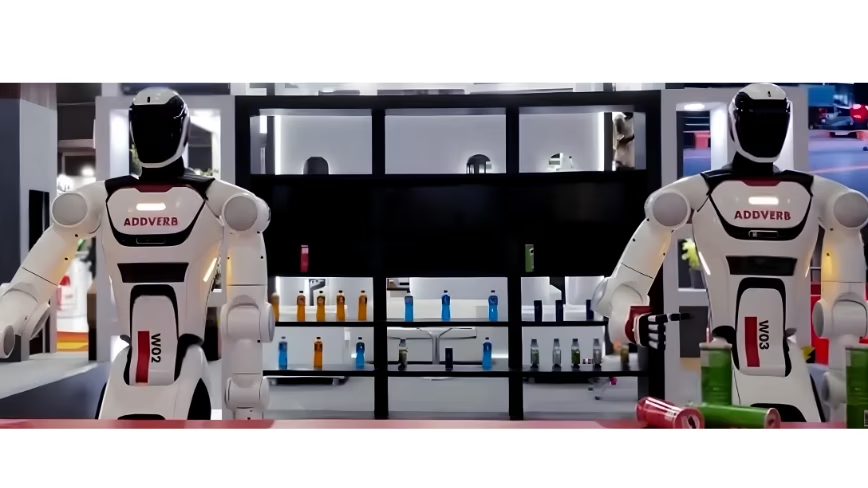
Addverb Technologies, the Indian robotics startup controlled by Mukesh Ambani’s Reliance Industries, is seeking to raise more than $100 million to fund development of humanoid and quadruped robots and build the AI systems to train them. CEO Sangeet Kumar told Bloomberg the raise is the company’s first major fundraising effort since Reliance’s $132 million investment in 2021.
The company currently makes robots for sorting, material movement, and factory automation at logistics firms, warehouses, and electronics companies. It operates across more than two dozen countries, with half its revenue coming from outside India.
The ambition
“We want to be in the top 10 in the next five years and top five in the next 10 years,” Kumar said. Addverb estimates it currently ranks just outside the global top 30 in robotics market share by revenue.
That gap is large. The companies above it include Unitree Robotics, which is preparing a $7 billion IPO, Tesla’s Optimus programme, and established Japanese and European industrial robotics firms with decades of manufacturing scale.
What the money is for
The $100 million will fund humanoid and quadruped robot development, data collection, and AI training systems. Addverb also plans to launch proprietary lidar sensors after more than two years of development, reducing dependence on imported components.
The proprietary technology push is strategic. Chinese competitors benefit from government subsidies and a dense manufacturing supply chain that Indian firms cannot yet match. Addverb is betting that vertical integration and domestic IP can offset the cost disadvantage.
The financials
Revenue is projected at 13 billion rupees ($136 million) this fiscal year, supported by an order book of approximately $200 million. The company reported losses during its international expansion but expects to return to adjusted profitability in the fiscal year ending March 2027 and net profit the following year.
Kumar said an IPO is a key option for scaling but Addverb has no immediate plans for one. “Probably when we are more than 40 billion or 50 billion rupees in revenue, that is when we would go for IPO,” he said, a milestone he believes could be reached within two years at current growth rates.
The backstory
Addverb was founded in 2016 by four engineers who previously worked at Asian Paints, India’s largest paints company. The asset-heavy model failed to attract venture capital, but an Asian Paints backer invested early.
Customers now include Lenskart, Hindustan Unilever, and Reliance. The company employs nearly 1,100 people. Reliance holds a controlling stake, with founders and employees owning about a fifth.
The flags
Addverb has not disclosed its current valuation or the terms of the $100 million raise. The $136 million revenue projection and the $200 million order book are company figures, not independently audited.
The humanoid robot market Addverb is entering is crowded and capital-intensive. Whether an Indian startup can compete with Chinese firms’ cost structure, Japanese firms’ manufacturing precision, and Tesla’s brand and capital is an open question. The company’s current position outside the top 30 means it needs to grow roughly 5x just to reach the lower end of its five-year target. That is ambitious for a company that has yet to report a net profit.


 Credit: Addverb Technologies