There are a lot of things that make Apple’s iOS a more attractive platform for development than Android. Better development tools, an installed user base that is more inclined to spend money on apps and the most popular App Store in the world, recently surpassing some 25B downloads total.
But if there is one major plus to working within the Apple ecosystem, it’s the fact that its users adopt new versions of its operating system far more quickly.
Self-styled ‘hobbyist’ data analyst Chris Sauve has a great post up on his blog PXLDOT that illustrates this point well. He recently ran the numbers on Android platform fragmentation and wanted to continue the discussion with some stats about iOS. The findings are dramatic and do a lot to explain the frustration that developers have with Android.
Sauve has parsed a lot of interesting data, over 50 different points from developers who publish their iOS version adoption stats like Marco Arment of Instapaper and David Lieb of Bump. He also dips into various statistics-gathering sites like Flurry and Apprupt. The numbers do have some room for error as the sources are varied and Apple doesn’t make these statistics public themselves, but they’re likely representative of the market and match up with Google’s publicly available stats.
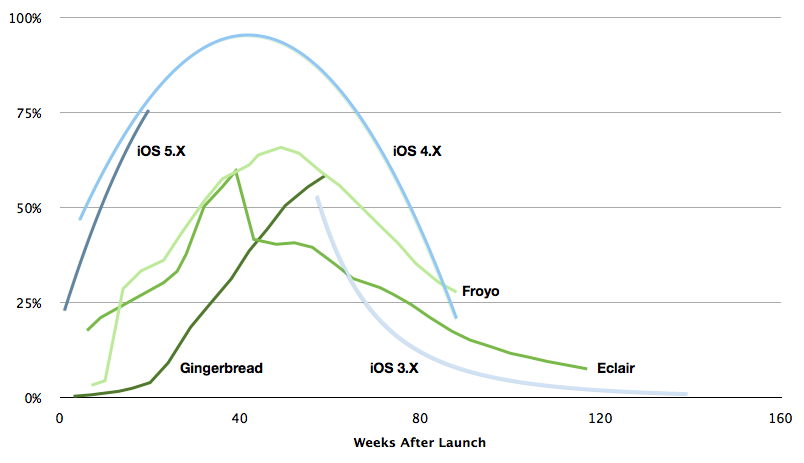
One of the most descriptive charts is this one, which dramatically demonstrates just how fast iOS adoption rates are when compared to Android. Look at the vertical shape of the iOS 5.x curve when compared to Gingerbread, Android’s latest version besides the brand new Ice Cream Sandwich, which doesn’t even register on this scale.
Sauve on just how incredibly fast iOS gets picked up when compared to Android:
iOS 5 captured approximately 75% of all iOS users in the same amount of time it took Gingerbread to get 4% of all Android users. Even more astounding is that 15 weeks after launch iOS 4 was at 70% and iOS 5 was at 60% while Ice Cream Sandwich got to just 1% share at the same age.
Another great point that Sauve makes about the data relates to the argument that the larger number of Android devices will eventually make for a more attractive target for developers, something that Google’s Eric Schmidt has touted as a plus of the ecosystem. Unfortunately, only a fraction of Android devices are on the latest version of the OS, which makes it difficult for developers, especially those with limited resources, to create versions of their apps that work appropriately across all devices.
It also makes it difficult for them to adopt the coolest new features of Android very quickly, as they must make sure that their apps work on the most common version of Android, even if it is far older and not as well equipped.
By contrast, iOS developers can make sure that their apps are optimized for a larger segment of Apple devices, effectively nullifying the advantage of Android’s larger install base. This gives developers the ability to be more confident in adopting features that are only available in newer versions of the OS without alienating a large segment of customers.
“With iOS, it’s usually safe to maintain compatibility about one year back,” says Instapaper developer Marco Arment. “So today, iOS 4 is a very safe minimum. Very soon, iOS 5 will be. Sometimes, an OS update offers so much for developers that it’s worth jumping the gun a bit.”
This goes for those who are introducing new apps as well. There is a tendency to look forward, rather than starting out with backwards compatibility in mind.
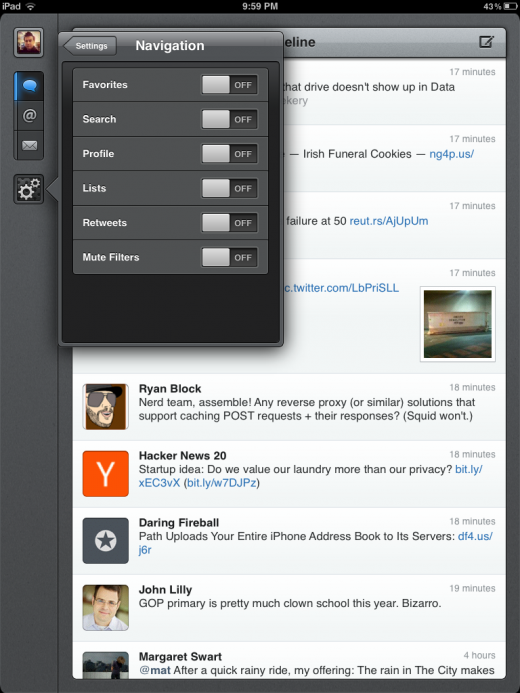
Tapbots recently launched a new version of its popular Twitter app Tweetbot for the iPad. This was offered as a separate app from the iPhone version, allowing developer Paul Haddad to choose which
OS he would make the minimum requirement. Tweetbot for iPad launched with iOS 5 — the latest major version — required.
“iOS 5.0 works on all the iPads, there’s not much of a reason to support older iOS versions,” sayd Haddad. “There’s a few people who are still running iOS 4.3 on iPad but that number is minuscule compared to the folks who have upgraded. It makes very little sense to spend the development effort support 4.x on iPads.”
The gamble paid off too, with the app reaching #1 on Apple’s top iPad Apps chart and Haddad says that “we’ve gotten two people complaining about it, so it was a pretty big win.”
“For anything new I wouldn’t even consider iOS 4,” Haddad continues. “For old iPad-only apps I’d drop support for 4.x. For universal apps that have already been developed I’d say 4.1+ is still viable.”
This is in stark contrast to Android, where even devices that are being launched now, like the Sony Experia S are still using Gingerbread. As BoingBoing’s Rob Beschizza puts it,”you can tell Sony is trying hard to catch up, however, because the edition of Android on it is only 14 months old.”
Laying the blame on phone makers for the lack of Android version adoption is easy, but they’re not the only ones to blame. Carriers also have an immense amount of control over the software and hardware of most phones that come to market. Apple, on the other hand, broke the mold and ships essentially whatever software it wants on its devices, with only minor concessions made to ready them for use on a particular carrier’s network.
At this point, it’s hard to see many Android developers being able to say with confidence that it will be launching its next app for ‘Ice Cream Sandwich’ only, period. Meanwhile, developers like Arment are using unqualified phrases like ”I’m going to require iOS 5 in my next update [of Instapaper].”


What a surprise, an Apple apologetic grasping at straws to justify his obsession.
I love how developing for Android is some sort of nightmare when somehow no one complains that web developers have to account for an even wider range of unknown systems.
Your argument holds no water. You are not the expert you think you are.
- spam
- offensive
- disagree
- off topic
LikeWith Android we never launch for just one version. That's just how Android works. Even if 75% of users were on ICS, we would still support 2.3. If everyone bought iPhones instead of Android phones, then it would make a difference that devs prefer iOS, but consumers prefer free, which Android essentially is.
- spam
- offensive
- disagree
- off topic
LikeEric Rooney That must be a lot of fun!
- spam
- offensive
- disagree
- off topic
LikeOtis Wildflower Sure it's more work, but we're supporting more users. This is why most companies now make apps for iOS and Android and soon for Windows phones. I mean, it's less efficient but it's acceptable for the time being, until there is more settling in.
- spam
- offensive
- disagree
- off topic
LikeCoincidentally, e27 posted an article on the same day on the same topic as well! http://e27.sg/2012/03/06/im-sorry-android-you-and-i-just-dont-work/
- spam
- offensive
- disagree
- off topic
LikeFully correct. Love iOS5. Thanks.
- spam
- offensive
- disagree
- off topic
LikeDries Grobler the circlejerk is complete.
- spam
- offensive
- disagree
- off topic
LikeThat's because Android has to be developed and released for the thousands of Android devices out there, and right now there is only ONE ICS phone out there, officially. You can install an ICS ROM to your XYZ android phone, but it's not official. And I would hope it's easier to be in control of one handset, like the iPhone, than it is to be in control of thousands.
- spam
- offensive
- disagree
- off topic
LikeAlex Hawk Incorrect, the Nexus S 4g already has the official update sent to it, and many more are releasing shortly.
- spam
- offensive
- disagree
- off topic
LikeWhy do more people prefer Android over iPhone? Try many kinds of Androids to chose from while the tiny iPhone is tired and boring. Who cares about other developers, as long as the phone's got Facebook.
- spam
- offensive
- disagree
- off topic
LikeiOS users definitely spend more money on apps than Android users. That says more about the type of users iOS has than the development platform however.
- spam
- offensive
- disagree
- off topic
LikeThat is a moronic argument as all Android apps work on any Android os after 2.0. It's like arguing that devs wont make apps for windows if windows 8 has a slow adoption rate.
- spam
- offensive
- disagree
- off topic
LikeDavid Marks But the argument is, why bother to add features to an OS if nobody is going to use or even have access to them?
- spam
- offensive
- disagree
- off topic
LikeJohn Molloy David Marks And also, there are ICS only apps available. Google Chrome for instance.
- spam
- offensive
- disagree
- off topic
LikeDoron Katz John Molloy David Marks It's currently in beta, jackwad. How do you actually function as a human being
- spam
- offensive
- disagree
- off topic
LikeDavid Marks You mean like Skype which was exclusive to one android phone then slowly got another and another one. Just because it would technically work on all androids doesnt mean its optimal on that. And regardless of apps, what if a security or improvement updated was made and 1% of people got the update
- spam
- offensive
- disagree
- off topic
LikeDavid Marks Exactly. Using the argument of this article, web developers should not exist.
- spam
- offensive
- disagree
- off topic
LikeApple makes the hardware and the software, Google makes the software and posts the source on a website for everyone to download (including the OEMs that make the hardware, you, and me). How can you compare those 2 models on the basis of "OS adoption". Every iOS release will go to all iOS devices within weeks, be cause it is designed and tailored for all of them. For Android, each OEM has to grab the generic Linux distro and fit it to their devices. OEMs do make things worse by adding way too much crap, and carriers go and throw even more crap on top. But you're comparing apples to oranges here.
- spam
- offensive
- disagree
- off topic
Likenemesys571 That's actually not how the process works at all. But, that being said, consumers and developers don't care. If Android ever wants to have parity in their eyes, it needs to solve this problem.
There is no such thing as fair here. Only good and not as good.
- spam
- offensive
- disagree
- off topic
LikeMatthew Panzarino please enlight me how the process actually works? This is obviously a problem, which is inherent of the model chosen by Google. The model used for over a decade by the open source community doesn't translate well to today's mobile device paradigm of the seller being in charge of updating the customer's device to every new version (versus just bug and security patches).
Sure most users don't care, and developers care about their bottom line, I agree on that, but that's not my point. I'm not saying the comparison is unfair, I'm just saying it is stupid. The author, and Sauve, failed to understand how the two approaches work (or chose to). Again, comparing apples to oranges.
- spam
- offensive
- disagree
- off topic
LikeMatthew Panzarino oh I didn't notice you were 'the author' I mentioned :)
- spam
- offensive
- disagree
- off topic
Likenemesys571 Matthew Panzarino All good, you're allowed to disagree! The workings of the process are sketched out somewhat in the Engadget article I linked in the piece, but there are better explanations out there. I agree that it's a convoluted and less than easy process, but somebody has to wade in and make it better. Not pointing out its shortcomings doesn't help anyone, us most of all.
- spam
- offensive
- disagree
- off topic
LikeMatthew Panzarino nemesys571 For having such strong opinions, have you ever written an app for either? I'll answer that for you. No. The only issue is that idiot bloggers with nothing better to do drum up pretend problems. You've done well in solidifying the fact that TNW is nothing more than little boys talking about things they don't understand.
- spam
- offensive
- disagree
- off topic
Likenemesys571 The process for Android you have outlined is quite bang-on. I'm saying this not by just reading blogs but being involved in the industry related to the Android upgrade process. Just one thing you missed though in the process is the semicon vendor. So let me outline the overall process:
Android publishes the Open Source version (aka Stock release). Then semicon vendors like Qualcomm, TI, NVIDIA, etc incorporate the new version of the software onto their reference hardware. This process typically takes about 2 months. Then the OEMs like Samsung, Sony, HTC, etc take the upgrade version from their respective semicon vendor. They first migrate the software release from the reference hardware to their actual phone model being upgrade. Then they merge their proprietary changes (like you said mostly crap). This typically takes another 2 to 3 months. Following this, if it is sold to an operator, the OEM has now got to migrate thousands of operator specific requirements. Of-course now they have to test all this stuff in labs and in the field. This further takes about 2 months. Now if one were to include parallelism in the whole development cycle between the semicon vendor release to the OEM upgrade push, the whole cycle take 4 to 6 months per model.
- spam
- offensive
- disagree
- off topic
LikeThis situation is so unfortunately, and renders the great promise of "open-source" Android largely a fraud.
It's not even fair to call it one operating system at this point, since users wait for every vendor to dribble out their proprietary versions of it months or years after each release. If they ever do.
I think we can also lay some blame on Google for not apparently not establishing a proper hardware abstraction layer, driver model, and license that would've prevented this fiasco. If Google had to suck up to telcos by allowing their crappy overlays, they should have required those overlays to use proper APIs and abstraction that allowed the replacement of the underlying OS in most cases.
Google (and others) did the work for these vendors and made them competitive in the phone marketplace. And what do these vendors do? Turn around and screw users and devalue the whole platform. That should never have been allowed.
- spam
- offensive
- disagree
- off topic
LikeSo UNFORTUNATE. Where is the EDIT BUTTON?
- spam
- offensive
- disagree
- off topic
LikeRussell Ziskey No joke! I want an edit button too.
- spam
- offensive
- disagree
- off topic
Likeandroid is a joke. my app is released on five platforms.. android has the least amount of sales. and it's not even close. it's ridiculous. and i'm just a college guy trying to make a buck.
- spam
- offensive
- disagree
- off topic
Likefx it's a joke because you didn't make as much money on it?
- spam
- offensive
- disagree
- off topic
Like