TL;DR
Zyg, the agentic e-commerce platform built by five IronSource co-founders, raised $60 million at a $500 million valuation led by Accel, just two months after emerging from stealth with a $58 million seed round. The company automates advertising, retention, support, and inventory forecasting for DTC sellers using AI agents that operate autonomously on platforms like Meta. The structural irony is that the team that built IronSource’s ad tech infrastructure for human media buyers is now building agents designed to replace them.
The founders of IronSource spent a decade building tools that helped mobile app developers monetise their products through advertising. They sold that company to Unity for $4.4 billion in 2022, watched Unity dismantle the ad network they had built, left in 2024, and have now returned with a company whose premise is that the entire category of work IronSource supported, the human management of digital advertising campaigns, can be automated by AI agents. Zyg, their new startup, raised $60 million at a $500 million valuation on Tuesday, led by Accel, with participation from Bessemer Venture Partners and Lightspeed Venture Partners. The company came out of stealth two months ago with a $58 million seed round. In eight weeks it has raised $118 million at a half-billion-dollar valuation without a single public customer case study. The bet is not that AI can assist e-commerce advertising. The bet is that AI agents can replace the people who run it.
The thesis
Zyg describes itself as an agentic operating system for e-commerce scale. The platform automates business functions that direct-to-consumer sellers currently manage through a combination of human operators, fragmented software tools, and advertising agencies: campaign creation and optimisation on Meta and other platforms, customer retention, support, and inventory forecasting. Chief Executive Officer Omer Kaplan told Bloomberg that Zyg’s agents are already running advertising campaigns on Meta’s platforms and are “doing the vast majority of the activity themselves.” The company’s customer base includes businesses with between $2 million and $15 million in annual revenue, the segment of the e-commerce market large enough to need sophisticated advertising but too small to afford the teams that run it.
The irony is structural. IronSource built the infrastructure that app developers used to acquire users and monetise through advertising. The company’s success depended on the existence of a large class of professionals, media buyers, growth managers, and performance marketers, who spent their days optimising campaigns inside platforms like Meta, Google, and the ad networks IronSource itself operated. Zyg’s premise is that those professionals are now a cost centre that AI agents can eliminate. The same team that built the tools human ad buyers used is now building the agents designed to make those humans unnecessary. It is not a pivot. It is a succession.
The market
Zyg is entering a category that barely existed twelve months ago and is now attracting hundreds of millions in capital. Hightouch raised $150 million at a $2.75 billion valuation last week to build an agentic marketing platform for enterprises, with Goldman Sachs and Bain Capital leading the round. Shopify has launched Agentic Storefronts that let merchants sell products inside ChatGPT, Perplexity, and Microsoft Copilot. Meta itself is moving toward fully automated advertising, where an advertiser inputs a business URL and Meta’s AI handles creative generation, audience targeting, budget allocation, and performance optimisation without human intervention. AI marketplaces are reshaping how advertising is created and distributed, collapsing the distance between an advertiser’s intent and a campaign’s execution to something approaching zero.
The competitive landscape suggests that Zyg’s timing is right but its window is narrow. When Meta completes its own automation of the advertising workflow, the question becomes what value a third-party platform adds on top of a system that already runs itself. Zyg’s answer is that Meta optimises for Meta. A direct-to-consumer brand needs agents that optimise across advertising, retention, support, and inventory simultaneously, making decisions that account for the full business rather than a single channel’s performance metrics. That cross-functional integration is what separates an agentic operating system from an automated ad tool, and it is what justifies the ambition of the valuation.
The speed
A $500 million valuation two months after stealth is not normal, even in 2026’s funding environment. But the velocity reflects a specific dynamic in AI venture capital: repeat founders with a demonstrated exit command valuations that bear no relationship to current revenue. VAST Data raised $1 billion at a $30 billion valuation as AI infrastructure demand accelerated, and the broader funding environment saw $297 billion flow into startups in Q1 2026 alone, with AI capturing 80 per cent of the total. In this market, a team that built and sold a company for $4.4 billion, that understands advertising infrastructure at a technical level, and that is applying that understanding to the single largest category of AI agent deployment, is exactly the profile that commands pre-revenue valuations at scale.
Accel, which led the round, raised a $5 billion fund in April specifically to back AI companies. The firm’s investment in Zyg is consistent with its thesis that the returns from AI will come not from foundational model companies but from vertical platforms that deploy agents in specific industries. Google is turning Chrome into an agentic workplace tool with autonomous browsing capabilities, and every major platform is building agent infrastructure. The venture bet on Zyg is that e-commerce advertising is a vertical where domain expertise, the IronSource team’s specific understanding of how campaigns work, provides an advantage that general-purpose agent platforms cannot replicate.
The talent
Zyg was founded by five of the original IronSource founders: Tomer Bar-Zeev as chairman, Omer Kaplan as CEO, Assaf Ben Ami as CFO and COO, alongside Nadav Ashkenazy and Daniel Shinar. The team also includes cybersecurity and AI specialists from Unit 81, the Israeli military’s elite technology unit. The funding will be primarily used to hire AI talent in Israel, a market where the competition for researchers and engineers has intensified as global companies and domestic startups chase the same pool of specialists. Meta’s raid of the Thinking Machines Lab founders, reportedly including a $1.5 billion engineer, illustrates the premium the industry places on concentrated AI talent. Israeli startups raised $15.6 billion in 2025, with AI-focused companies commanding the majority of capital, and the talent war is the primary constraint on how fast companies like Zyg can build.
The Unit 81 connection is relevant beyond credentials. Building agents that autonomously manage advertising campaigns, handle customer data, and make inventory decisions requires the kind of security architecture that military intelligence backgrounds produce. An agent that runs ad campaigns is also an agent with access to business-critical systems, customer information, and financial data. The governance challenge, how to let an agent operate autonomously while preventing it from making catastrophic errors, is as much a security problem as an AI problem, and Zyg’s founding team is constructed to address both.
The question
Agentic AI is entering specific verticals from construction to logistics to legal services, and in each category the same question applies: does the agent platform become the new operating layer for the industry, or does the incumbent platform absorb the agent functionality into its own product? In e-commerce advertising, the incumbents are Meta, Google, Amazon, and Shopify, each of which is building AI automation directly into its platform. Meta’s Advantage+ suite already handles creative generation and targeting for 8 million advertisers. Google’s Performance Max automates campaign creation across all Google surfaces. Shopify’s AI agents manage everything from SEO to email to ad buying.
Zyg’s wager is that the multi-platform problem is unsolvable from inside any single platform. A DTC brand selling on Shopify, advertising on Meta and Google, retaining customers through email and SMS, and forecasting inventory across seasonal demand curves needs an agent that understands the business as a system, not a collection of channels. That is the same insight that made IronSource valuable: app developers needed a monetisation layer that worked across ad networks, not inside any single one. The founders are running the same play, one abstraction layer higher. The difference is that the previous abstraction layer helped humans manage complexity. This one is designed to eliminate the need for the humans entirely. Whether that works at the scale of the DTC market, for the thousands of mid-sized brands that cannot afford engineering teams but generate enough revenue to justify AI-powered operations, will determine whether Zyg’s $500 million valuation was prescient or premature. The founders have two months of post-stealth existence and $118 million in capital to find out.


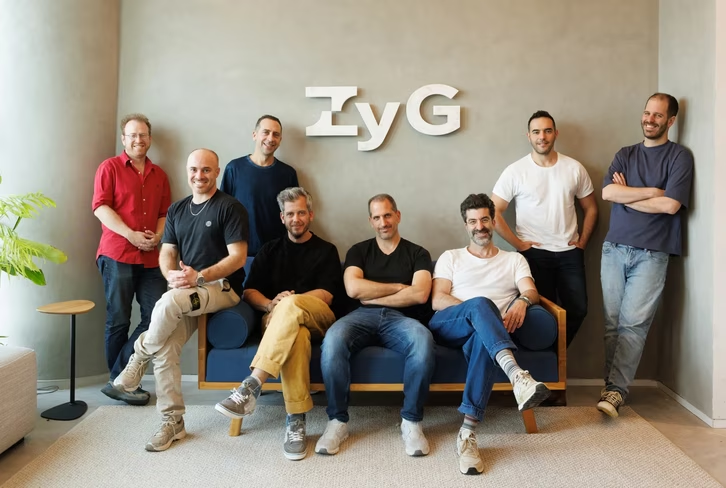
 Credit: Zyg