 Credit: 9yz
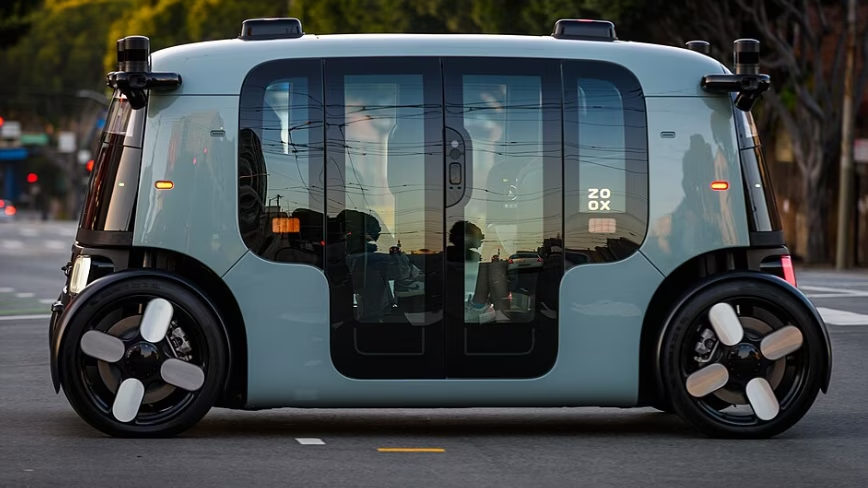
Zoox has published the reasoning behind its claim to be safer than human drivers. Everything reduces to one number, the predicted rate of collision, injury and fatality events, expressed as miles per event. Risk from driving software, from the vehicle itself and from fleet operations is added together into that single estimate.
It functions as a gate. Before any safety-relevant software release, hardware change or revision to operating procedure, Zoox updates the case and checks the combined figure still clears its target.
The target is anchored in human data. Zoox builds its benchmark from NHTSA’s crash sampling and fatality reporting systems and two Federal Highway Administration datasets, then parses them by road speed and weights them to match the mix of roads its robotaxis actually use.
What it does not publish is the answer. Zoox sets its target by comparison to that benchmark and says it aims to be significantly safer than a human driver, but never defines how much safer counts as significant. Nor does it give the figure its fleet currently reaches.
The engineering underneath is specific enough to argue with. Zoox names the hazard analyses it runs, follows ISO 26262 with integrity ratings on the platform, and uses simulation that deliberately searches for the conditions where a collision is most likely, weighted afterwards by real fleet exposure.
Some of it is genuinely unusual. A separate collision checker runs its own perception and can veto a trajectory the main system has planned, and Zoox concedes that a likelihood-based metric cannot capture rare avoidance scenarios, so it keeps a test set where the robotaxi must at least match a competent human.
Remote staff are inside the model rather than outside it. TeleGuidance tacticians never drive, offering route guidance while the vehicle keeps responsibility, and the risk of them making a mistake or their tools failing is priced into the same estimate.
The framework also reserves the right to restrict, pause or ground the fleet. Three weeks before publishing it, Zoox recalled all 105 of its robotaxis after one failed to detect heavy smoke and drove into an active fire scene in Las Vegas.
That was the fourth software recall in roughly 13 months, and it followed the regulator demanding fixes for vehicles interfering with first responders. NHTSA had logged 123 collisions involving Zoox vehicles in autonomous mode as of March.
The analytical approach exists because the mileage does not. Zoox has around three million autonomous miles, Waymo passed a hundred million more than a year ago, and Zoox now has a paid service to protect while it closes that gap.
Get the TNW newsletter
Get the most important tech news in your inbox each week.


