TL;DR
Zendesk has appointed Tifenn Dano Kwan, a serial enterprise SaaS CMO with stints at Amplitude, Dropbox, Collibra, and SAP, as its new chief marketing officer. The hire comes as Zendesk races to reposition itself as an AI-first customer service company under private equity ownership.
Zendesk has appointed Tifenn Dano Kwan as its new chief marketing officer, bringing in a veteran enterprise SaaS marketer as the company accelerates its pivot toward AI-powered customer service. Dano Kwan replaces Kelly Waldher, who joined the company from Google in 2023.
The appointment comes at a defining moment for Zendesk. The company has spent the past six months acquiring AI companies, launching autonomous service agents, and publicly declaring that 2026 will be the year AI handles more customer service interactions than humans. It needs a marketing leader who can sell that transformation to enterprise buyers, and Dano Kwan has spent a decade doing exactly that at companies navigating similar inflection points.
Dano Kwan’s career reads like a tour of enterprise SaaS during its most turbulent period. She served as CMO at SAP Ariba and SAP Fieldglass, where she led marketing for two of SAP’s largest B2B platforms. She then moved to Dropbox as CMO, where she drove growth through a digital-first strategy as the company fought to differentiate its core file storage business from bundled alternatives offered by Google, Apple, and Microsoft. Dropbox’s founder Drew Houston stepped down as CEO just last week, underscoring the ongoing challenges facing legacy SaaS companies trying to reinvent themselves around AI.
After Dropbox, Dano Kwan served as CMO at Collibra, the data intelligence platform, before joining Amplitude as CMO in October 2022. At Amplitude, she led global marketing strategy for a digital analytics company whose product sits at the centre of how software teams measure user behaviour, a role that gave her direct exposure to the AI-driven product development cycle that now defines enterprise software.
Zendesk’s transformation is well underway. In March 2026, the company completed its acquisition of Forethought, an AI agent platform specialising in self-improving customer service agents. The deal was Zendesk’s largest in two decades. In December 2025, it acquired Unleash, an AI-powered enterprise search platform. In May 2026, it introduced what it calls the Autonomous Service Workforce, a vision for AI agents that resolve customer issues end-to-end without human intervention. Zendesk says its AI agents routinely resolve more than 80% of interactions across its customer base.
The competitive landscape makes the marketing challenge acute. Salesforce has poured resources into Agentforce, its AI agent platform for customer service, closing 29,000 deals and reaching $800 million in annual recurring revenue. Intercom has positioned its Fin AI agent as the benchmark for conversational customer support. Sierra, backed by Salesforce co-founder Bret Taylor, hit $100 million in annual recurring revenue within seven quarters of launch. Every major player in customer service software is racing to claim the AI agent market, and the positioning wars are only beginning.
What distinguishes Zendesk’s pitch is its installed base. The company has been the default customer service platform for mid-market and enterprise companies for more than a decade, with hundreds of thousands of businesses running their support operations on its software. The AI transformation is not about winning new customers from scratch. It is about convincing existing customers to adopt AI agents within a platform they already use, and persuading new buyers that Zendesk’s AI-first approach is more credible than competitors building AI capabilities on top of legacy architectures.
That positioning challenge is precisely the kind of marketing problem Dano Kwan has spent her career solving. At SAP, she marketed established enterprise platforms to buyers who were sceptical of incumbents reinventing themselves. At Dropbox, she fought for differentiation in a commoditised market. At Amplitude, she positioned an analytics product at the intersection of product development and AI. Each role required translating complex technical shifts into clear commercial narratives for enterprise buyers.
Zendesk has been privately held since November 2022, when a consortium led by Hellman & Friedman and Permira acquired the company for $10.2 billion. Tom Eggemeier, who joined as interim CEO during the transition, became the permanent chief executive in May 2023. Under PE ownership, Zendesk has restructured its leadership team aggressively. Craig Flower was appointed chief operating officer in February 2026 to accelerate the company’s shift to an AI-first operating model.
The leadership churn signals a company being reshaped for a specific outcome. Private equity firms do not typically hold assets indefinitely, and the cadence of executive appointments, acquisitions, and product launches suggests Zendesk is building the narrative and financial profile for either a return to public markets or a strategic sale. A new CMO with deep enterprise SaaS experience fits that pattern. The next phase of Zendesk’s story will be told not just through product launches, but through how effectively the company markets its AI transformation to investors and customers alike.
For Dano Kwan, Zendesk represents a chance to lead marketing at a company where the stakes are existential rather than incremental. If Zendesk successfully transitions from a traditional help desk platform to an AI-first service company, it will be one of the most significant reinventions in enterprise software. If it fails, it risks being outflanked by competitors who started from AI-native foundations. The CMO role at Zendesk is not about brand campaigns and demand generation. It is about defining what the company becomes next.


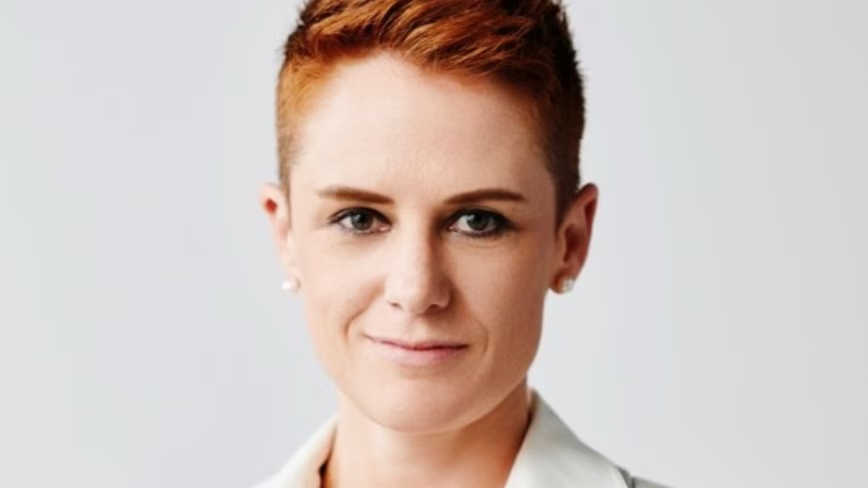
 Credit: LinkedIn