TL;DR
Drew Houston is stepping down as Dropbox CEO after 19 years, with former Vimeo CPO Ashraf Alkarmi taking over. The company’s market cap has halved since its 2018 IPO as Google, Apple, and Microsoft squeezed its core storage business.
Ashraf Alkarmi, a former Vimeo and Amazon executive who joined Dropbox 18 months ago, takes over a company whose market cap has halved since its 2018 IPO
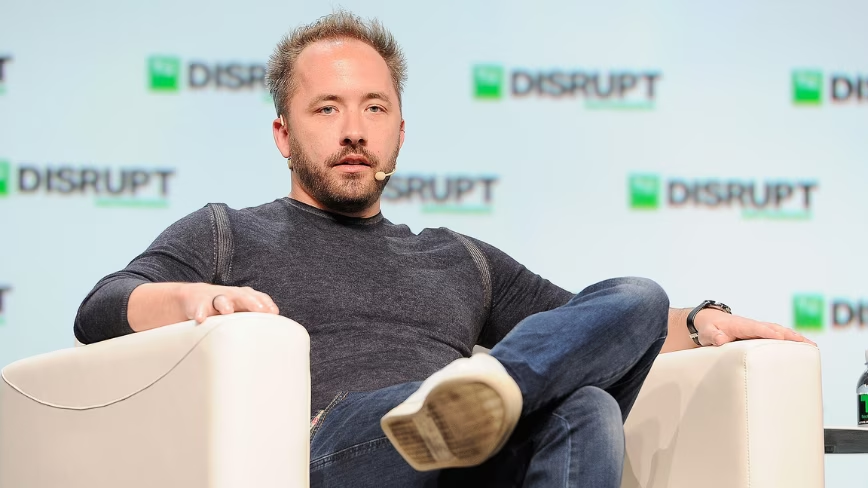
 Credit: Techcrunch
Drew Houston is stepping down as Dropbox CEO after 19 years, with former Vimeo CPO Ashraf Alkarmi taking over. The company’s market cap has halved since its 2018 IPO as Google, Apple, and Microsoft squeezed its core storage business.TL;DR
Drew Houston, the co-founder who built Dropbox from a Y Combinator demo into a company with more than 700 million registered users, is stepping down as chief executive. Ashraf Alkarmi, Dropbox’s current head of product, has been named co-CEO effective immediately. After a transition period, Houston will become executive chairman and Alkarmi will take the role outright.
Dropbox shares fell roughly 2.4 per cent in premarket trading on the news. The company’s market capitalisation now sits just above $6 billion, down by half from the peak it reached on its first day of trading in March 2018.
Houston, who is 43, told CNBC that his next chapter will be entrepreneurial and AI-focused. He did not announce a specific venture but made clear that retirement, or sailing, is not the plan.
Alkarmi, 47, joined Dropbox in November 2024 as senior vice president and general manager of Dropbox Core. Before that he was chief product officer at Vimeo from 2022 to 2024 and held senior product leadership roles at Amazon from 2018 to 2022, where he ran Amazon Freevee. He also led product at Meta and founded PresAsk, an audience engagement platform. Houston credited Alkarmi with making the company “a lot more responsive to our customers” and said the new leader was “taking bigger swings on innovation.”
The transition comes alongside a second senior hire. Michael Torres, currently vice president of product for Google’s Chrome, will join Dropbox as chief product officer on 7 July. Torres previously served as vice president and general manager of Kindle at Amazon.
The leadership change reflects the strategic reality Dropbox has been navigating for years. The company pioneered consumer cloud storage but watched as Google Drive, Apple iCloud, and Microsoft OneDrive bundled comparable features into their operating systems and productivity suites at no additional cost. Dropbox’s core file sync business still generates revenue, $629.5 million in the first quarter of 2026, but growth has stalled at under 1 per cent year over year. Excluding FormSwift, which the company plans to wind down by the end of 2026, revenue grew 2 per cent.
Houston spent his final years as CEO trying to reposition Dropbox around AI. The flagship product of that effort is Dropbox Dash, an AI-powered universal search tool that aggregates content from more than 30 workplace applications, including Slack, Gmail, Google Workspace, and Microsoft Teams, into a single searchable interface. Dash uses retrieval-augmented generation to summarise documents, compare files, and surface answers across a company’s scattered information.
The problem is that the competitors Dropbox is trying to outrun are building the same capabilities into their own platforms. Google announced an AI agent platform at Cloud Next 2026 that integrates search, summarisation, and workflow automation directly into Workspace. Microsoft has embedded Copilot across OneDrive, Teams, and the entire 365 suite. Both have the distribution, the data, and the compute budget that Dropbox does not.
The company has responded with cost discipline. Dropbox cut 16 per cent of its workforce in 2023 and carried out further restructuring in 2024. It ended the first quarter of 2026 with $1.3 billion in cash. But efficiency alone does not solve the growth problem, and Alkarmi’s mandate is clearly to find a product-led path forward.
Founder-to-operator CEO transitions are common in maturing tech companies, but they carry risk. The incoming leader inherits both the strategic direction and the cultural identity that the founder shaped. Alkarmi has been at Dropbox for just 18 months. Whether he can drive the kind of product reinvention the company needs while maintaining the loyalty of a workforce that has been through multiple rounds of layoffs is an open question.
For Houston, the departure closes a chapter that began in 2007 when he forgot a USB drive on a bus and decided to solve the problem. Dropbox went on to define an entire product category. The fact that the category was then absorbed by platform companies with deeper pockets does not diminish the achievement, but it does explain why the founder is leaving and why the company needs a different kind of leader for what comes next.
Get the most important tech news in your inbox each week.


