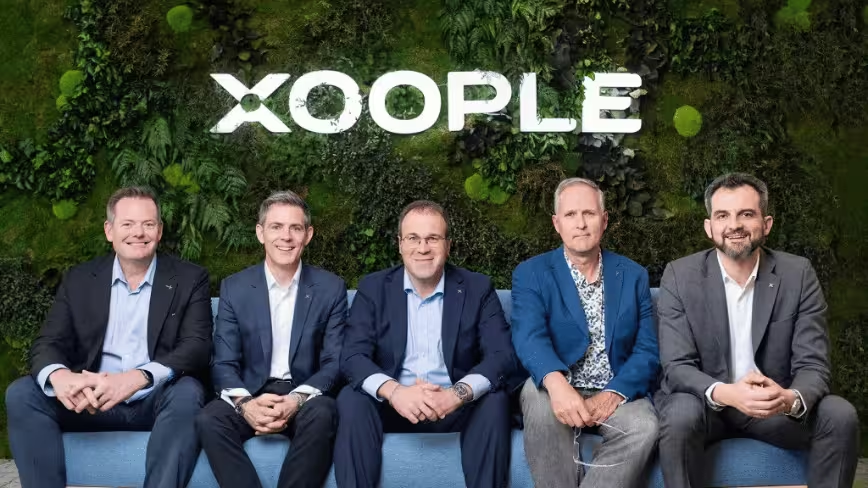
Xoople team

In short: Xoople, a Madrid-based geospatial data company founded in 2019, has raised a $130 million Series B led by Nazca Capital, bringing its total funding to $225 million and pushing its valuation into unicorn territory. The round was co-invested by MCH Private Equity, CDTI (the Spanish government’s technology development fund), Buenavista Equity Partners, and Endeavor Catalyst. Alongside the raise, Xoople announced a partnership with US space and defence contractor L3Harris Technologies to build sensors for its own satellite constellation, designed to produce Earth surface data it says will be “two orders of magnitude better than existing monitoring systems.” The company’s EarthAI platform, built on Microsoft Azure and distributed through Microsoft and Esri, delivers continuous surface intelligence for insurers, farmers, governments, and infrastructure operators.
Xoople has spent seven years building something that did not previously exist in a commercially deployable form: a continuous, AI-native data layer for the Earth’s surface. The Madrid startup, founded in 2019, emerged from that development period with a €115 million in prior funding, a platform embedded in the two most widely used enterprise geospatial ecosystems in the world, and a thesis that the AI era will require a fundamentally different approach to Earth observation — one designed from the ground up for machine learning rather than adapted from satellite imagery workflows built for human analysts. The $130 million Series B, led by Nazca Capital, confirms that investors believe that thesis is credible enough to back at scale.
CEO and co-founder Fabrizio Pirondini told TechCrunch the raise brings Xoople’s total funding to $225 million and puts the company in unicorn territory on valuation. The round was joined by MCH Private Equity, CDTI, the Spanish government-backed technology development fund that has also backed Nazca Capital’s aerospace and defence fund, Buenavista Equity Partners, and Endeavor Catalyst.
What EarthAI actually does
Xoople’s core product, EarthAI, is an end-to-end Earth intelligence system. It ingests continuous surface data, currently sourced from government spacecraft and third-party satellite networks, and processes it into AI-ready datasets that can be queried for change detection, risk prediction, and environmental monitoring. The key design choice is continuity: rather than producing point-in-time images for human review, EarthAI is built to stream a persistent, structured view of the planet’s surface into AI models that need regular, reliable ground truth.
The use cases span industries that share a dependence on understanding what is happening on the physical surface of the Earth. For agriculture, EarthAI provides early detection of crop stress, monitors soil health and water conditions, and generates data that enables farmers to participate in carbon credit markets. For insurance, it enables more precise climate risk pricing and real-time verification of natural disaster claims, removing the delay and subjectivity of ground-based assessments. For infrastructure operators, it monitors physical assets for signs of stress or degradation before failures occur. For governments, it supports emergency planning, environmental enforcement, and humanitarian response. Capital flowing into specialised AI applications at the intersection of science, data, and infrastructure has accelerated considerably over the past year, and Xoople sits precisely at that intersection.
The satellite play
The $130 million will fund Xoople’s transition from a platform built on others’ data to one powered by its own. Alongside the Series B, the company announced a partnership with L3Harris Technologies, a US space and defence contractor, to design and manufacture sensors for Xoople’s own satellite constellation. The sensors will collect optical data. Pirondini told TechCrunch that the constellation is designed to produce “a stream of data that is going to be two orders of magnitude better than existing monitoring systems“, a claim that, if borne out, would represent a substantial leap over the imagery quality currently available from commercial earth observation operators.
That claim is where Xoople meets its competitive reality. The company is entering a market that includes Vantor (formerly Maxar Intelligence, rebranded in October 2025), Planet Labs, BlackSky, Airbus Defence and Space, ICEYE, and Capella Space — all of which have satellites already in orbit and established AI-focused data processing pipelines. Companies building the hardware and data layers that AI depends on face a lengthy gap between the announcement of a new approach and its delivery in deployable form, and Xoople’s constellation is not yet in orbit. For now, EarthAI runs on data it did not produce. The L3Harris partnership signals that the proprietary data supply is the next phase.
Distribution before data
Xoople’s strategic sequencing is unusual for an Earth observation company. Most competitors in the space led with hardware — launching satellites, then figuring out distribution. Xoople did the reverse: it spent its first seven years embedding its platform into Microsoft and Esri, the two dominant environments where enterprise buyers, governments, and GIS professionals already live. Neither Microsoft nor Esri has its own proprietary satellite data. Xoople positioned itself to supply that gap from inside the platforms where the purchasing decisions are made.
The Microsoft relationship is structural: Xoople’s platform runs on Azure, and the company is integrated with Microsoft’s Planetary Computer Pro, which delivers AI-powered geospatial insights for enterprise use. Esri, the world’s largest geospatial software company, is a partner distributor. The implication is that when Xoople’s own constellation is operational and its data quality delivers on the “two orders of magnitude” promise, it will have distribution in place that its newer competitors would need years to replicate. The investment flowing into cloud-based AI data infrastructure has made the ability to process and deliver petabytes of Earth surface data at low latency a tractable problem; the scarcity is in the quality and continuity of the underlying data itself.
A Spanish unicorn in a European context
Xoople’s raise is one of the larger deep tech rounds to come out of Spain in recent years, and it lands in a moment that the European space and defence investment community has been accelerating. Nazca Capital, which led the Series B, runs Spain’s largest private equity fund specialised in aerospace and defence, a fund that also received a €294 million commitment from CDTI and a €40 million investment from the European Investment Fund. The investor composition of the Xoople round,government-backed funds, European private equity, and Endeavor Catalyst, which focuses on high-impact technology entrepreneurs, reflects the persistent tension in European technology between deep technical ambition and the capital required to realise it: the funding is patient, multi-source, and has a public interest dimension that pure venture rounds often lack.
The earth observation market was valued at $7.04 billion in 2025 and is projected to reach $14.55 billion by 2034, growing at just over 8% annually. Xoople is betting that as AI models grow more capable and more dependent on real-world data, the market for continuous, structured Earth surface intelligence, rather than periodic imagery, will grow faster than that aggregate. A year in which the appetite for AI applications in climate, infrastructure, and environmental risk grew considerably provided the validation Xoople needed; the $130 million is the bet that the second half of the decade will prove it right at scale.
Get the TNW newsletter
Get the most important tech news in your inbox each week.


