TL;DR
Waymo is blocked from NYC by Mayor Mamdani, the taxi lobby, and labor unions. Governor Hochul withdrew her statewide robotaxi proposal after outcry.
Waymo is blocked from NYC by Mayor Mamdani, the taxi lobby, and labor unions. Governor Hochul withdrew her statewide robotaxi proposal after outcry.
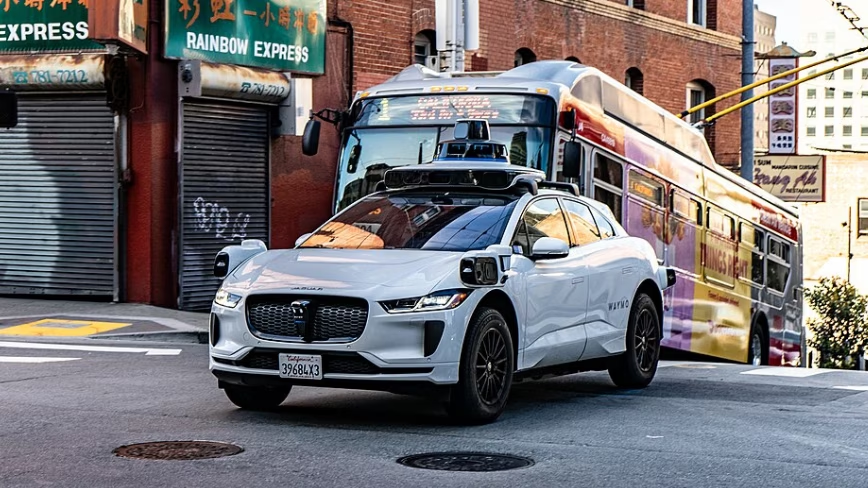
Waymo
 Credit: Han Zheng
Waymo is blocked from NYC by Mayor Mamdani, the taxi lobby, and labor unions. Governor Hochul withdrew her statewide robotaxi proposal after outcry.
Waymo delivers more than 500,000 paid rides per week across 10 US cities, raised $16 billion in February, and is expanding internationally to Tokyo and London. It cannot operate in New York City.
The reason is not technical, it is political.
As the New York Times reported this week, opposition from local politicians, labor unions, and an influential taxi lobby has stopped the Google-owned robotaxi company from entering the country’s largest and most lucrative ride-hailing market. The roadblocks are structural, not temporary.
New York Governor Kathy Hochul introduced a budget proposal in January that would have legalized commercial robotaxi pilots across New York state, excluding New York City. A month later, she withdrew it. The pushback from driver groups, transit workers, and state legislators was immediate and overwhelming.
“Based on conversations with stakeholders, including the legislature, it was clear that the support was not there to advance this proposal,” a spokesperson for the governor told CNBC. The reversal killed Waymo’s most promising regulatory pathway into the New York market.
Newly elected NYC Mayor Zohran Mamdani has made his position clear. Mamdani, who went on a hunger strike alongside taxi workers during his earlier political career, has declined to renew Waymo’s testing permit, which expired on March 31. The permit, approved by former Mayor Eric Adams in August 2025, had allowed Waymo to test eight Jaguar I-PACE vehicles with safety drivers in Manhattan and downtown Brooklyn.
No collisions were reported during the entire testing period, according to NYC’s Department of Transportation. That fact has not changed the political calculus.
“Our strategy remains the same,” Waymo’s global head of public policy Justin Kintz told the New York Times. “We want to meet people and governments where they are.”
“We know that some of them will take more time than others,” Kintz added. “But we’re committed to earning trust.”
The company has spent at least $1.8 million lobbying New York state officials since 2019, according to state records, and recently retained The Parkside Group at $15,000 per month to lobby on autonomous vehicle legislation. The money has not moved the needle.
The standoff reflects a broader tension in the robotaxi industry. Waymo must approach each state and city individually for permission to operate, a patchwork regulatory environment that gives local politicians effective veto power. Legislation has stalled in at least eight states, including New York, Virginia, Oregon, and Minnesota, even as 18 states now allow fully driverless commercial operations.
Waymo’s technical record in New York was clean, but its broader safety record is more complicated. The company issued its sixth recall this week after robotaxis drove into highway construction zones 13 times across Phoenix and the San Francisco Bay Area.
A rider told CBS News they thought they were going to die. Waymo offered three free rides worth up to $40 each.
The recall pattern gives ammunition to Waymo’s opponents in New York. New York Magazine argued that what could reverse the Mamdani administration’s resistance would be proof that the vehicles are safe, beyond the company’s own statistics. That is difficult to demonstrate when the company is simultaneously pulling its fleet off highways because the software cannot reliably detect cones and closure signs.
The economic stakes are enormous. Waymo is deploying its new, cheaper Ojai robotaxi and targeting one million weekly rides by the end of 2026, with plans for more than 20 additional cities including international markets. New York City, where over 100,000 for-hire vehicle drivers operate and the taxi industry generates billions annually, would be its single most valuable market.
But the city’s taxi medallion system has already been through one near-collapse, when Uber and Lyft decimated medallion values from over $1 million to under $200,000 a decade ago. Taxi drivers who fought back from that crisis are not interested in another disruption. The New York Taxi Workers Alliance, which represents roughly 28,000 drivers, has framed the fight against robotaxis as a labor rights issue.
The competitive landscape is shifting around Waymo while it waits. GM is rebuilding its autonomous vehicle program after shutting down the $10 billion Cruise division. Tesla has launched a limited robotaxi service in Austin, and Amazon’s Zoox operates in San Francisco and Las Vegas.
None of them are in New York either, which suggests the city’s resistance is not Waymo-specific but industry-wide.
For now, Waymo’s $16 billion war chest and 500,000 weekly rides have not purchased entry to the one market that matters most. The company’s strategy of patience and lobbying may eventually work, but in a city where taxi drivers have political allies in the mayor’s office, the state legislature, and the labor movement, “eventually” could mean years.
Get the most important tech news in your inbox each week.


