 Credit: Walden Robotics
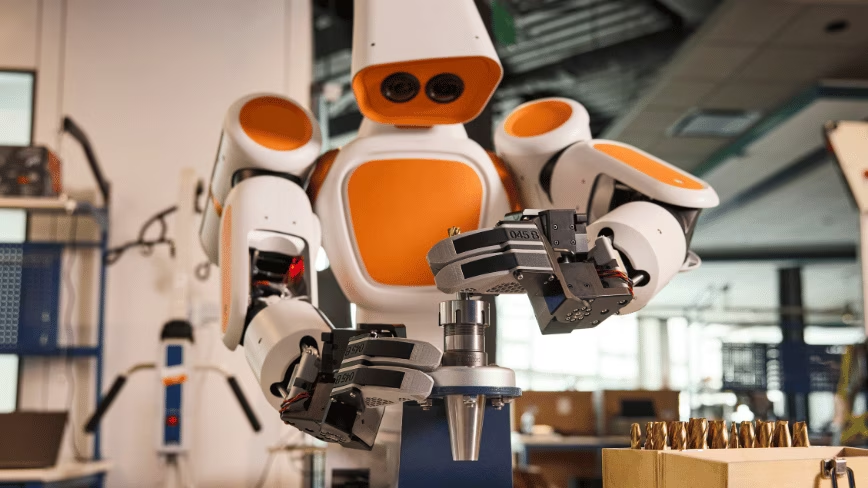
Walden Robotics has launched from stealth with $300m and a $1.1bn valuation. The Toyota spin-out builds humanoids for factories, and it left off the legs on purpose.
“If you listen to the people on the factory floor, they aren’t ready, and they don’t want them yet.” That is Russ Tedrake, telling Bloomberg why his new robots roll on wheels instead of walking on legs.
Tedrake runs Walden Robotics, a Cambridge startup that came out of stealth on Wednesday with $300m in funding and a $1.1bn valuation. It is a Toyota spin-out, and its robots already work in a Toyota factory.
Toyota and Deviation Capital co-led the seed round. Nvidia, Boeing, Samsung Ventures, and CoreWeave Ventures also put money in. That is a heavy roster for a company barely six months old.
Wheels, not legs
Most humanoid firms are chasing robots that walk. Walden went the other way. Its machines pair a humanoid upper body with a wheeled base, a choice Tedrake puts down to safety and practicality.
Wheeled robots slow and stop around people more easily, so they clear existing factory safety rules. They also carry bigger batteries and more computing power. For a machine built to work a full shift, that beats looking human.
Already on the job
Walden is not selling a promise. Since February, its robots have run in production at a Toyota plant in North America, one of them working eight-hour shifts beside human teams. They take the dull, fiddly jobs: loading and unloading car parts, cleaning machinery, and kitting parts for assembly.
The company spun out of the Toyota Research Institute in January and builds its own hardware, software, and AI. Its robots run on Large Behavior Models, a class of AI the team helped pioneer that lets them pick up new tasks and improve through practice. Customers now span automotive, aerospace, semiconductors, electronics, logistics, and life sciences.
“Providing real value to customers… requires a deep understanding and respect for how manufacturing is done today,” Tedrake said at launch. Toyota’s chief technology officer, Hiroki Nakajima, framed it in the company’s own language of kaizen and jidoka, and of keeping people at the centre.
A crowded, unproven race
Walden joins a stampede. 1X, LimX, and Booster are pouring billions into humanoids, and carmakers are adding them to plants. Hyundai is scaling up Boston Dynamics’ Atlas. Morgan Stanley reckons the market could top $5tn by 2050.
Tedrake will not oversell it. “Everyone recognises the magnitude of the opportunity and the technology feels ready, but success is not assured,” he said. “You have to think through the business case, the unit economics.”
The name is a tell. Walden, after Thoreau, is meant to signal robots that free people for better work, not replace them. Whether wheels or legs win the factory floor, Walden has a head start, and a Toyota plant to prove it in.
Get the TNW newsletter
Get the most important tech news in your inbox each week.


