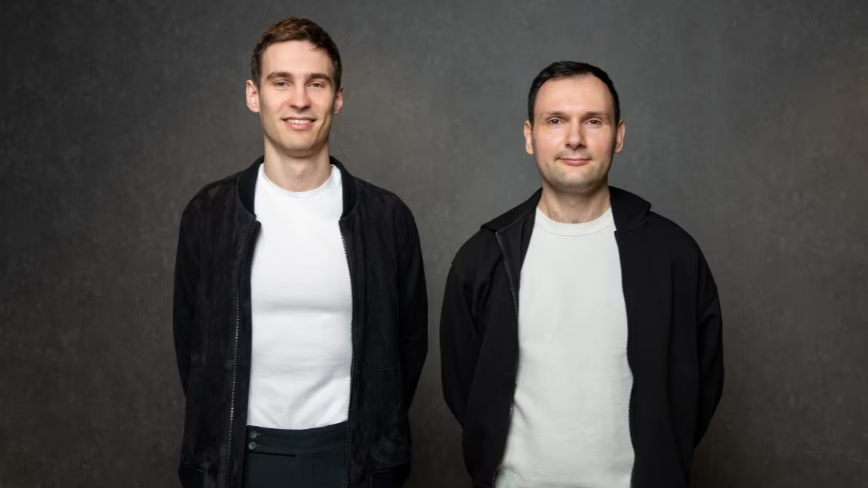
The Warsaw- and Munich-based ex-Meta engineering team hit $15m annualised recurring revenue in ten weeks. The angel list reads like a who’s who of European and US software.
Viktor, the Warsaw- and Munich-based AI-agent company built by former Meta engineers Peter Albert and Fryderyk Wiatrowski, has raised a $75m Series A led by Accel.
Bek Ventures, Kaya VC, Inovo VC, and Tenacity Capital joined the round, alongside an unusually long angel-investor list that includes Slack co-founders Stewart Butterfield and Cal Henderson, Vercel chief executive Guillermo Rauch, Deel chief executive Alex Bouaziz, ElevenLabs chief executive Mati Staniszewski, Framer founder Koen Bok, Instacart co-founder Max Mullen, Sana founder Joel Hellermark, 20VC’s Harry Stebbings, Lenny Rachitsky, Shaan Puri, Charlie Songhurst, Daniel Gross, and Nat Friedman.
The customer-growth claim is what makes the round legible. Viktor reached $15m in annualised recurring revenue in roughly ten weeks, on the founders’ account.
The company says more than 12,000 teams have now installed Viktor across Slack and Microsoft Teams. That is the kind of curve that pulls Accel into a Series A at this size eighteen months after the company started shipping. It is also, on the available evidence, faster than any comparable enterprise-software-distribution data point in the recent Slack-marketplace ecosystem.
Viktor lives inside a customer’s existing Slack or Microsoft Teams workspace and, on the company’s framing, connects to more than 3,000 SaaS tools to execute multi-step workflows: reports, drafting, scheduling, data entry, status updates, and overnight instructions from a phone.
It positions itself as a team member rather than a personal assistant, the structural distinction Albert and Wiatrowski use to separate Viktor from ChatGPT, OpenAI’s OpenClaw, Claude’s Slack integration, and Tasklet.
Zhenya Loginov, the Accel partner on the deal, will join the board. The firm’s own portfolio note frames Viktor inside a ‘modern workplace’ AI category, mostly served until now by frontier-model labs selling APIs and downstream platforms reselling them.
Peter Albert (CTO) and Fryderyk Wiatrowski (CEO) met at Meta. The team of six engineers comes from Meta, Google, and Oxford. The Warsaw-Munich split makes Viktor a structurally European company anchoring its commercial reach inside two American communication platforms, which explains part of the angel roster: Butterfield and Henderson run the Slack marketplace Viktor sits inside, and Bok, Staniszewski, Rauch, and Hellermark are the European founders Viktor is modelling its own scaling against.
Customer testimonials are doing the work of run-rate metrics that the company has not published. Highgarden Holdings CEO Justin Hibbert says Viktor ‘got the entire budget from $12.5 million down to $7.2 million’. Authority Makers’ Nico Torres credits it with ‘$133,752 a year in new recurring revenue’ in the first thirty days.
Como Business Coaching’s Jacob Aldridge calls Viktor ‘the cheapest employee I’ve ever hired’. The pattern is structural: Viktor’s marketing positions the product against ChatGPT specifically, on the bet that the comparison is the one the buyer is mentally already running.
The wider category context is the part that matters for the round’s longer-arc significance. Anthropic shipped ten financial-services agent templates earlier this month inside Claude and lined them up against Microsoft 365 distribution. Google, OpenAI and Salesforce have all been pushing variants of the same agent-in-the-workflow positioning.
Viktor’s bet, on the company’s own framing, is that the agent that wins the workplace will be the one that lands inside the team’s existing chat surface with installation friction approaching zero, rather than the one that wins on model quality.
The next twelve months will determine whether the company can hold its growth-rate lead against the foundation-model-lab incumbents now actively building toward the same surface.
Wilson Sonsini served as legal counsel on the Series A. Post-money valuation, run-rate revenue beyond the $15m ARR figure, and planned Warsaw-Munich headcount expansion have not been disclosed.
The Series A will, on the founders’ brief, fund continued engineering buildout, expanded integrations against the 3,000-tool target, and enterprise-segment commercial scale-up.
Get the TNW newsletter
Get the most important tech news in your inbox each week.
Also tagged with


