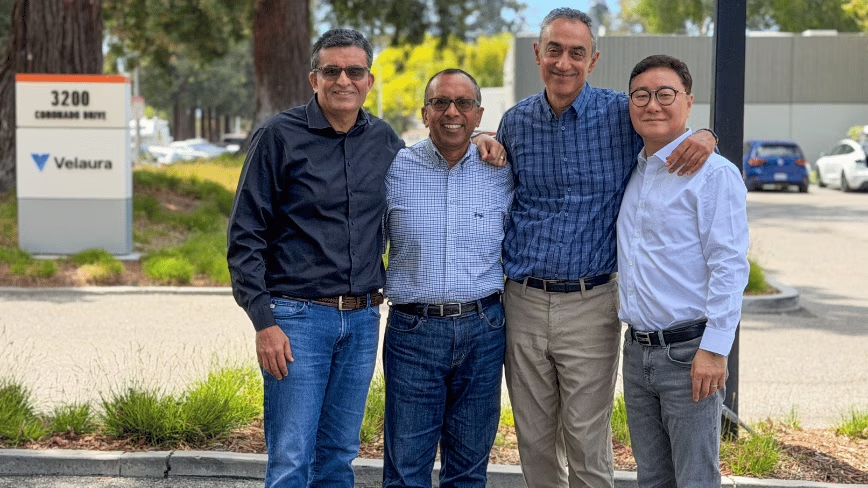
Velaura AI Founding team (left to right): Rajiv Khemani – CEO, Sanjay Gupta – President, Manu Gulati – Chief Development Officer, YJ Kim – President Products
 Credit: Velaura AI
A chip startup that promises to cut the power AI uses has raised $110mn and crossed a $1bn valuation. Velaura AI, based in Santa Clara, announced the Series A round on Tuesday. The company said in a statement that it builds ultra-low-power silicon and software for data centres and for what the industry calls physical AI.
Seligman Ventures led the round. New investors Capricorn Investment Group and Prosperity7 Ventures joined, the company said. So did existing backers including Mayfield, Maverick Silicon, MARA, Premji Invest, the Samsung Catalyst Fund and StepStone Group. Reuters reported the valuation at more than $1bn.
Velaura said it will use the money to speed up development of its chip products and to hire engineering and customer-facing staff.
The pitch is power, not speed
Velaura’s core argument is about electricity. AI now runs into a power wall before a compute one, the company argued. Demand for compute keeps climbing, but the electricity to support it does not arrive as fast. Hyperscalers are pouring hundreds of billions of dollars into AI data centres, the company noted, and they face long waits for power to come online.
That constraint has become a running theme in the industry. OpenAI has gone as far as hiring a power trader, treating electricity as a position on its books. Velaura is selling into the same squeeze, from the silicon up.
Its main product is a chip-design platform called Titan Core.
The company says it delivers a two-to-four-times improvement in performance per watt for the mathematical operations inside AI accelerators, without losing performance. Velaura calls the underlying technology already proven. Its designs run in more than 30 million chips today, built on leading manufacturing processes, the company said.
Velaura unveiled Titan Core earlier this year, pitching it at the efficiency and power savings of data-centre workloads, according to Reuters. The new funding is meant to turn that platform into shipping products.
An Arm-style business model
Velaura does not plan to sell chips of its own. It licenses its technology instead. The startup charges an upfront fee, plus a royalty tied to a share of the power savings a customer achieves, according to Reuters.
Chief executive Rajiv Khemani confirmed to Reuters that the structure resembles Arm’s per-chip licensing model, from the years before Arm began selling its own chips. It is an unusual arrangement. Velaura only earns its royalty if the customer’s electricity bill actually falls.
The customer list is not public, but Khemani gave Reuters a sense of its scale. Velaura is talking to three of the four largest cloud-computing providers as potential customers, he said. He declined to name them. The backers also include the bitcoin miner MARA, which has moved into AI computing, the company said.
A team from the big chipmakers
Velaura’s pitch leans heavily on its people. The leadership team includes executives and engineers from Apple, Nvidia, Google, Qualcomm and Marvell, the company said. The co-founders are Khemani and Manu Gulati, who have built and sold chip companies before. Between them, the team has shipped billions of devices, the company said.
That track record is part of why investors backed the round. The financing is Mayfield’s fourth partnership with Khemani and its second with Gulati, Quartz reported. “We invest in people first,” Mayfield managing partner Navin Chaddha said in a statement.
“The next era of AI will be defined not only by better models, but also by fundamentally better compute economics,” Khemani said. He framed the goal as scaling AI from big data centres down to machines that work in the physical world.
The second bet is physical AI
Velaura is aiming at two markets at once. The first is the data centre. The second is physical AI, the term for intelligent robots, drones and autonomous systems that have to run under tight power and heat limits.
For the lead investor, that second market was the draw. “Physical AI represents one of the next major frontiers for AI, and it will require a fundamentally different approach to compute centred on extreme power efficiency,” said Umesh Padval, managing partner at Seligman Ventures.
He said it was the firm’s first investment in physical AI. Other startups are already chasing that market, from robot-training construction machines to embodied systems that have to think on limited battery power.
Another new backer made the same case. “Velaura is attacking that problem at its root, the silicon itself, with technology that has shipped at scale,” said Dipender Saluja, managing partner at Capricorn Investment Group. He pointed to the mix of measurable efficiency gains and commercial validation as the reason to invest.
Prosperity7 Ventures, the venture arm tied to Saudi Aramco, joined the round as well, the company said.
Outside analysts pointed to the same efficiency case. Velaura’s approach could cut the total cost of running AI, ease thermal limits and fit more AI into existing buildings, said Patrick Moorhead, chief analyst at Moor Insights & Strategy, in a statement. Those are the pressures every large AI operator is now trying to manage.
A crowded field
Velaura joins a wave of startups selling alternatives to the standard AI chip. Groq raised a fresh round this month, and Etched doubled its valuation to $21bn, both pitching purpose-built inference hardware. Cerebras is selling wafer-scale systems for the same market.
Velaura’s angle is narrower and, if its numbers hold, harder to argue with. It is not promising faster chips. It is promising the same work for less power, and asking to be paid out of the savings.
Get the TNW newsletter
Get the most important tech news in your inbox each week.


