TL;DR
Gritt raised $32M for AI robots that attach to existing construction equipment and place solar panels up to four times faster than manual crews.
The San Francisco startup's $26M Series A was led by Obvious Ventures, with Union Square Ventures and Active Impact Investments also participating, bringing total funding to just over $32 million
Gritt-Robot
 Credit: Gritt
Gritt raised $32M for AI robots that attach to existing construction equipment and place solar panels up to four times faster than manual crews.
San Francisco-based Gritt has exited stealth with just over $32 million in combined pre-seed and Series A funding to deploy AI-powered robotic systems on large-scale construction sites, starting with solar farms. The $26 million Series A was led by Obvious Ventures, with Union Square Ventures and Active Impact Investments also participating, following an earlier pre-seed round from First Round Capital, Climactic, Congruent Ventures, and VSC Ventures. The company’s systems do not replace existing construction equipment but attach to it, using robotic arms mounted on standard skid steers and forklifts to pick, transport, and position solar panels with millimeter precision.
The throughput gains are substantial, according to both the company and TechCrunch’s reporting. A typical eight-person crew installs around 800 panels per day, but the same crew working alongside Gritt’s system can place 3,000 to 4,000 panels daily. The company says its machines have placed tens of thousands of panels with zero breakages, a claim that has not been independently verified.
Gritt says it is contracted to help install nearly 3 gigawatts of solar capacity over the next 18 months, with customers that include three of the top 10 US power construction companies. Only two systems are currently deployed in the field, but the company plans to scale to 48 within six months. The gap between two working machines and a contracted pipeline worth gigawatts of solar is the kind of distance that separates a promising demo from a functioning business.
The timing aligns with a demographic cliff in construction. More than 41 percent of the US construction workforce is expected to retire by 2031, according to Bureau of Labor Statistics data, and the industry has struggled to attract younger workers. Construction robotics startups on both sides of the Atlantic are raising capital to fill the gap, with investors betting that physical AI can do for building sites what automation did for factories decades ago.
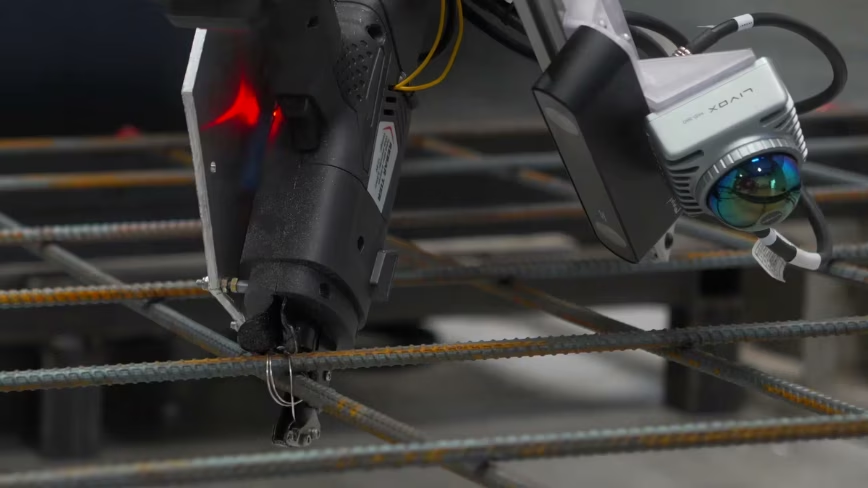
Gritt was founded by Puneet Puri and Vishal Dugar, both graduates of Carnegie Mellon’s robotics programme, who designed the system to learn from every deployment. Tasks that originally took weeks to train now take days using the same underlying AI pipeline, according to the founders, who told TechCrunch that a rebar-tying demo required only a single day of training after the initial solar panel work. Beyond panel placement, Gritt plans to expand into drilling posts, tying rebar, and assembling the mounting racks that a growing number of construction robotics companies are targeting.
The competitive field includes Luminous Robotics, Cosmic, and China’s Trinabot, all of which build their own dedicated panel-installing hardware rather than attaching AI to off-the-shelf machines. Gritt’s bet is that its approach scales faster and at lower cost, since customers do not need to buy new equipment. Whether that advantage holds as the company moves from two deployed systems to 48, and from solar panels to the broader range of construction tasks it has promised, will determine if the bet pays off.
Get the most important tech news in your inbox each week.


