TL;DR
FCC filing patterns suggest Valve’s Steam Machine could launch on or before June 29, matching the Steam Controller’s regulatory timeline.
A Reddit user noticed that Valve's Steam Controller user manual was published in the FCC database only after the device went on sale, and the Steam Machine's manual is scheduled to go public on June 29, implying the console could arrive sooner
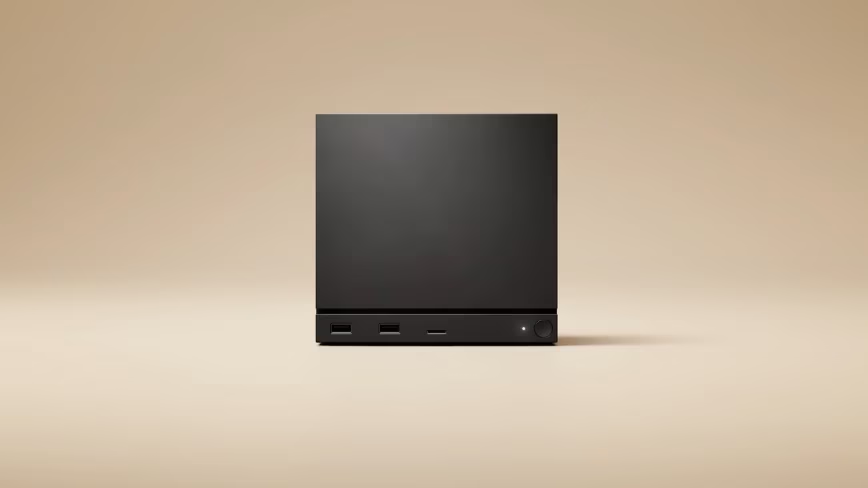
Machine
 Credit: Steam
FCC filing patterns suggest Valve’s Steam Machine could launch on or before June 29, matching the Steam Controller’s regulatory timeline.
Valve’s Steam Machine, the compact gaming PC announced in November 2025, could launch on or before June 29 based on a pattern in the company’s FCC regulatory filings. The theory, first spotted by Notebookcheck and sourced to Reddit user u/wayTooManyBugs, draws on how Valve handled the regulatory paperwork for its Steam Controller, which launched on May 4 this year. It remains speculation, but Valve has already confirmed the Steam Machine will ship this summer.
The logic is straightforward. Valve submitted the Steam Controller’s FCC documents on November 24, 2025, but the user manual and product images were kept confidential until May 20, 2026, more than two weeks after the controller had already gone on sale. The Steam Machine’s FCC documents were filed around the same time, and the publication date for its user manual and product photos is listed as June 29, 2026. If Valve follows the same approach, releasing the manual only after the hardware is available, the Steam Machine would need to arrive before that date.
The theory is plausible but unconfirmed. FCC publication dates are set by the applicant and can be changed, and Valve has said nothing about a specific launch date beyond “summer 2026.” The company originally targeted early 2026 but pushed the timeline back after the global RAM and SSD shortage driven by AI data centre demand made components significantly more expensive. Memory prices have risen three to five times above their November 2025 levels, according to multiple industry reports, and the shortage forced Valve to revisit both its shipping schedule and its pricing.
That pricing is the bigger question. Valve has not announced what the Steam Machine will cost. Czech retailers briefly listed the 512GB model at approximately $950 and the 2TB version at around $1,070 earlier this year, but those figures are estimates, not confirmed retail prices. Reports from multiple outlets have suggested the final price could exceed $1,000, which would place the Steam Machine well above the $499 PlayStation 5 and in territory more commonly associated with mid-range gaming PCs than consoles.
The hardware itself sits in an unusual position. The Steam Machine uses a semi-custom AMD Zen 4 six-core, 12-thread CPU and an RDNA 3 GPU with 28 compute units and 8GB of GDDR6 VRAM, alongside 16GB of DDR5 system RAM and up to 2TB of SSD storage. Valve claims it delivers six times the performance of the Steam Deck and targets 4K gaming at 60 frames per second using AMD’s FSR upscaling. The cube-shaped chassis measures roughly 156 by 152 by 162 millimetres, about six inches per side, and runs SteamOS 3, Valve’s Arch Linux-based operating system.
The GPU specification is where sceptics focus. The 28-compute-unit RDNA 3 configuration with 8GB of VRAM trails the PS5’s custom RDNA 2 GPU in raw performance, and the 8GB VRAM ceiling is a known bottleneck for modern games that struggle to run well on GPUs with that much memory or less, particularly at higher resolutions. The “4K/60” claim relies heavily on FSR upscaling rather than native rendering, a distinction that matters to the audience most likely to buy a $1,000 gaming device. Buyers comparing the Steam Machine to a PS5 will see a higher price for lower GPU performance, though Valve’s pitch is that access to the full Steam library and SteamOS flexibility makes up the difference.
The Steam Machine is launching alongside two other Valve products confirmed for summer 2026: a redesigned Steam Controller, already on sale at $99, and the Steam Frame, a VR headset that arrives into a consumer electronics market reshaped by the same memory crisis that delayed the console. Valve imported roughly 50 tonnes of hardware labelled “game consoles” in two shipments earlier this year, according to import records flagged by Notebookcheck, which suggests manufacturing is well underway even if a launch date has not been set publicly.
Whether the Steam Machine succeeds depends less on when it arrives than on what it costs when it does. Valve can absorb some of the hardware cost upfront if the goal is to expand SteamOS adoption and pull more users into the Steam ecosystem, a strategy it used with the Steam Deck. But the memory shortage has made that calculation harder, and a $1,000 price tag, if it materialises, would position the Steam Machine as a luxury product rather than a mass-market console. The FCC filing gives eager buyers a date to circle on the calendar. The price announcement will determine whether they actually open their wallets.
Get the most important tech news in your inbox each week.


