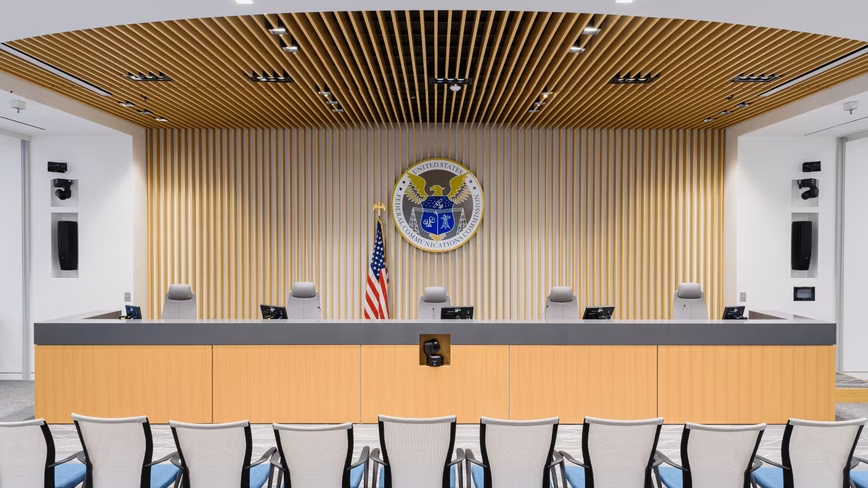
 Credit: US Federal Communications Commission
The Federal Communications Commission has raised about $3.5 billion from an auction of mid-band wireless spectrum, with most of the proceeds earmarked to fund the removal of Chinese-made telecom equipment from US networks.
The agency’s long-running “rip and replace” programme, which reimburses smaller carriers for swapping out gear from Huawei and ZTE, has spent years short of the money Congress promised it, and the auction was the mechanism chosen to close the gap.
Up to $3.3 billion of the proceeds will go towards repaying a Treasury loan that has been keeping the rip-and-replace effort alive.
The programme was established by a 2021 law with $1.9 billion in funding, but carriers submitted reimbursement requests closer to $5 billion, leaving a shortfall the FCC estimated at roughly $3 billion.
Rather than wait for a fresh appropriation, Congress authorised the agency to auction spectrum and direct the receipts back to the carriers doing the removal.
The spectrum in question is the AWS-3 band, a slice of mid-band airwaves the FCC had previously sold and then found itself reauctioning after a tangle of defaulted licences.
The agency adopted final rules in 2025 and set the sale in motion this month. Mid-band spectrum is the workhorse frequency for 5G coverage, balancing range and capacity in a way that the very high and very low bands cannot, which is part of why the auction drew the bidders it did even as demand started slowly.
The rip-and-replace effort sits inside a longer campaign to push Chinese vendors out of Western communications infrastructure on national-security grounds, the worry being that equipment supplied by firms with obligations to Beijing could be used for surveillance or sabotage.
The same logic now drives US pressure on allies abroad. Washington has been urging NATO members to use defence budgets to tear out Huawei gear, a suggestion that landed with a shrug in Brussels, where Europe remains split over how far to go.
That split is instructive about the bill the US has set itself. Chinese vendors supply an estimated third to 40 per cent of Europe’s 5G infrastructure, and a full removal there would be the largest forced replacement of telecoms equipment in the continent’s history.
The European Commission has labelled Huawei and ZTE high-risk suppliers and wants tighter oversight, but Germany and Spain have been leading the resistance to a bloc-wide ban, wary of the cost and of retaliation from Beijing.
The American programme is smaller in scope but further along, and the auction gives it the cash to keep going.
For the carriers waiting on reimbursement, mostly rural and regional operators that built networks on Huawei and ZTE hardware because it was cheap and capable, the money cannot arrive fast enough.
Many have already pulled equipment on the promise of being repaid, and the funding gap has left some of them carrying the cost in the meantime. The FCC has granted repeated extensions to the removal deadlines as the financing caught up.
The auction does not make the programme whole on its own, but it closes the largest part of the shortfall, and it does so without asking Congress for new money.
What the sale settles is the funding question, not the strategic one. The US has decided that the presence of Chinese gear in its networks is a risk worth several billion dollars to eliminate, and it has now found a way to pay for the conviction.
Whether allies reach the same figure is the question that travels to the next NATO meeting.
Get the TNW newsletter
Get the most important tech news in your inbox each week.
Also tagged with


