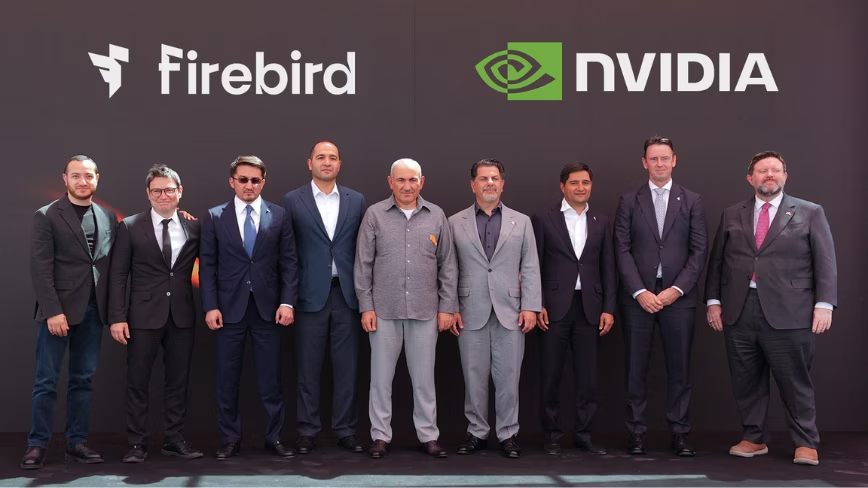
The launch of Firebird’s AI factory in Armenia, the largest in the region.
 Credit: Nvidia
When Armenia opened the biggest AI factory in its region last month, we filed it under compute diplomacy. The Wall Street Journal now reports what the compute actually bought.
Robbie Whelan reported on Friday that US negotiators used the promise of access to Nvidia’s AI chips to help secure a peace deal. Armenia and Azerbaijan reached that preliminary agreement last year. His sources are people involved in the talks.
The inducement, specifically, was expanded approval for chip purchases for an Armenian data centre project. The Journal says that detail had not been reported before. It calls the arrangement one of the most striking instances so far of what US officials are calling chip diplomacy.
We covered the building without knowing what it was for
Firebird’s facility in Hrazdan opened in August. We reported it at the time as the largest AI factory in the region. The slug we gave it carried the words export licence and compute diplomacy, because the approval was the interesting part even then.
What we did not have was the reason for the approval. Prime Minister Nikol Pashinyan appeared at the opening flanked by technology and political leaders. The banner behind them carried the Firebird and Nvidia logos. The Journal reports the chips behind that banner were part of what brought him to the table.
Two nations spent decades in conflict over Nagorno-Karabakh. The agreement their leaders initialled last year followed White House intervention. According to the Journal, a data centre was inside the deal.
Why a licence is a lever at all
Advanced Nvidia processors are export-controlled. A buyer outside a small group of trusted countries needs Washington to approve the sale, and approval is discretionary.
That makes an export licence something a government can grant, withhold, expand or slow down, without passing a law or spending money. It is closer to a visa than to a subsidy.
Which is why it works as a diplomatic instrument. A country that wants to host AI infrastructure cannot buy its way there if the licence does not come, and no amount of domestic capital substitutes for the hardware.
Firebird has done this before, in a different country
The company is not incidental to the pattern.
Kazakhstan signed a $10bn agreement with Firebird in June, to build what it called Data Center Valley. The same Nvidia-backed developer, the same model, a different post-Soviet state.
Read the two together and Firebird looks less like a data centre company that happens to work in difficult places. It looks more like an instrument. Where it builds, American chips arrive under licence, and American diplomacy arrives with them.
The Gulf version ran in parallel
Washington has used the same lever elsewhere, and we have been tracking the results.
G42, the Abu Dhabi AI company, is exploring the sale of a majority stake to American companies, as we reported on Thursday. The purpose is to secure chip access past April 2027. That is the same currency, spent in the other direction: a company reshaping its ownership to keep buying.
Armenia got chips for signing a peace deal. G42 is contemplating selling control of itself to keep the chips it already has. The instrument is identical.
We named it in May
The phrase the Journal attributes to US officials is not new to this desk.
In May we published a piece on AMD’s Lisa Su meeting China’s vice premier in Beijing. The slug read chip diplomacy intensifies. In August we used compute diplomacy for Armenia. The vocabulary was available because the pattern was visible before the confirmation arrived.
Azerbaijan, for its part, has its own ambitions in the sector. Its startups raised $2.6m last year, which is the scale it is working from.
What sits inside the deal
The Journal’s account puts roughly 70,000 Nvidia processors behind a proposed $5bn Firebird project in Armenia. Those figures reach us through follow-up coverage of the Journal rather than from the article itself, which sits behind a paywall.
Rev Lebaredian, a senior Nvidia executive of Armenian descent, told the Journal that chip diplomacy is front and centre for this administration. He said the company’s presence in Armenia is a factor in creating the conditions for peace.
That is an unusual sentence for a chip executive. It describes commercial activity as a component of a peace process, in a country where his employer’s hardware was the offer on the table.
Jensen Huang appeared by video at the ribbon cutting, framing the facility as the start of connecting the region to the global AI economy. Huang advises the president on artificial intelligence.
Armenia is not the first place Washington has spent this currency. Follow-up coverage of the Journal notes that AI hardware has featured in arrangements with the United Arab Emirates and Saudi Arabia, which is the pattern the G42 talks sit inside.
There is also a physical component to the Armenian settlement. US Middle East envoy Steve Witkoff has proposed rail lines, pipelines and roads connecting Azerbaijan to its exclave of Nakhchivan, with construction due to start next year.
The parts nobody has published
Several things are still missing, and they are the things that would let anyone judge this.
No public account says what Azerbaijan received, only what Armenia did. Nobody has published the export licence terms, the conditions attached, or what happens to the approval if the agreement fails. It is a preliminary deal, not a treaty.
The Commerce Department has said nothing publicly about whether an export licence can be conditioned on a diplomatic outcome. That is the question a lawyer would ask first.
What is on the record is narrower and still substantial. A US administration treated advanced semiconductors as a bargaining instrument between two states at war, and an Nvidia executive has said so on the record.
Get the TNW newsletter
Get the most important tech news in your inbox each week.


