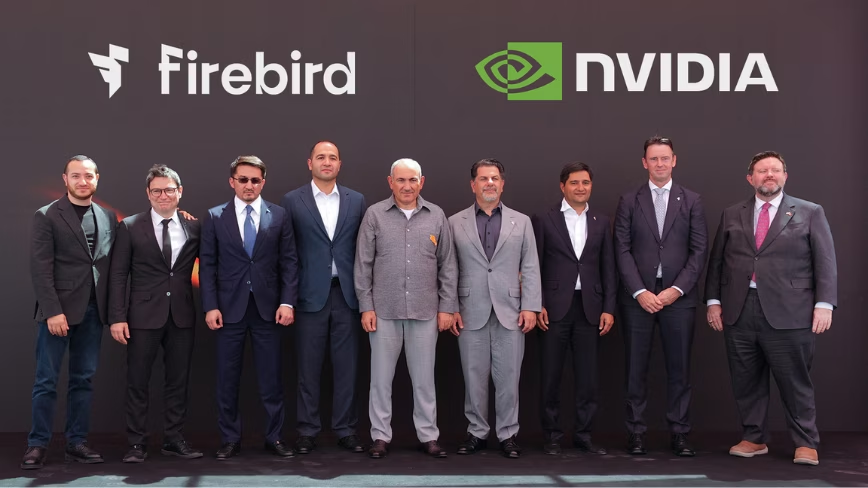
The launch of Firebird’s AI factory in Armenia, the largest in the region.
 Credit: Nvidia
Firebird, a US-based AI cloud company, opened what NVIDIA calls the CIS region’s largest AI factory in Hrazdan, Armenia on Saturday. Armenian Prime Minister Nikol Pashinyan attended, alongside Kazakhstan’s deputy prime minister Zhaslan Madiyev and David Allen, the US chargé d’affaires in Armenia.
That guest list is the story. A US company opened a facility in a country inside Russia’s traditional sphere of influence, with an American diplomat and a Kazakh minister watching.
The licence is the load-bearing fact
None of this happens without export approval. Firebird secured a US export licence in November 2025, the regulatory step that allowed advanced NVIDIA hardware into Armenia at all.
The politics were made explicit in February. Firebird and the US government jointly announced Phase 2 at a Yerevan press conference during Vice President JD Vance’s visit, scaling the project to $4 billion and roughly 50,000 GPUs with licensing for a further 41,000 NVIDIA GB300 units.
Phase One was $500 million. The announcement claimed Armenia would host one of the world’s five largest AI GPU clusters.
What is actually running
The opened flagship, DC-1, is specified at 6,144 NVIDIA B200 GPUs across 15 megawatts, liquid-cooled and built on NVIDIA’s reference architecture. The target is more than 70,000 Rubin and Blackwell GPUs and 300 megawatts by the end of 2027.
That is a twentyfold increase in power capacity in roughly 17 months. A planned DC-2 is listed at 75,000 VR200 GPUs across 125 megawatts, with a third site at similar scale.
The delivery speed is genuinely notable. NVIDIA says the site went from plan to operating capacity in just over six months, with Schneider Electric supplying switchgear, three-phase UPS systems and rack enclosures, and Vertiv providing chilled-water cooling.
The power trick
The facility runs on NVIDIA’s DSX platform, which codesigns compute, networking, power and cooling as a single system rather than separate procurements. NVIDIA claims it allows up to 40% more GPUs on the same footprint by recovering stranded power.
For a site scaling from 15 to 300 megawatts, that coordination is where the capacity maths gets made. It is also, in NVIDIA’s own framing, a tokens-per-dollar argument rather than a performance one.
Who is paying for it
Firebird said NVIDIA intends to invest in the company, following an earlier CoreWeave investment this year. The pattern is familiar: NVIDIA takes a position in a company that then buys NVIDIA hardware at scale.
NVIDIA has now committed more than $40 billion to AI equity positions in 2026, and the structures have grown more creative. It took a $2.1 billion warrant in IREN as part of a five-gigawatt data centre deal.
The same logic runs through its sovereign deals. NVIDIA invested $1 billion in Naver while striking a $500 billion arrangement with SK Group, an approach critics have labelled circular financing.
The neocloud playbook
Firebird fits a category that barely existed three years ago: companies that buy GPUs at scale and rent them to model builders. CoreWeave, an early Firebird backer, has signed a multi-year deal with Anthropic to run Claude at production scale.
Europe has its own version. Nscale committed €695 million to Portugal with Microsoft, reaching a $14.6 billion valuation in two years, on much the same thesis about sovereign capacity.
Firebird’s first named customer is Perplexity, which is using the site for its answer engine and AI agent platform.
Where this goes next
Firebird is pursuing an approximately two-gigawatt roadmap spanning Armenia, Kazakhstan and further markets, which explains why a Kazakh deputy prime minister was at an Armenian ribbon-cutting.
The strategic logic is straightforward. Compute is becoming the thing countries align around, and the United States has found a way to place it in a region where its influence has historically been thin.
The open question is demand. Building 300 megawatts in the Caucasus assumes customers will route workloads there rather than to cheaper or closer capacity, and one answer engine does not settle that.
Get the TNW newsletter
Get the most important tech news in your inbox each week.


