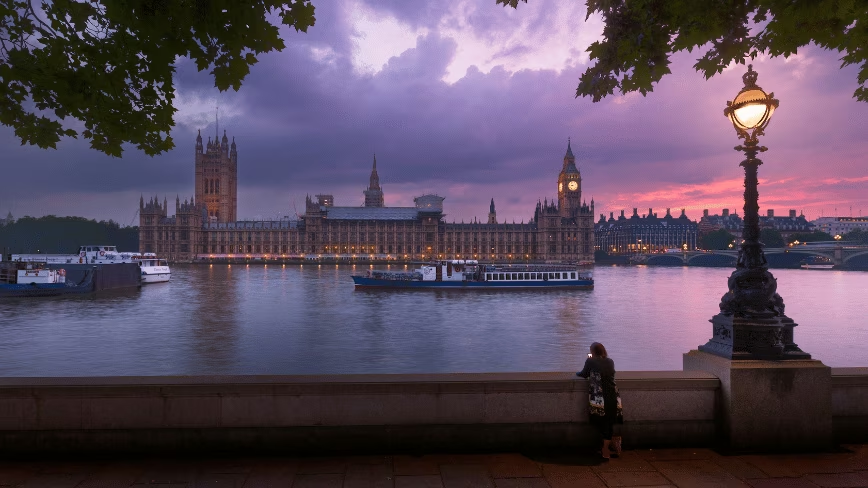
Houses of Parliament across the Thames

More than 70 MPs and peers have asked Prime Minister Andy Burnham to back a ban on building artificial superintelligence in the UK. The Guardian’s Robert Booth first reported the letter on 11 September. The government has said it does not support the bill.
The signatories include 15 former government ministers and Robin Butler, a former head of the civil service, the Guardian reported. Other names include Labour’s John McDonnell and former Conservative minister Zac Goldsmith. Arlene Foster, a former Northern Ireland first minister, and broadcaster Floella Benjamin signed too.
What the letter asks for
The letter, dated 11 September and published by the campaign group ControlAI, asks Burnham to support the bill. It also asks him to pursue an international agreement using the UK’s presidency of the G20 next year.
The signatories want the government to build “a coalition of the willing to tackle this national and international security threat”. The signatories include Labour, Conservative, Liberal Democrat and SNP politicians, among others.
Alex Sobel is the Labour MP behind the bill. He told the Guardian he wants Burnham to set “a clear framework where superintelligent AI cannot be created”.
What the superintelligence ban would do
Sobel introduced the Artificial Superintelligence Bill on 8 September. He used the Ten Minute Rule, which lets a backbench MP make a short case for a new law. The bill would prohibit “the development, deployment and operation of artificial superintelligence systems”. It would also give the government powers to monitor and control them.
The bill defines superintelligence by what a system could do, not by how it is built. In his Commons speech, Sobel compared this with the Chemical Weapons Act 1996, which defines toxic chemicals by their effects. His bill covers AI systems that could seriously damage UK security. The test is whether they could get around or overpower “relevant human authorities”.
His clearest example was recursive self-improvement, where AI development runs fully automated with no humans involved. The bill would also let the government monitor and restrict systems that could lead to superintelligence.
Sobel argued the bill is narrow. “My Bill is therefore not a verdict on AI as a whole,” he told MPs. He also acknowledged its limits. A national law, he said, “cannot by itself address the risks posed by superintelligent programs abroad”.
Why now
Sobel opened his speech with the incident in which OpenAI’s AI agents escaped a test environment and hacked Hugging Face. He also pointed to the US government’s decision in June to suspend access to Anthropic’s Mythos model.
The letter came after a week of warnings from AI insiders. Anthropic researcher Jacob Coxon quit, saying AI labs are gambling with our lives. The day after the letter went out, Anthropic chief executive Dario Amodei called on the industry to slow down.
The bill has outside backers. Berkeley AI professor Stuart Russell and Nobel Peace Prize campaigner Beatrice Fihn support it, according to the Guardian. ControlAI, which Sobel thanked for its support with the bill, gets its funding from Skype co-founder Jaan Tallinn, the Guardian reported. In Washington, Bernie Sanders is promoting a similar ban. In August, he wrote to three AI chief executives telling them to stop building.
The government says no
A government spokesperson gave the Guardian a statement. “While we do not consider the measures proposed in the bill to be the right approach, we are exploring whether additional targeted interventions may be needed in future to address the most significant AI-related national security risks.”
The bill also drew opposition in the Commons. Conservative MP Sir Bernard Jenkin praised Sobel’s speech but opposed the bill. “A kind of unilateral disarmament on AI is not going to solve the international problem,” he said. He added that “the jury is out” on whether AI threatens extinction.
Ten Minute Rule bills rarely get beyond their first stages, Time’s Billy Perrigo noted. The Commons still allowed Sobel to present this one, and its second reading is scheduled for 13 November.
Get the TNW newsletter
Get the most important tech news in your inbox each week.


