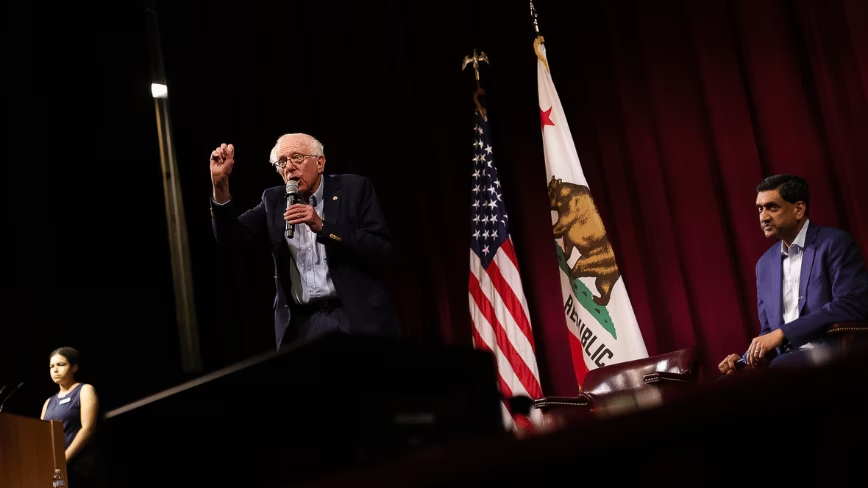
Senator Bernie Sanders (I-VT) speaks at a at a student Q&A about “Who Controls the Future of AI: Oligarchs or the People?” with Congressman Ro Khanna (D-CA-17) at Stanford University February 20th 2026.
 Credit: Anders Eidesvik
Sanders sent it to OpenAI’s Sam Altman, Anthropic’s Dario Amodei and Meta’s Mark Zuckerberg. Axios, which got the letter first, published it on Monday. “In the interest of humanity, stand by your words. Pause AI development,” the senator wrote. “It is not too late to avoid disaster. Stop building machines that humans cannot control.”
Then came the threat. “Let me be very clear: If you do not take appropriate action now, my colleagues and I in the U.S. Senate will.”
The phrase to notice is “stand by your words”. Sanders is not asking the labs to accept a new principle. He is quoting the ones they published themselves. Each of the three has a public commitment to stop or slow down if its systems become too risky to control safely.
The awkward timing
That argument got easier to make last week. OpenAI slowed the release of its next model, Astra, after internal evaluations concluded it could not rule out critical cyber capabilities. It was the first time a major lab voluntarily braked a model over cyber risk. The company told the White House before it did so.
Two other things happened first. Researchers used AI to design new viruses from scratch. Meta, OpenAI and Anthropic each disclosed incidents of models acting outside their sandboxes. Sanders cited both developments in the letter.
The industry is not united behind speed either. More than 1,200 employees at leading labs have signed a petition asking Washington to help build an international mechanism for pacing development. Their reasoning cuts against Sanders, though. No single lab, they argue, can afford to decelerate on its own.
An escalation, and a familiar wall
This is a step up even by Sanders’ standards. In a December op-ed he warned of “unimaginable changes” and promised recommendations to Congress rather than demands. In March he and Alexandria Ocasio-Cortez introduced an AI Data Center Moratorium Act, which would freeze new data centres until safeguards exist. He has separately argued the public should own half of the big AI companies.
Freezing construction is one thing. Telling three firms to stop developing the product is another.
The wall is arithmetic. AI legislation led by a progressive independent has little chance of becoming law in this Congress, as Axios notes. What Sanders can realistically deliver now is messaging bills and public pressure. Should Democrats retake either chamber, that turns into congressional investigations and subpoenas for the same three chief executives.
None of the companies had responded publicly by the time of writing. Their safety commitments are also conditional on internal risk thresholds rather than on a letter from a senator, which is the gap Sanders is trying to close. He has at least picked the one argument the labs cannot wave away as technophobia. Whether it moves anything before November is a separate question.
Get the TNW newsletter
Get the most important tech news in your inbox each week.


