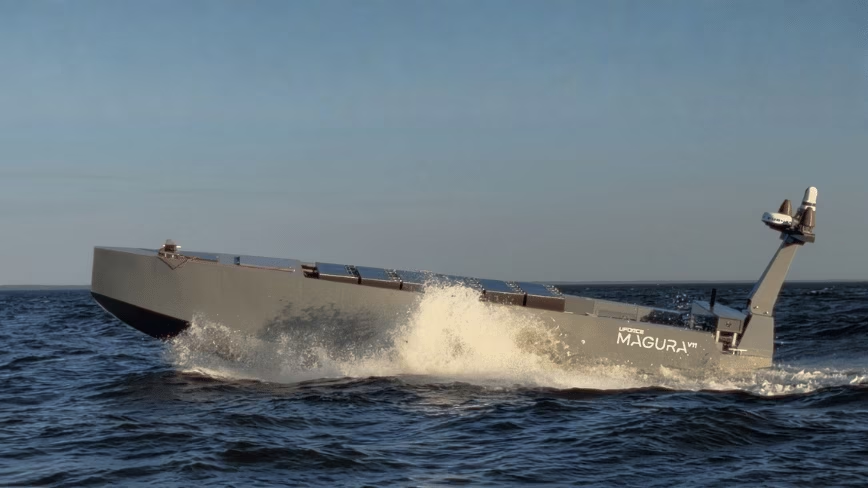
Uforce’s Magura MV11 uncrewed surface vessel, unveiled in August 2026.

Uforce, the London-based drone company built from Ukrainian battlefield manufacturers, is in talks to raise about $500m at a valuation of around $5bn, Bloomberg reported on Monday. Valor Equity Partners, the firm run by SpaceX board member Antonio Gracias, would lead the round.
Yazhou Sun and Rebecca Torrence cited people familiar with the matter who asked not to be named. The round has not closed and the terms could change, they said. Uforce declined to comment to Bloomberg. TNW has not independently verified the report.
If the number holds, Uforce will have gone from a $1bn valuation to $5bn in six months. It raised $50m in March at just over $1bn, led by Shield Capital and Lakestar. Sifted reported in August that the company was seeking upwards of $4bn. Bloomberg’s figure is a billion higher, three weeks later.
What Uforce is
The company is not a startup in the usual sense. It formed from nine Ukrainian defence manufacturers that had been working together since Russia’s full-scale invasion, and moved its headquarters to London, partly to protect itself from sabotage. Its portfolio covers all three domains: the Magura sea drones that have struck Russian warships in the Black Sea, the Nemesis strike drones, ground robots, and counter-drone systems.
In April, Ukraine said it had seized an enemy position using only unmanned systems, and Uforce was at the centre of the claim. The company said then that it had run more than 150,000 combat missions since 2022. No Western defence startup has a record like it, because no Western defence startup has fought a war.
The scale behind it is real. When TNW last looked at the company in May, it employed more than 1,000 engineers, developers and operators across six European countries and reported bookings growth of 450% for 2025. Those were company figures with no public audit behind them. But they are the numbers a $5bn price is being set against.
That record is what Uforce is selling. Its pitch, as Bloomberg describes it, is an integrated combat system that NATO can buy off the shelf while Europe scrambles to build drone arsenals.
Who runs it
The people running it are political as much as technical. Chief executive Oleg Rogynskyy previously built the sales software company People.ai. Chairman and co-founder Oleksiy Honcharuk was Ukraine’s prime minister in 2019 and 2020. Ben Wallace, the former UK defence secretary, sits on the board. Bloomberg corrected its story on Monday afternoon after the company said Rogynskyy is not a founder. The distinction matters: he runs a merger of nine companies rather than having built any of them. The men who did build them are the ones NATO buyers will want to meet.
Why Valor matters
The investor says as much as the number. Valor is Gracias’s firm, and Gracias is one of Elon Musk’s longest-standing backers. Valor owned about 4% of SpaceX when it listed, according to Bloomberg, and has since put money into Anduril, Hadrian and Chaos Industries. Hadrian, which builds automated defence factories and counts Valor among its backers, raised $1.37bn at $8bn in August.
Gracias has been explicit about where the SpaceX proceeds go. Bloomberg reported in July that he was looking at AI and energy bets after the listing. Defence hardware built on live combat data sits close to both.
A Valor-led round would put Uforce inside the same investor network as the most aggressive American defence startups. It would also mark a US firm leading the largest round yet for a European drone company built on Ukrainian technology, at a moment when Europe is trying to buy less from America, not more.
The European drone repricing
The $5bn figure only looks large in isolation. Quantum Systems, the German surveillance drone maker, raised $1.2bn at $8bn in July. Helsing raised $1.8bn at $18bn the same month. Berlin’s Stark Defence raised $500m at $3.5bn in June.
Against those, Uforce at $5bn ranks as the third or fourth European drone company by price, not the first. What separates it from the others is not the valuation but the source of the product. Quantum Systems and Helsing sell to Ukraine. The companies inside Uforce built their drones there, under fire, and are now selling the result to the countries that funded the war.
The buyer side is moving too. Europe’s governments have spent 2026 announcing drone programmes, and the suppliers with finished systems are the ones collecting the valuations. The US is taxing imported drones at 100%, with Europe capped at 15%, and NATO is building an AI-driven sensor and strike network along its eastern flank. Both create demand for a supplier that already has an integrated system rather than a component.
What to watch
Three things will tell you whether this round is real. The first is the close. Bloomberg’s sources said the terms could change, and Sifted’s $4bn became Bloomberg’s $5bn in three weeks. Valuations that rise between reports sometimes fall between term sheet and wire.
The second is who else is in. A Valor-led round with European co-investors is a different deal from a Valor-led round without them. Lakestar and Shield Capital led in March; whether they follow on tells you what the earlier backers think of the price.
The third is the customer list. Uforce is selling to NATO governments, and NATO governments announce procurement. A $5bn valuation on Ukrainian orders is a war stock. The same valuation on a German or Polish contract is a company.
Get the TNW newsletter
Get the most important tech news in your inbox each week.


