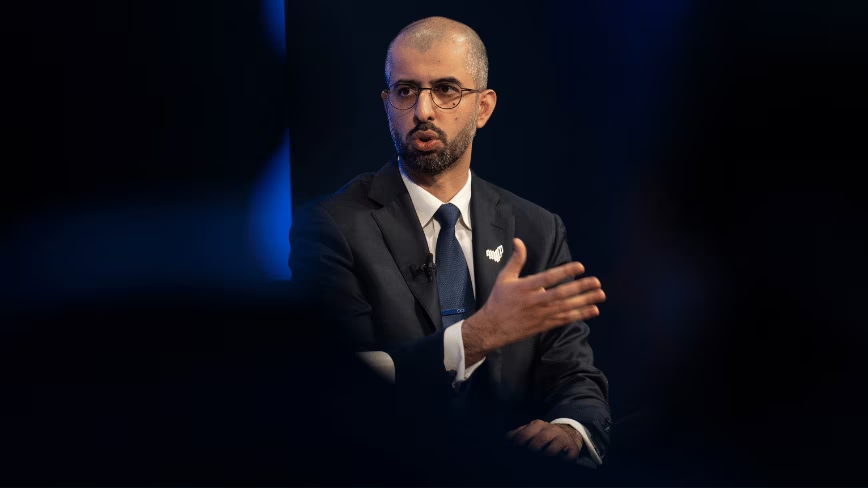
UAE Minister of State for Artificial Intelligence Omar Sultan Al Olama speaks at the World Economic Forum Annual Meeting in Davos in January 2023

The UAE will change its requirements for data centres and stop promoting where they are. Omar Sultan Al Olama, the country’s Minister of State for Artificial Intelligence, Digital Economy and Remote Work Applications, said so on Tuesday at Dreamforce in San Francisco.
Data centres have become critical infrastructure and a target, he told Salesforce chief executive Marc Benioff.
“Unfortunately they’re more important than bridges. They’re more important than roads. They’re more important than tunnels because our whole lives are on these devices that we’re using,” Al Olama said, in a session Salesforce published.
Salesforce lost both UAE data centres
Benioff raised the war in the region during the conversation. Salesforce has two data centres in the UAE for backup and recovery, he said. Both run through a relationship with Amazon.
Salesforce was surprised that on the first day of the war “both of those data centers were destroyed”, Benioff said. Its teams had to recover as much as they could. They also opened a backup data centre outside the country.
Amazon Web Services said this week it cannot restore its Bahrain region or one UAE zone, six months after the strikes.
Al Olama said he was due to fly to Ecuador on 28 February, the day the war began. In the first week, the UAE faced more than a thousand projectiles and drones, he said. A launch from Iran takes about two minutes to reach the country.
The UAE intercepted more projectiles than the whole Middle East and Israel combined, according to Al Olama. He said the impact on human lives and on business was zero. Life in the country is now completely normal, he added.
“We’re not going to promote the locations of data centers for anyone who wants to have any idea to do something with them,” he said.
He expects most countries will need to change their rules too.
“We can’t afford to make that mistake again”
Al Olama became the UAE’s AI minister in 2017. He said the Middle East led the world in technology, economy and culture from 813 AD to 1515 AD. Then it banned the Gutenberg printing press for 200 years and fell behind.
He gave three reasons for the ban. Rulers feared misinformation. Clerics feared people would alter the holy scriptures. Advisers feared the unknown. Al Olama compared those fears to today’s calls to regulate AI.
“So, we can’t afford to make that mistake again. And even if you fear certain things, you have to put your head down and focus on the things that you know are going to change people’s lives.”
Al Olama also said he felt “very scared” the first time he heard AI founders describe what the technology could become.
Older models in government, frontier models kept out
Governments do not need the newest models to improve people’s lives, Al Olama argued. Most UAE government services now use large language models to answer questions, he said. They use older models, not frontier ones such as Anthropic’s Fable or OpenAI’s Astra.
He pointed to TAMM, an Abu Dhabi app. Users tell an agent what they need, and it handles the whole government process for them.
Some say frontier models carry cyber security risks. If that is the consensus, governments should agree not to deploy them, he said. A leak or the loss of records would affect millions of people.
His other red line is AI that predicts crime. The problem is false positives, he said. A person the system flags might never commit the crime.
He also warned against a surveillance state. The UAE looks at AI for quality of life, not economic gain, he said. He gave the “red carpet experience” at the airport as an example. UAE residents walk along it past ultra high-definition cameras, without stopping at a desk.
80,000 civil servants trained on agents
Al Olama addressed job losses directly. The UAE has trained 80,000 people in agentic AI, he said. That is every employee of the federal government. Before that, it trained a million people to write prompts for AI.
He expects AI to create jobs rather than destroy them. Anyone who does lose a job will be able to do more with that knowledge, he argued. Fifty-six of the UAE government’s chief AI officers were in the audience.
Dubai’s business chamber has run its own agentic AI training for companies.
Regulation: bring in the innovators
On regulation, Al Olama said governments should hire people with an innovator’s mindset. He described how the UAE wrote its data protection law. It did not copy the EU’s GDPR. Instead, it asked data companies to draft the law. Then government and civil society filled the gaps.
Government officials tend to overregulate and the private sector tends to underregulate, he said. On East and West, he called AI development a race.
“So if you go and ban artificial intelligence in the US it will mean that you’re at a disadvantage. Unless you can convince China to do that as well then this isn’t an option that’s on the table.”
A cure for cancer, and a warning
Looking ahead, Al Olama said he expects a cure for cancer within five years if the breakthroughs continue. He also warned of an age of “incredible inequality”. Companies must make the technology fair and affordable for Africa, Asia and Latin America, he said.
The UAE is investing abroad in AI infrastructure, including a planned investment in German data centres. At home, it is splitting up its Stargate data centre after the Iran threat.
Get the TNW newsletter
Get the most important tech news in your inbox each week.


