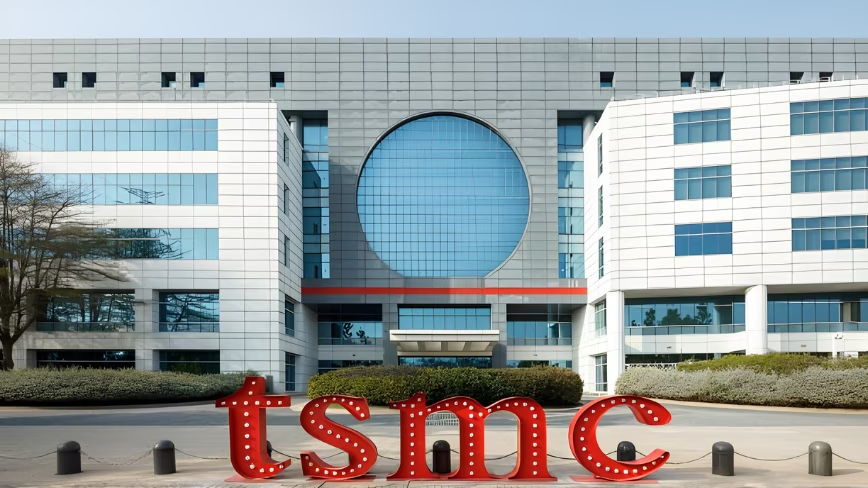
TSMC will build additional advanced packaging fabs in the second phase of the Chiayi Science Park in southern Taiwan, National Science and Technology Council minister Wu Cheng-wen said at a groundbreaking ceremony on Sunday.
Packaging is where the AI supply chain currently pinches, and it is the same constraint that Nvidia’s multi-year HBM4 deal with SK Hynix was written to relieve.
Wu said TSMC would add three advanced packaging facilities in Phase II on a site of roughly 90 hectares that will be developed into a packaging cluster led by the company.
Two facilities in Phase I of the park began mass production in June. Once both phases are running, companies at the Chiayi Science Park are expected to generate more than NT$300bn ($9.35bn) in annual output and support around 9,000 jobs, Wu said.
The expansion is aimed squarely at demand for high-performance computing chips, where TSMC’s CoWoS process, which fuses logic dies and stacked memory into a single package, has been the gating item for two years.
Every AI accelerator that matters passes through that step, which is why capacity announcements in a rice-farming county now move the industry’s planning assumptions.
Demand for that step keeps arriving from new directions. Google’s four-partner inference chip supply chain, built with Broadcom, MediaTek and Marvell, runs through TSMC like everyone else’s, which means each new custom accelerator programme lands as another claim on the same packaging lines.
Wu framed Chiayi as one link in a longer chain, saying the park would connect with the Southern Taiwan Science Park sites in Tainan, Kaohsiung and Pingtung, along with the Central Taiwan and Hsinchu parks, to form what he called the world’s most comprehensive AI and semiconductor corridor. Biotechnology, aerospace and precision machinery firms are expected to move into the Chiayi site over time.
The groundbreaking landed on the same day TSMC reported record second-quarter revenue of T$1.27tn ($39.62bn), up 36% year on year and slightly ahead of an LSEG SmartEstimate drawn from 20 analysts. June revenue alone rose 67.9% from a year earlier to T$442.68bn.
Those figures were originally due last Friday and were delayed by Typhoon Bavi, which shut financial markets in Taipei. TSMC gave no forward guidance in the statement and will update its outlook at its earnings conference on Thursday, where analysts expect a 58.8% rise in second-quarter net profit.
The revenue print landed slightly above the upper end of the company’s own April guidance of $39bn to $40.2bn, a range TSMC gives only in US dollars. Yuanta Securities had told clients last week to expect gross margin at the top of the 65.5% to 67.5% band, with earnings per share around NT$24.1.
Shares closed up 1% in Taipei on Monday ahead of the release, while the broader market finished flat.
The company is now Asia’s most valuable listed business, with a market capitalisation of about $1.96tn, and its Taipei-listed shares are up 57% this year. That kind of run has drawn its own commentary at home, with Taiwan’s central bank governor warning investors about leverage as the AI rally has extended.
What Wu did not give was a construction timeline, a cost for the Phase II fabs, or a date for when the new capacity comes online. TSMC itself has not published a separate statement on the expansion, and the numbers so far come from the government rather than the company.
Chiayi County was known, until recently, mainly for agriculture. It is now being asked to host the step in the process that decides how many AI accelerators the world gets to ship.
Get the TNW newsletter
Get the most important tech news in your inbox each week.


