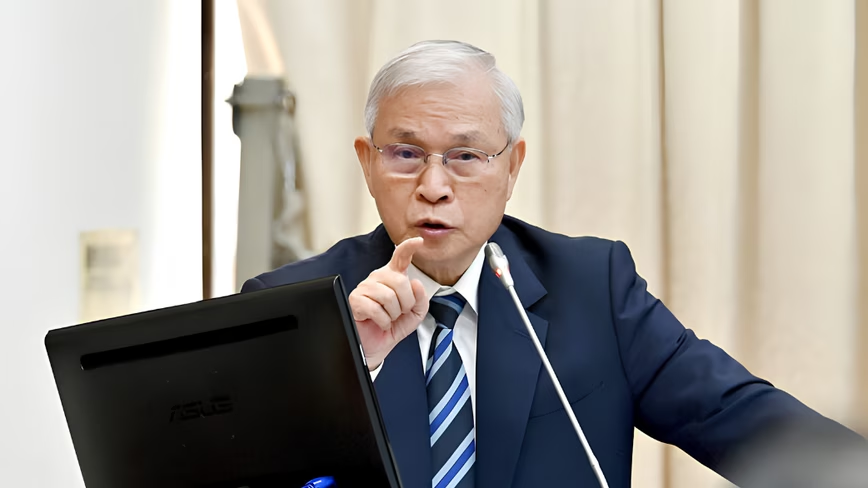
 Credit: George Tsorng/Taipei Times
Taiwan’s top central banker has urged investors to steer clear of heavy borrowing to chase the island’s surging stock market, a rally powered by global demand for the AI hardware that Taiwanese firms supply.
Yang Chin-long, governor of the Central Bank of the Republic of China (Taiwan), delivered the caution on Thursday while reporting to lawmakers, as debate over an overheating AI trade reaches Taipei.
“I can only say that we hope investors do not use excessive leverage in their investments,” Yang told the legislature’s Finance Committee, adding that the market as a whole rested on solid fundamentals.
His comments were more measured than the bubble talk circulating in global markets. Rather than declaring an AI bubble outright, Yang played down the idea that rising retail borrowing posed any immediate threat, saying the situation was far from signalling systemic risk.
The context is a remarkable run in Taipei. The benchmark Taiex has climbed around 60% since the start of the year, hitting a record 46,459 points on 3 June before slipping into a correction.
That surge tracks the fortunes of the companies at the heart of the AI supply chain, above all chipmaker TSMC, whose weighting dominates the index. As orders for AI accelerators have swelled, so has the temptation for retail investors to borrow against homes and other assets to buy in.
Lawmakers have flagged what they call the “four loans” problem, meaning mortgages, margin financing, personal credit loans and car loans being redirected into equities.
Yang acknowledged the rapid inflows but said regulators were watching them closely and saw no sign of a broad financial-stability threat.
He also drew a careful distinction over the central bank’s own financial-stability report, which had noted fast-growing financing linked to AI-related sectors.
Those references, Yang said, drew on International Monetary Fund analysis rather than the bank’s independent assessment.
The nuance matters. The headline risk that markets fret about, a sudden repricing of AI stocks, is not what Yang was chiefly warning against. His concern was narrower: that leverage can turn an ordinary correction into forced selling and losses households cannot absorb.
Taiwan sits in an unusual position in the AI debate. Its economy has been one of the biggest winners of the boom, with exports and growth lifted by insatiable demand for chips, yet that same concentration leaves it exposed if sentiment turns.
The stakes are national, not just personal. Taiwan’s export-driven economy has been running unusually hot, with forecasters pencilling in some of its fastest growth in years on the strength of chip shipments, much of it flowing through a handful of firms.
It is a tension others in the industry keep circling, from those who insist it is no bubble to sceptics who see stretched valuations.
For a central bank whose currency underpins one of the world’s most AI-exposed economies, the calculus is more delicate than a single verdict on the technology.
Central bankers elsewhere have voiced sharper warnings, with some cautioning that stretched AI valuations could seed a broader financial shock.
Yang’s message was calmer, and pointed inward at investor behaviour rather than at the technology itself.
Regulators have tools if froth builds, from raising margin requirements to tightening credit, though Yang gave no hint that any were imminent. His preference, in keeping with the bank’s cautious style, was to talk investors down rather than legislate them out of the trade.
For now, the governor’s prescription is restraint rather than alarm. He stopped short of proposing new curbs on margin lending, leaving the message to investors simple enough: enjoy the rally if you must, but do not bet the house on it.
Get the TNW newsletter
Get the most important tech news in your inbox each week.


