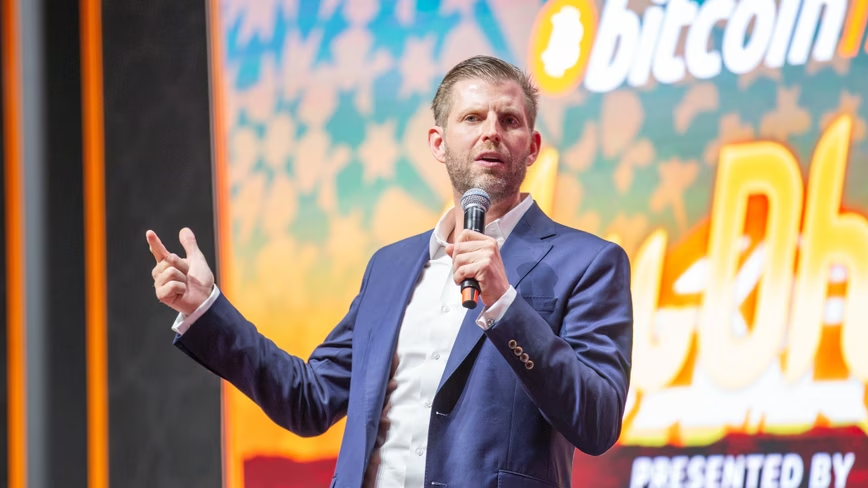
Eric Trump speak at Bitcoin conference in Abu Dhabi United Arab Emirates Abu Dhabi ADNEC Marina December 11, 2024
 Credit: Tarek ibrahim / Shutterstock.com
A crypto venture backed by Donald Trump and his family is helping to bankroll a platform that resells artificial intelligence from Chinese companies the US government has blacklisted, an arrangement that sits awkwardly beside the administration’s own campaign to choke off China’s AI industry.
Reuters reported on Monday that World Liberty Financial, the Trump-linked crypto firm, is behind WorldClaw, a Hong Kong-based service offering access to models from developers Washington has flagged as security risks.
WorldClaw’s pitch is a menu of roughly 90 AI models, of which about 43 come from Chinese companies.
They reportedly include Alibaba and Baidu, both designated by the Pentagon as aligned with China’s military, and Z.ai, which is subject to US Commerce Department export restrictions.
The line-up is also said to feature DeepSeek and Moonshot, two labs that American officials have accused of building their systems on stolen US technology. Models from OpenAI and Anthropic sit on the very same shelf.
The financial plumbing is what turns an unremarkable AI reseller into a political problem.
Customers can pay for WorldClaw using USD1, World Liberty Financial’s dollar-pegged stablecoin, and each such transaction stands to benefit the venture, in which the Trump family is reported to hold a stake of around 38%.
Put plainly, the president’s family could earn from Americans buying access to the Chinese AI that the president’s own government is straining to keep out.
That is the crux of the discomfort. The administration has made countering Chinese AI a centrepiece of policy, from export controls on advanced chips to public accusations that Chinese labs are copying American models at industrial scale.
A Trump-branded venture positioned to profit from selling those same models is, at the very least, an unusually literal collision between public policy and private interest.
The tension is not abstract: the harder the administration pushes to restrict a given Chinese lab, the more valuable a frictionless way to buy its models quietly becomes.
World Liberty and WorldClaw reject that framing. The two say they operate independently of one another, and that listing an AI model does not amount to endorsing its developer, no more than an app store vouches for every app it carries.
The White House, for its part, has repeatedly maintained that Trump acts only in the public interest and holds no conflicts of interest, a position it restated in response to the reporting.
World Liberty Financial has become the most lucrative and most scrutinised of the family’s crypto ventures.
It has drawn attention both for the scale of money involved and for the unusual company it has sometimes kept, and the president’s crypto holdings have swelled into the billions on paper even as ethics lawyers warn about the fading line between the family business and the office he holds.
The firm has lately pushed deeper into the mainstream too, winning preliminary US approval for a national bank charter tied to the same USD1 stablecoin that now doubles as a payment rail for WorldClaw.
The WorldClaw arrangement crystallises a tension the crypto and AI booms keep throwing up: rules written in Washington, money made everywhere else.
Stablecoins move value across borders with almost no friction, and a reseller in Hong Kong can offer a restricted Chinese model to a buyer in Ohio in a few clicks.
Export controls were built for shipping containers and data centres, not for a checkout page settled in a president-linked token.
None of this is unlawful on its face, and WorldClaw is far from the only route to a Chinese model. But the optics are striking, and the episode will sharpen an already loud argument about whether the Trump family’s crypto empire can sit comfortably alongside the powers of the presidency.
For now, the same government trying to wall off Chinese AI has a first family placed, however indirectly, to take a cut when Americans buy it regardless.
Get the TNW newsletter
Get the most important tech news in your inbox each week.


