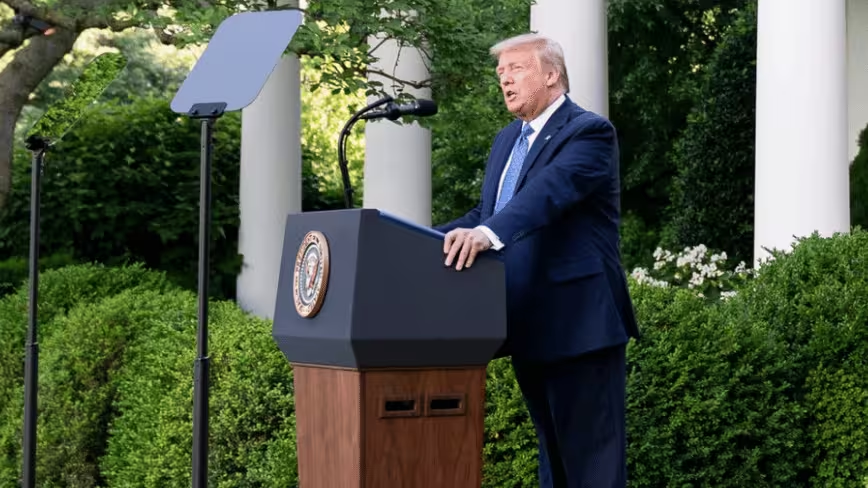
President Trump
 Credit: United States Federal Government
Summary: The White House OSTP released a policy memo accusing China of “industrial-scale” distillation of US AI models, committing to share intelligence with US AI companies and explore accountability measures. OpenAI accused DeepSeek of distilling its models in February; Anthropic named DeepSeek, MiniMax, and Moonshot AI as having created 24,000 fraudulent accounts generating 16+ million exchanges with Claude. The Deterring American AI Model Theft Act (H.R. 8283) was introduced on 15 April. The memo arrives three weeks before a planned Trump-Xi summit on 14 May.
The White House accused China on Wednesday of conducting “industrial-scale” theft of American artificial intelligence, releasing a policy memorandum that commits the government to sharing intelligence with US AI companies about foreign distillation campaigns and exploring measures to hold the perpetrators accountable. Michael Kratsios, director of the Office of Science and Technology Policy, said the US “has evidence that foreign entities, primarily in China, are running industrial-scale distillation campaigns to steal American AI. We will be taking action to protect American innovation.” The memo lands three weeks before a planned Trump-Xi summit in Beijing on 14 May, positioning AI technology protection as both a national security imperative and a negotiating chip.
Distillation is the technique at the centre of the dispute. It does not require stealing model weights or breaking into servers. A distiller feeds thousands or millions of carefully constructed queries to a frontier AI model, collects the responses, and uses those responses to train a cheaper rival model that approximates the original’s capabilities at a fraction of the cost. It is, in effect, learning from the teacher’s answers rather than the teacher’s brain. The legal status of this technique is unsettled. The strategic implications are not.
The evidence
The OSTP memo builds on allegations that US AI companies have been making since February. OpenAI sent a formal memo to the House Select Committee on China on 12 February accusing DeepSeek of distilling its models. OpenAI said it had identified accounts associated with DeepSeek employees that developed methods to circumvent access restrictions, routing queries through obfuscated third-party proxies to extract outputs at scale. OpenAI’s terms of service explicitly prohibit using outputs to create “imitation frontier AI models.” DeepSeek has not publicly responded to the allegations.
Anthropic published more detailed evidence on 23 February, naming three Chinese laboratories. DeepSeek, it said, conducted more than 150,000 exchanges with Claude focused on foundational logic and alignment techniques. MiniMax drove the most traffic, with more than 13 million exchanges. Moonshot AI generated more than 3.4 million exchanges targeting agentic reasoning, tool use, coding, and computer vision. Across the three firms, Anthropic identified approximately 24,000 fraudulent accounts that generated more than 16 million exchanges with Claude. The accounts used jailbreaking techniques to expose proprietary information and circumvented geofencing through commercial proxy services.
By early April, OpenAI, Anthropic, and Google had begun sharing distillation threat intelligence through the Frontier Model Forum, a coalition originally founded in 2023 with Microsoft. The arrangement is modelled on cybersecurity threat-sharing frameworks: when one company detects an attack pattern, it flags it for the others. That three fierce competitors agreed to cooperate on anything is itself a measure of how seriously they take the threat. DeepSeek proved that frontier AI performance no longer requires Silicon Valley-scale resources, and the question the US government is now asking is how much of that efficiency was earned and how much was extracted.
The policy response
The OSTP memo is a policy statement, not an executive order or a binding regulation. It directs federal departments to share intelligence with US AI developers about foreign distillation attempts, help industry strengthen technical defences, and explore accountability measures for foreign actors. No specific sanctions, entity list additions, or enforcement actions were announced on Wednesday. The memo’s practical force will depend on what follows it.
Congress is moving in parallel. On 15 April, Representative Bill Huizenga introduced the Deterring American AI Model Theft Act of 2026, co-sponsored by Representative John Moolenaar, who chairs the House Select Committee on China. The bill would direct the government to identify entities using “improper query-and-copy techniques” and impose sanctions through the Commerce Department blacklist. The House Select Committee held a hearing on 16 April titled “China’s Campaign to Steal America’s AI Edge,” with witnesses from Brookings, the Silverado Policy Accelerator, and the America First Policy Institute. The issue has bipartisan support. Roll Call reported that “winning the AI arms race holds appeal for both parties.”
The legal theory underpinning prosecution remains unclear. The Protecting American Intellectual Property Act, signed in January 2023, authorises sanctions for trade secret theft, but whether extracted model outputs qualify as trade secrets under existing frameworks is an open question. The South China Morning Post noted that Anthropic’s distillation charges “expose an AI training grey area,” and legal analysts at Just Security have argued that the case for imposing costs on distillation requires targeted government intervention precisely because existing intellectual property law does not cleanly cover it.
The second line of defence
The shift from hardware controls to model-level protections represents an acknowledgement that the first line of defence is leaking. The US has been restricting China’s access to advanced AI chips since October 2022, broadening the rules in October 2023 and again with the AI Diffusion Rule in January 2025. In January 2026, the Bureau of Industry and Security shifted its review of H200 and AMD MI325X exports to China from a presumption of denial to case-by-case review, while the White House simultaneously imposed a 25% tariff on advanced semiconductors. Nvidia was permitted to sell its H20 inference chip; AMD its MI308.
But hardware controls are circumvented in practice. A $2.5 billion scheme to smuggle Nvidia AI chips to China through Super Micro’s co-founder was charged in March. Jensen Huang warned that DeepSeek optimising for Huawei chips would be a “horrible outcome” for America, because it would eliminate the hardware chokepoint entirely. If advanced chips can be smuggled despite export controls, and if Chinese chipmakers are closing the gap with domestic alternatives, then preventing access to the models themselves becomes the critical second layer of the technology denial strategy. Proposals to tag AI chips with unique identifiers represent a third layer, tracking hardware flows to prevent diversion. The emerging architecture is defence in depth: control the chips, control the models, and track both.
The open-source complication
Distillation is not the only channel through which US AI technology reaches Chinese laboratories. Meta’s Llama models are open source, meaning the weights are publicly available for download. Chinese researchers from PLA-linked institutions fine-tuned Llama 13B on military data to create ChatBIT, a model designed for military intelligence applications. Meta’s acceptable use policy prohibits military and espionage applications, but the company has no technical means to enforce that restriction on open-source releases. Once the weights are published, control is relinquished. Meta responded by opening Llama to the US military and Five Eyes allies while maintaining the ban for adversaries, a policy distinction that is legally meaningful and practically unenforceable.
The tension between open-source AI and national security has been building for years but has not produced a coherent policy resolution. Open-source models drive research, attract talent, and create ecosystems that benefit American companies. Restricting them would slow US innovation while pushing Chinese developers toward domestic alternatives. Not restricting them means providing the foundational technology for adversary military applications. The Huizenga bill focuses on distillation, the unauthorised extraction of capability from closed models, rather than on open-source distribution, sidestepping the harder question.
What comes next
The US-China chip war has already drawn allies into the effort, with the Netherlands restricting ASML’s lithography exports under American pressure. Model-level restrictions would require a different enforcement architecture. Chips are physical objects that cross borders. Distillation happens over the internet, through API calls that can be routed through any jurisdiction. Detecting it requires the kind of behavioural analysis that Anthropic performed when it identified 24,000 fraudulent accounts, not the kind of customs inspection that catches smuggled hardware.
The Trump-Xi summit on 14 May will test whether the OSTP memo is the beginning of a sustained enforcement campaign or a negotiating position designed to extract concessions. China wants the US to loosen technology controls, remove more than 1,000 Chinese firms from entity lists, and reduce investment restrictions. The US wants China to stop distilling its AI models, stop smuggling its chips, and stop fine-tuning its open-source models for military use. The gap between those positions is wide enough that neither side is likely to get what it wants. What the memo establishes, regardless of the summit’s outcome, is that the US now treats AI model protection as a category of national security alongside chip export controls and semiconductor equipment restrictions. The question is no longer whether distillation is a problem. It is whether the government can enforce a border around something that has no physical form.
Get the TNW newsletter
Get the most important tech news in your inbox each week.
Also tagged with


