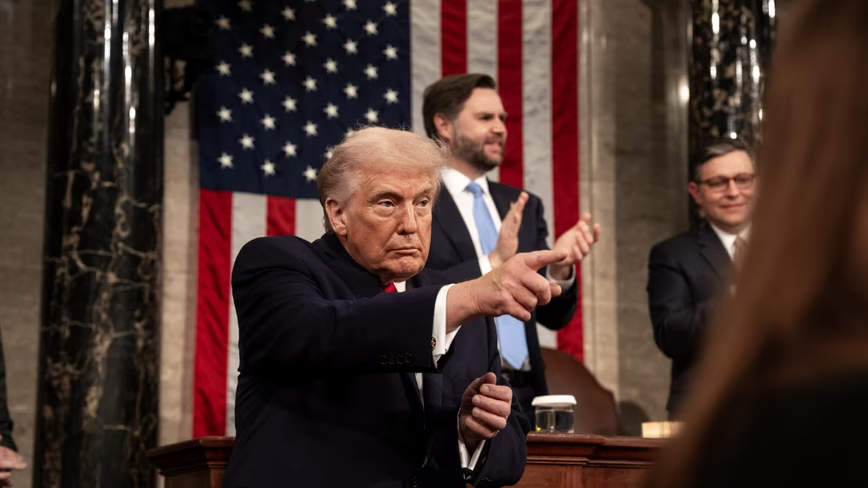
President Donald Trump’s State of the Union address, Tuesday, February 24, 2026, on the House floor at the U.S. Capitol in Washington, D.C.
 Credit: Official White House Photo by Emily J. Higgins
Donald Trump was watching golf at his Doonbeg resort in Ireland on Sunday when reporters asked him about the AI industry’s sudden appetite for slowing itself down.
He said the United States leads China, that he wants to keep it that way, and that “whoever wins with AI wins”.
“We can put guardrails, we can do this and that, but I think you have a lot of negative forces that are bringing it up that … shouldn’t be bringing it up, and they’re bringing up things that won’t happen,” Trump told reporters.
The Associated Press reported the remarks from Dublin.
Two days earlier, Dario Amodei had said Anthropic and its rivals must slow down, committing his company to third-party evaluators with internal access and asking Washington for an antitrust waiver so competitors could coordinate on safety.
Sam Altman agreed the same day and said OpenAI would match it. Elon Musk agreed as well, according to the AP.
The call Trump brushed aside therefore came from Anthropic, OpenAI and xAI, which between them build most of the frontier models the United States is racing China with.
Inside the industry, the position has broad backing. OpenAI’s chief scientist said last week that no lab has solved alignment well enough to keep scaling at maximum speed, and 1,134 lab employees signed a letter in July asking the government to build the means to pace development.
Trump has been consistent about the frame, if not the detail. On Thursday, leaving Dallas, he dismissed extinction fears outright and put the American lead over China at about a year. Sunday’s answer moved a little: guardrails are now something the administration could do, even if he named none.
Congress is working a different track, and Speaker Mike Johnson said the country needs “some guardrails, some safety measures” while holding its edge over China, and wants to bring industry leaders together for “one big meeting”, which he called a priority for himself and for Congress.
Kevin Hassett, who directs the National Economic Council, said officials covering cyber and science policy expect to meet this week on next steps.
Nothing in any of that carries a date. Xi Jinping is due at the White House this month, and the AP puts AI on the likely agenda without confirming it.
The last time the two men discussed the subject, in Beijing in May, Trump left saying they had discussed AI guardrails and nothing was signed.
The administration’s spending says what the president’s remarks do not. In May, it began underwriting AI exports through the Export-Import Bank, drawing on more than $100bn of unused lending capacity to push American systems abroad. The companies now asking to slow down are the companies that the programme was built to speed up.
Get the TNW newsletter
Get the most important tech news in your inbox each week.


